Official sources checked on November 18, 2026.
In Canada, the 200 amp panel upgrade cost for a full 100A to 200A overhead electrical service upgrade (new 200A breaker panel, meter base, service mast, entrance cables and grounding) ranges from $2,500 to $5,000 before tax in Ontario and Alberta (typical: $3,600, or about $4,068 with 13% HST in Ontario), $2,500 to $4,500 before tax in Quebec (typical: $3,400), and $2,700 to $5,400 before tax in British Columbia (typical: $3,900). If your home already has a 200A service entrance and you only need to swap an old fuse box or full breaker panel at the same location, expect to pay $1,500 to $3,300 before tax (typical: $2,200 to $2,400 depending on the province). Conversely, an underground service upgrade adds $1,400 to $3,500 for trenching and conduit. To build an itemized estimate for your province and options, use our electrical panel upgrade cost calculator.
In this guide
200 amp panel upgrade cost by province and project type
When comparing quotes from licensed electrical contractors, make sure you distinguish between a panel swap (replacing the interior distribution box on an existing 200A entrance) and a full service upgrade from 60A or 100A to 200A. Upgrading the service capacity requires replacing every component between the utility connection point and your basement panel: the weatherhead and mast, the 200A meter base outside, the heavy-gauge service entrance conductors, the grounding system, and the 200A breaker panel itself.
| Project type & options (November 2026, before tax) | Ontario (13% HST) | Quebec (14.975% GST+QST) | British Columbia (5% GST) | Alberta (5% GST) |
|---|---|---|---|---|
| Full 100A to 200A service upgrade (overhead) New 200A panel, meter base, mast, cables & grounding | $2,500 – $5,000 Typical: $3,600 | $2,500 – $4,500 Typical: $3,400 | $2,700 – $5,400 Typical: $3,900 | $2,500 – $5,000 Typical: $3,600 |
| 200A panel replacement at same location Existing 200A service entrance, fuse box or panel swap | $1,500 – $3,000 Typical: $2,200 | $1,800 – $2,800 Typical: $2,300 | $1,600 – $3,300 Typical: $2,400 | $1,500 – $3,000 Typical: $2,200 |
| 100A sub-panel addition (garage or basement) Adds circuit spaces when main service capacity is sufficient | $1,250 – $2,650 Typical: $1,800 | $1,150 – $2,450 Typical: $1,650 | $1,350 – $2,850 Typical: $1,950 | $1,250 – $2,650 Typical: $1,800 |
| Underground service upgrade surcharge Trenching, rigid PVC/steel conduit, pulling cables & backfill | +$1,500 – $3,200 Typical: +$2,200 | +$1,400 – $3,000 Typical: +$2,000 | +$1,600 – $3,500 Typical: +$2,400 | +$1,500 – $3,200 Typical: +$2,200 |
| Option: Type 2 whole-home surge protector Hardwired surge protection at the main bus bar | $275 – $575 Typical: $400 | $250 – $550 Typical: $375 | $300 – $625 Typical: $430 | $275 – $575 Typical: $400 |
| Option: AFCI / GFCI breaker code compliance Arc-fault and ground-fault breakers for bedrooms & wet areas | $500 – $1,300 Typical: $800 | $450 – $1,200 Typical: $750 | $550 – $1,400 Typical: $850 | $500 – $1,300 Typical: $800 |
| Option: 50A or 60A EV charger conduit rough-in Dedicated 240V circuit and cable/conduit to garage or driveway | $500 – $1,400 Typical: $850 | $450 – $1,250 Typical: $750 | $550 – $1,500 Typical: $900 | $500 – $1,400 Typical: $850 |
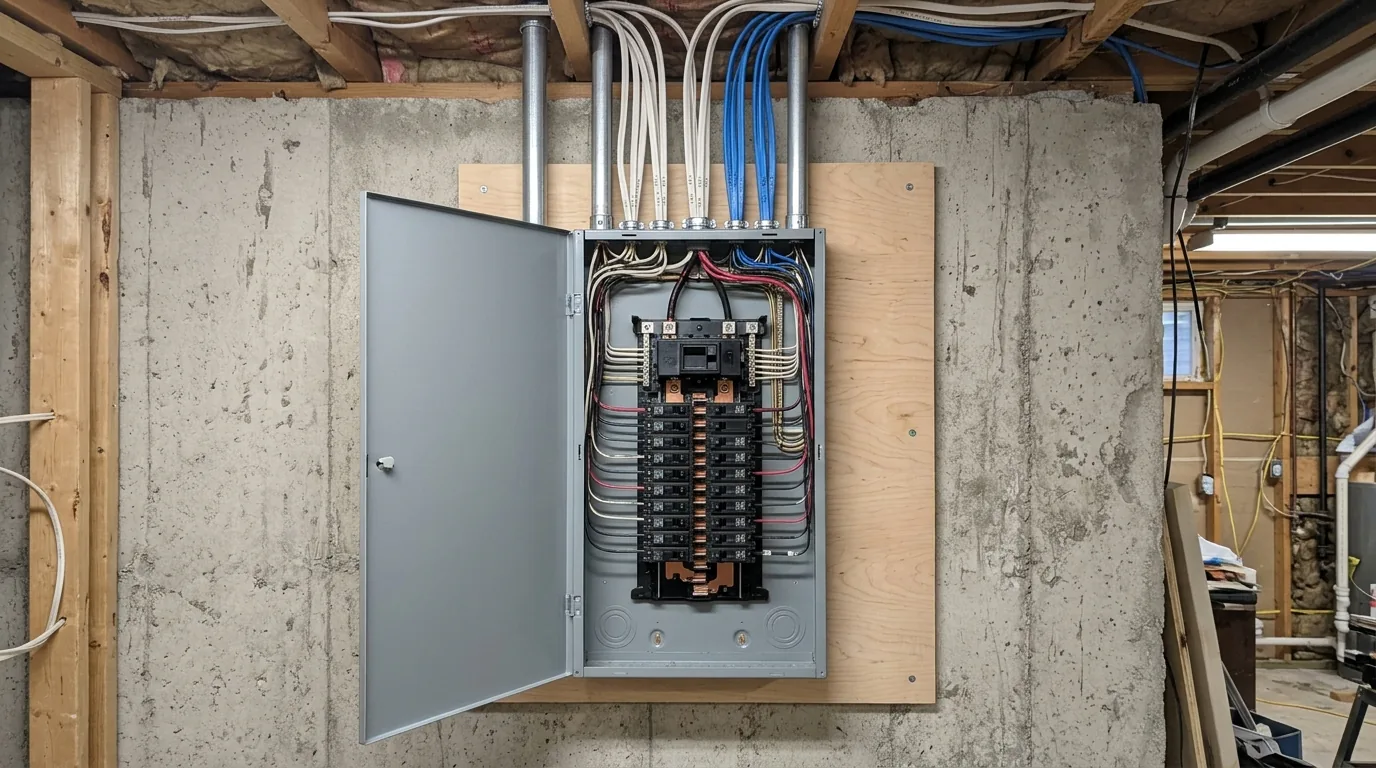
What is included in a 100A to 200A service upgrade: materials vs labour
On a typical $3,600 before-tax overhead 100A to 200A upgrade in Ontario or Alberta ($3,400 in Quebec, $3,900 in BC), electrical hardware accounts for roughly $950 to $1,850, while licensed electrical labour, permit fees, utility coordination and warranty represent $1,950 to $2,750. Every code-compliant 200A service upgrade includes five core assemblies required by the Canadian Electrical Code (CEC):
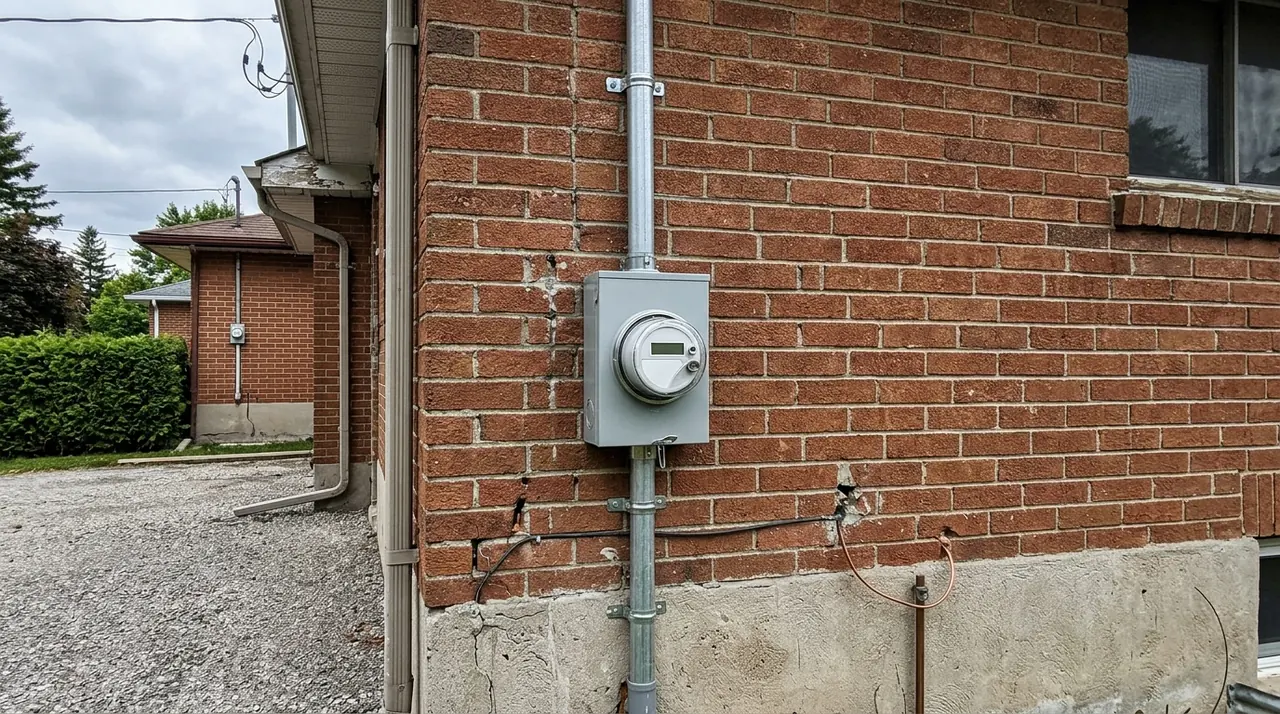
- Service mast, weatherhead and attachment point: rigid galvanized steel conduit rising through the roof overhang or anchored to the exterior wall to meet your local utility’s clearance rules above driveways, decks, windows and walkways.
- 200A utility-approved meter base: the exterior socket that holds your utility smart meter. A 100A meter socket is not rated for 200A continuous duty and must always be replaced during a service upgrade.
- Service entrance conductors: heavy-gauge copper (typically 2/0 AWG) or aluminum (typically 4/0 AWG) conductors pulled from the weatherhead through the meter base into the main breaker compartment of the indoor panel.
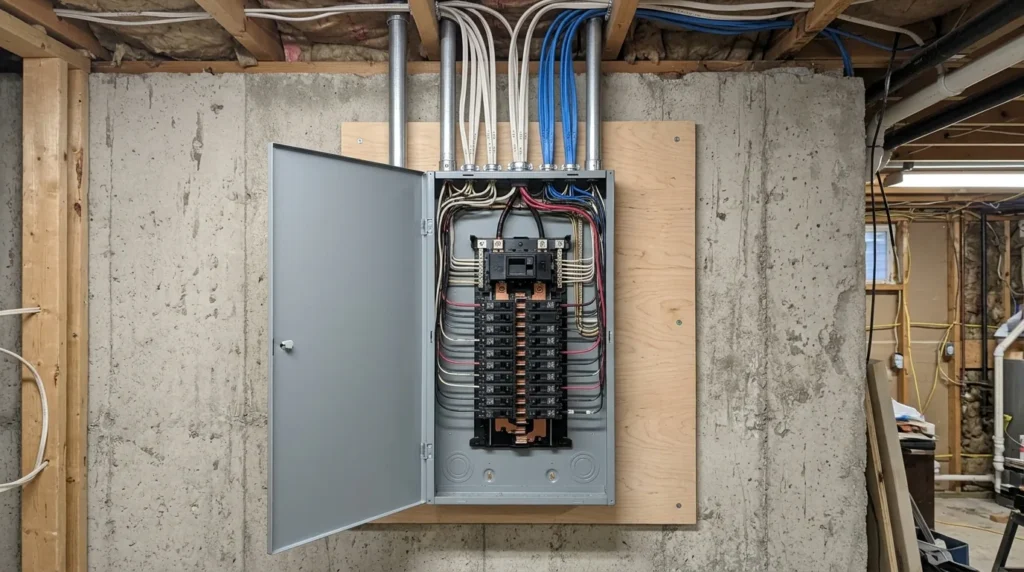
- 200A distribution panel (40 to 60 circuit spaces): a CSA-certified steel enclosure equipped with a 200A main breaker (22 kA interrupt rating), tin-plated or copper bus bars, and a full set of branch breakers to reconnect your existing 120V and 240V household circuits.
- Grounding and bonding electrode system: two driven ground rods spaced at least 3 metres apart (or an approved ground plate) connected with #6 AWG bare copper wire, plus bonding jumpers to the domestic cold water entry and gas piping as required by CEC Section 10.
Three site conditions commonly push the 200 amp panel upgrade cost toward the upper end of the range ($4,500 to $5,400 before tax for overhead service): panel relocation (if the old fuse box sits inside a clothes closet, bathroom, or cramped crawlspace that violates current CEC working-clearance rules, requiring a large splice box and extending every branch cable), 1965–1978 aluminum branch wiring (which requires CSA-approved Al/Cu pigtails or specialized connectors), and long conductor runs between the exterior meter and the interior panel (which in several jurisdictions require a separate exterior 200A main disconnect switch next to the meter).
Worked example: 100A to 200A upgrade with EV charger rough-in and surge protection
Consider a 1978 detached home in Mississauga, Ottawa, Calgary or Vancouver with a 100A overhead electrical service and a full 24-space panel. The homeowners are installing a cold-climate heat pump and a Level 2 electric vehicle charger (40A continuous load on a 50A breaker) and want a Type 2 whole-home surge protector installed at the same time to protect the new heat pump inverter board and EV charger. Bundling these add-ons during the main panel replacement saves a second electrician service call and permit fee.
| Line item (bundled overhead upgrade) | Ontario (13% HST) | Quebec (14.975% tax) | BC (5% GST) | Alberta (5% GST) |
|---|---|---|---|---|
| Full 100A to 200A overhead service upgrade (typical) | $3,600 | $3,400 | $3,900 | $3,600 |
| Type 2 whole-home surge protector installed | $400 | $375 | $430 | $400 |
| 50A / 60A EV charger conduit & cable rough-in | $850 | $750 | $900 | $850 |
| Subtotal before sales tax | $4,850 | $4,525 | $5,230 | $4,850 |
| Applicable sales tax on invoice (HST / GST+QST / GST) | $631 | $678 | $262 | $243 |
| Estimated total including tax | $5,481 | $5,203 | $5,492 | $5,093 |
You can customize this calculation for your province, switch between overhead and underground service, or test a simple panel swap using our electrical panel upgrade cost calculator. If you are budgeting for home electrification at the same time, you can also run your numbers in our EV charger installation cost calculator and our heat pump cost calculator. For province-by-province prices, hardwired vs NEMA 14-50 code rules and EVEMS savings, see our complete Level 2 EV charger installation cost guide.
Do you really need 200 amps? CEC Section 8-200 load calculation and insurance rules
A common misconception is that adding up the numbers printed on all the breaker handles in your panel tells you how many amps you are using. In reality, the sum of branch breaker handles in a 100A panel routinely exceeds 300A. Under Section 8-200 of the Canadian Electrical Code (CEC), licensed electricians determine your required service capacity using a formal demand-factor load calculation that combines:
- A basic living-area load of 5,000 W for the first 90 m² of living space, plus 1,000 W for each additional 90 m² (or portion thereof);
- Electric space-heating loads (first 10,000 W at 100%, balance at 75%) and air-conditioning or heat pump loads (subject to non-coincident heating/cooling rules);
- An electric range load (6,000 W base for a range up to 12 kW, plus 40% of any amount over 12 kW);
- Continuous loads such as an electric vehicle charger, hot tub, pool heater or electric tankless water heater counted at 100% (unless controlled by an approved automated load management system);
- 25% of the rating of other permanently connected appliances over 1,500 W (such as an electric storage water heater or clothes dryer).
Paying for a full 100A to 200A upgrade is generally the right investment in four clear scenarios:
- You still have a 60A service or an obsolete fuse box: most Canadian home insurers either refuse to write a policy on a 60A electrical service or require buyers to replace a glass-fuse panel (or recalled breaker panels with known trip failures) within 30 to 60 days of closing.
- You combine electric heating with major new 240V loads: if your home uses electric baseboards or an electric furnace alongside an electric hot water tank, stove and dryer, adding both a cold-climate heat pump (with electric backup strips) and a Level 2 EV charger or hot tub will push the CEC Section 8-200 demand past 100A (24,000 W at 240V).
- You are building a legal basement suite or secondary dwelling unit: adding a second kitchen range, laundry circuit and dedicated HVAC zone almost always requires a 200A service entrance (48,000 W capacity at 240V).
- Your overhead 100A equipment is 35+ years old: if the exterior meter socket is rusting or the panel bus shows heat discolouration, upgrading directly to 200A costs only about $1,200 to $1,400 more than a 100A/200A panel swap and doubles your home’s electrical capacity for decades.
200A service upgrade vs EV load management device (EVEMS) vs 100A sub-panel
If your existing 100A breaker panel is in good condition—especially if your home has an expensive underground service feed or gas heating—you may not need a 200A upgrade just to install one EV charger or finish a basement. The table below compares a 200A service upgrade against an Electric Vehicle Energy Management System (EVEMS / DCC load controller) and a 100A sub-panel.
| Comparison factor | 100A to 200A service upgrade | EV load management device (EVEMS / DCC) | 100A sub-panel addition |
|---|---|---|---|
| Typical installed cost (before tax) | $3,400 – $3,900 (overhead) $5,400 – $6,300 (underground) | $1,150 – $1,450 installed (range: $900 – $1,800) | $1,650 – $1,950 installed (range: $1,150 – $2,850) |
| Increases total home amperage? | Yes (doubles service capacity from 24 kW to 48 kW) | No (pauses EV charging automatically whenever total house load exceeds 80% of 100A) | No (adds physical breaker slots fed from the existing main panel) |
| Requires utility disconnect appointment? | Yes (Hydro One, Toronto Hydro, Hydro-Québec, BC Hydro, EPCOR/ENMAX) | Usually no (installed downstream of the main breaker) | No (electrician shuts off the main panel breaker during tie-in) |
| CEC Section 8-200 impact | Raises total allowable calculated demand to 200A | Allows the EV charger to be excluded from the Section 8-200 service load calculation (CEC Rule 8-500) | Does not change total service capacity |
| Best fit | Older 60A/100A overhead service, adding multiple 240V loads (EV + heat pump + hot tub or suite) | Healthy 100A panel (especially with underground feed) adding a single Level 2 EV charger | Existing 200A panel (or lightly loaded 100A gas-heated home) that has run out of physical breaker spaces |
Permits, utility disconnect and rebates in Ontario, Quebec, BC and Alberta
Replacing a main electrical panel or upgrading a service entrance is regulated permit work across Canada and requires coordination between a licensed electrical contractor, the provincial safety authority, and your local electricity distributor:
If the job also involves opening walls or changing structure, a municipal building permit may apply on top of the electrical permit; in Toronto, our building permit guide explains the City side and the 2026 fees.
- Ontario: work must be performed by an ECRA/ESA Licensed Electrical Contractor (LEC), who files a Notification of Work with the Electrical Safety Authority (ESA) and arranges the service isolation and reconnection with your local distribution company (Hydro One, Toronto Hydro, Alectra, Hydro Ottawa, etc.). Always ask for the ESA Certificate of Acceptance when the job is complete.
- Quebec: DIY panel replacement is prohibited by law. Work must be done by a licensed electrical contractor holding a valid RBQ subclass 16 licence and membership in the Corporation des maîtres électriciens du Québec (CMEQ), who coordinates disconnection and reconnection with Hydro-Québec.
- British Columbia: a licensed electrical contractor pulls an electrical permit through Technical Safety BC (or the municipal inspection department in cities such as Vancouver, Burnaby, Surrey or Victoria) and coordinates the service upgrade with BC Hydro or FortisBC.
- Alberta: a Master Electrician pulls an electrical permit under the Alberta Safety Codes Act through the municipality (Calgary, Edmonton, etc.) or an accredited agency, and schedules the disconnect/reconnect with ENMAX, EPCOR, FortisAlberta or ATCO.
Are there rebates for a 200 amp panel upgrade in 2026? There is no universal provincial rebate for a standalone panel upgrade in Ontario, Quebec or Alberta. However, in British Columbia, income-qualified households switching from fossil-fuel heating to an eligible heat pump can receive funding toward an accompanying electrical service upgrade through the CleanBC Energy Savings Program. In addition, in Quebec (Écorecharge, up to $600) and BC (BC Hydro EV charger rebate, 50% up to $350), incentives are available for eligible Level 2 EV chargers and load management devices.
RénoClair tip: before requesting quotes from 2 or 3 licensed electrical contractors, take four photos with your phone: (1) your current panel with the door open, (2) a wide shot showing 2 metres of wall space around the panel, (3) the exterior meter base, and (4) the overhead mast up to the roofline (or the underground conduit entry). Sending these photos upfront lets contractors verify utility clearance rules and give you a firm quote without surprise day-of-install charges.
Frequently asked questions
The bottom line
Budgeting for the 200 amp panel upgrade cost in Canada starts with confirming whether you need a full 100A to 200A service upgrade (typically $3,400 to $3,900 before tax for overhead service, plus $2,000 to $2,400 if underground) or a simpler panel swap on an existing 200A entrance (typically $2,200 to $2,400 before tax). Always have a licensed electrical contractor run a CEC Section 8-200 load calculation first, and bundle any surge protection or EV charger rough-in into the same outage window.
Planning rooftop solar alongside your service upgrade? See our 4-province guide to solar panel installation cost in Canada for busbar limits, provincial rebates and tax-included totals.
Adding backup power during your 200A upgrade? Check our guide to home generator installation in Canada for portable vs. standby pricing, transfer switch permits and worked tax-in examples.
Sources
- Electrical Safety Authority (ESA — Ontario) — Ontario Electrical Safety Code (CEC Part I with Ontario amendments), Notification of Work rules and Licensed Electrical Contractor requirements, checked November 18, 2026.
- Corporation des maîtres électriciens du Québec (CMEQ) — Quebec Construction Code, Chapter V – Electricity, residential service upgrade and load calculation rules, checked November 18, 2026.
- Technical Safety BC — Homeowners and residential electrical permit requirements in British Columbia, checked November 18, 2026.
- Government of Alberta — Safety Codes Act — Electrical permit and inspection standards in Alberta, checked November 18, 2026.
- RénoClair pricing dataset (version 2026.Q4-panel-2, reviewed November 2026) compiled from published Canadian electrical contractor price guides; see our sources and methodology.