Official sources checked on October 17, 2026. Price ranges compiled from eight Ontario price guides published between March and September 2026.
The heat pump cost in Ontario is usually about $3,500 to $9,000 installed for a single-zone ductless unit and $6,000 to $18,000 for a whole-home ducted cold-climate system, before rebates, based on price guides published in 2026 by seven Ontario HVAC contractors and one national home-improvement retailer. Hybrid systems that keep a gas furnace as backup run about $7,500 to $18,000, and geothermal systems $20,000 to $45,000. The Home Renovation Savings program pays up to $7,500 on a cold-climate air-source heat pump in homes heated by electricity, oil, propane or wood (up to $2,000 in Enbridge gas-heated homes), but only if you get pre-approval before the work starts.
In this guide
Heat pump cost in Ontario at a glance
The table below shows the lowest and highest installed prices published for each system type. Most homes with ducts in good condition and a standard electrical panel land in the lower half of each range.
| System type | Installed price (before rebates) | Typical use | Home Renovation Savings rebate |
|---|---|---|---|
| Ductless mini-split, single zone | $3,500 to $9,000 | One room, addition, basement or open main floor | Yes, if the model is a listed cold-climate unit |
| Ductless multi-zone (2 to 4 indoor heads) | $5,500 to $20,000 (most quotes $8,000 to $15,000) | Homes without ducts, such as baseboard-heated bungalows | Yes, if cold-climate |
| Ducted cold-climate air-source (central) | $6,000 to $18,000 (typical 3-ton job with good ducts: $7,500 to $12,000) | Whole home, existing forced-air ducts | Yes |
| Ducted standard-efficiency air-source | $5,000 to $13,000 | Whole home in milder use, mainly cooling | No (not cold-climate) |
| Hybrid (heat pump + gas furnace backup) | $7,500 to $18,000 | Gas-heated homes that keep the furnace for the coldest days | Yes, on the heat pump portion |
| Ground-source (geothermal) | $20,000 to $45,000 | Larger lots, long-term owners | Yes, up to $12,000 (non-gas homes) |
How these ranges were built: RénoClair read the published price pages of seven Ontario HVAC contractors (in Toronto, Mississauga, Vaughan, Durham Region and the Ottawa area) and one national home-improvement retailer’s Ottawa installation page, all consulted on October 17, 2026. Pages were dated March to September 2026; the retailer’s page was undated. Only one contractor states that its prices exclude HST, so ask every installer whether HST is included. These are published ranges, not quotes for your home.
Installed prices by system type
The type of system matters more than the brand. Ducts, the number of indoor heads and the climate rating explain most of the gap between a $5,000 and a $15,000 quote.
Ductless mini-split, single zone: $3,500 to $9,000
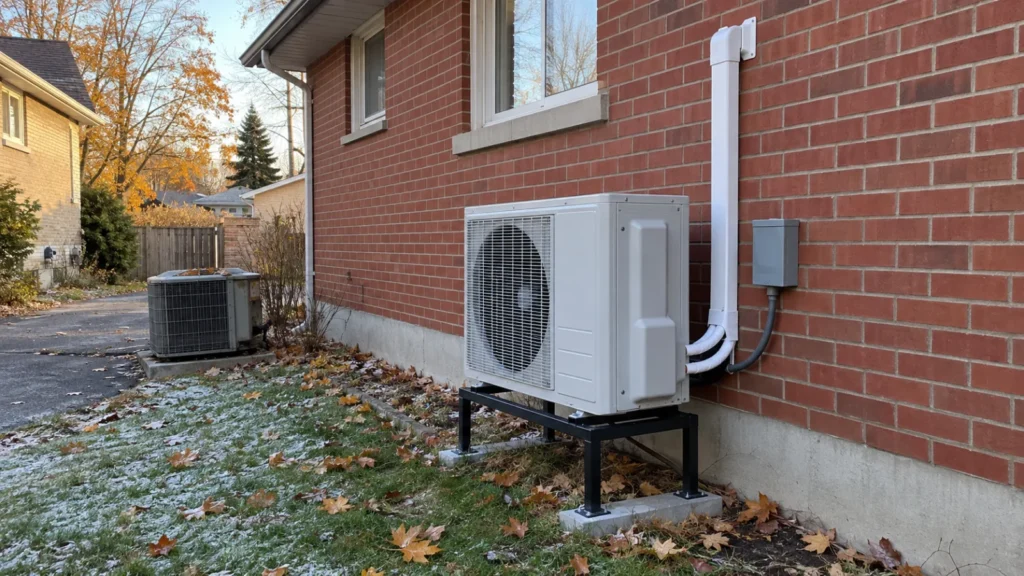
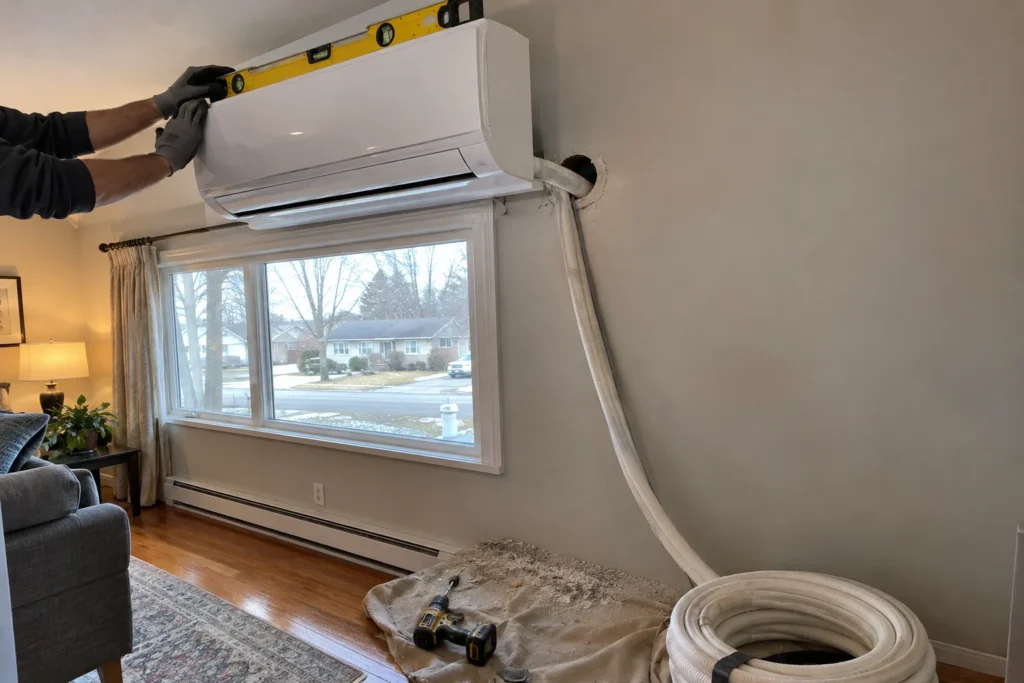
One outdoor unit feeds one wall-mounted head. Published ranges start at $3,500 and several stop between $5,500 and $7,000; one Durham Region contractor lists $4,000 to $9,000 plus HST. A Markham retailer that sells units with installation included lists single-zone models from $3,299 to $3,799 (9,000 to 18,000 BTU/h, sale prices seen in October 2026). A single head heats one open area well but will not evenly heat closed bedrooms upstairs.
Ductless multi-zone: $5,500 to $20,000
One outdoor unit feeds two to four indoor heads. This is the usual choice in homes heated by electric baseboards, which have no ducts. Each extra head adds equipment, a refrigerant line, wall coring and labour, which is why ranges are wide. Most published figures sit between $8,000 and $15,000; the national retailer quotes up to $15,500 for complex multi-room jobs.
Ducted cold-climate heat pump: $6,000 to $18,000
A central cold-climate air-source heat pump uses your existing ductwork and replaces (or works with) the furnace and air conditioner. A Toronto contractor puts the most common job, a 3-ton system with existing ducts, at $7,500 to $10,000. An Ottawa-area contractor lists $8,000 to $12,000 for the same kind of system, and other GTA contractors publish $6,000 to $14,000. Two contractors quote up to $18,000 for whole-home systems in larger houses.
Cold-climate models cost more than standard ones: published premiums are $1,000 to $3,000. They are also the only air-source models eligible for Home Renovation Savings. According to Natural Resources Canada’s heat pump basics page (updated July 21, 2025), cold-climate heat pumps “can work in lower temperatures, well below freezing down to -30°C.”
Hybrid system with a gas furnace: $7,500 to $18,000
A hybrid (dual-fuel) system pairs a heat pump with a gas furnace that takes over in very cold weather. Three contractors publish ranges of $7,500 to $15,000, $8,000 to $15,000 and $9,000 to $18,000. One Durham Region contractor says most of its customers replacing a gas furnace and air conditioner with a cold-climate hybrid land between $9,000 and $13,000 before rebates. If your current furnace is recent, some installers can add a heat pump to it, which lowers the cost.
Ground-source (geothermal): $20,000 to $45,000
Geothermal systems need a ground loop drilled or trenched on your lot, so the installation can cost as much as the equipment. Published ranges are $20,000 to $45,000; one Ottawa-area contractor splits a typical job into $10,000 to $20,000 for the unit and $10,000 to $20,000 for installation. The rebate is higher too (see below), and Home Renovation Savings requires the installer to hold IGSHPA certification.
What drives the price of a heat pump
Natural Resources Canada’s heat pump guide (updated December 24, 2025) sums it up: the cost “depends on the type of system, your design objectives, and any existing heating equipment and ductwork in your home,” and “additional modifications to the ductwork or electrical services may be required.” Ontario price guides put numbers on each item:
| Cost item | Published range (Ontario, 2026) | When it applies |
|---|---|---|
| Electrical panel or service upgrade | $500 to $5,500 | Older 60 A or 100 A panels; several contractors say 200 A is often needed |
| Duct modifications (returns, trunks) | $300 to $5,000 | Undersized or leaky ducts; added duct runs |
| Full duct retrofit | $5,000 to $10,000 | Older homes with no ducts (one Toronto contractor, pre-1950 homes) |
| Extra ton of capacity | $300 to $900 per ton | Larger or leakier homes (one GTA contractor) |
| Long refrigerant line set or wall coring | $300 to $1,200 | Outdoor unit far from indoor unit |
| Zoning (dampers, controls) | $800 to $2,500 | Ducted homes with uneven floors (one GTA contractor) |
| Permit and electrical inspection | $200 to $400 | Listed by one Toronto contractor |
| Old equipment removal | $100 to $300 | Listed by one Toronto contractor; the national retailer includes haul-away |
| Smart thermostat | $0 to $400 | If your thermostat is not compatible |
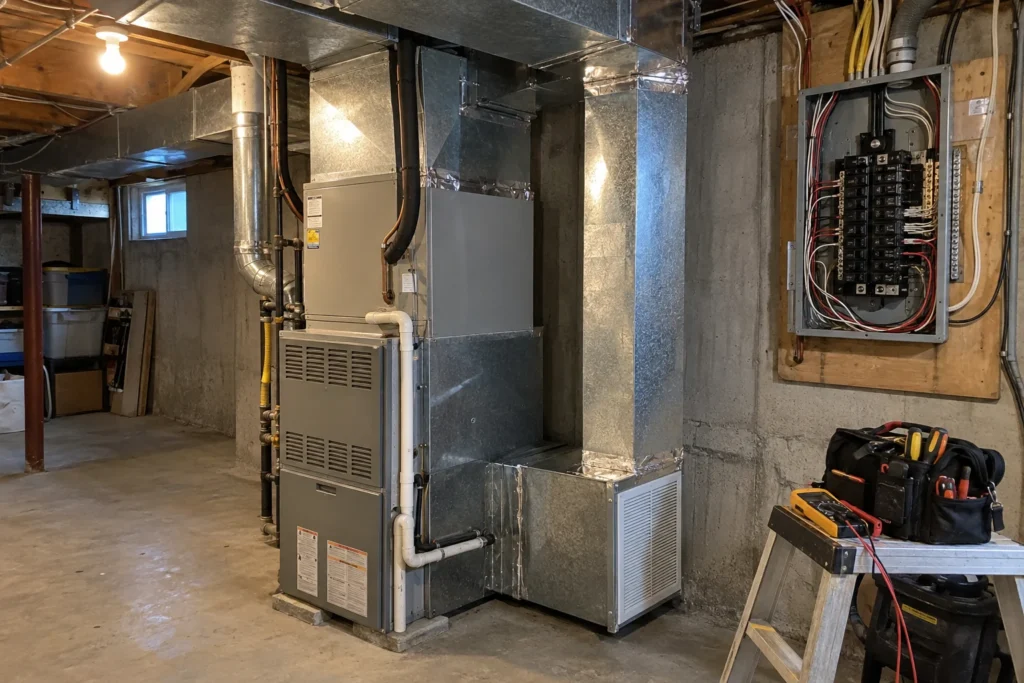
Size (tons). One ton equals 12,000 BTU/h of capacity. An Ottawa-area contractor matches 2 to 2.5 tons to homes of 1,000 to 1,500 sq ft, 2.5 to 3.5 tons to 1,500 to 2,200 sq ft and 3.5 to 5 tons to larger homes, with typical totals of $5,500 to $8,000, $7,500 to $10,000 and $9,500 to $12,000+. Square footage is only a starting point: insulation, windows and air leakage change the heat load.
Ducts. Heat pumps often move more air than the old air conditioner. NRCan notes that “some modifications may be needed to your ductwork to avoid added noise and fan energy use.”
Electrical capacity. Contractors report that central heat pumps typically need a dedicated 240 V circuit of 30 to 60 A. Homes on 60 A or 100 A service are the ones most likely to need a panel or service upgrade. Ask the installer to do a load calculation before quoting.
Your current heating. Replacing an oil or propane system fully costs more than adding a heat pump to a recent gas furnace. Electric baseboard homes have no ducts, so they usually go ductless.
RénoClair tip
Ask for a room-by-room heat loss calculation, not a sizing based only on square footage. An oversized unit costs more up front and runs less efficiently in mild weather; an undersized one leans on backup heat more often, as NRCan’s guide explains.
Sizing and backup heat: why the cheapest quote can cost more
A heat pump that is too small or too big can wipe out the savings you paid for. NRCan’s guide states that if a heat pump is undersized, “the supplemental heating system will be used more frequently,” and if it is oversized, “the desired energy savings may not be realized.” It recommends that “a heating and cooling professional be retained to undertake the required calculations.”
Even cold-climate models reach a point where their output drops. NRCan says air-source heat pumps have a minimum outdoor operating temperature of about -15°C to -25°C for newer models, and that it is important to plan for a supplemental heat source. In practice that means electric backup coils, the existing furnace (hybrid) or baseboards that stay in place. Make sure the quote says which backup you will have and who installs it.
Rebates that lower the heat pump cost in Ontario
The main program is Home Renovation Savings, run by Save on Energy and Enbridge Gas. Amounts depend on how your home is heated before the installation. The figures below come from the official heat pump page, checked October 17, 2026 (the page shows no update date).
| Current main heating | Cold-climate air-source heat pump | Ground-source heat pump |
|---|---|---|
| Electricity, oil, propane or wood | $1,250 per ton, up to $7,500 | $2,000 per ton, up to $12,000 |
| Enbridge natural gas | $500 per ton, up to $2,000 | $3,000 flat |
| Rented heat pump (any eligible heating) | $500 per ton, up to $2,000 | $3,000 flat |
- Pre-approval is mandatory. The program page says: “Installations done before approval are not eligible for rebates.”
- Participating contractor. You must choose an installer from the program’s list of participating HVAC contractors.
- Eligible model. The unit must be an active model on Natural Resources Canada’s list of cold-climate air-source or ground-source heat pumps. Standard-efficiency models get nothing.
- Per-ton calculation. Air-source rebates are based on the rated heating capacity at 8.3°C (47°F); ground-source rebates on closed-loop capacity.
- Payment. Once the claim is approved, the cheque should arrive by mail within 60 days.
Other help: income-eligible homeowners heated by electricity or oil may get a cold-climate heat pump installed at no cost through the Energy Affordability Program (1-844-770-3148). The federal government also announced a National Heat Pump Rebate on October 8, 2026; on October 17, 2026, no application date or portal had been published. For full eligibility rules, see our guide to the Ontario heat pump rebate, or estimate your amount with the heat pump rebate calculator.
Two worked examples: from quote to net cost
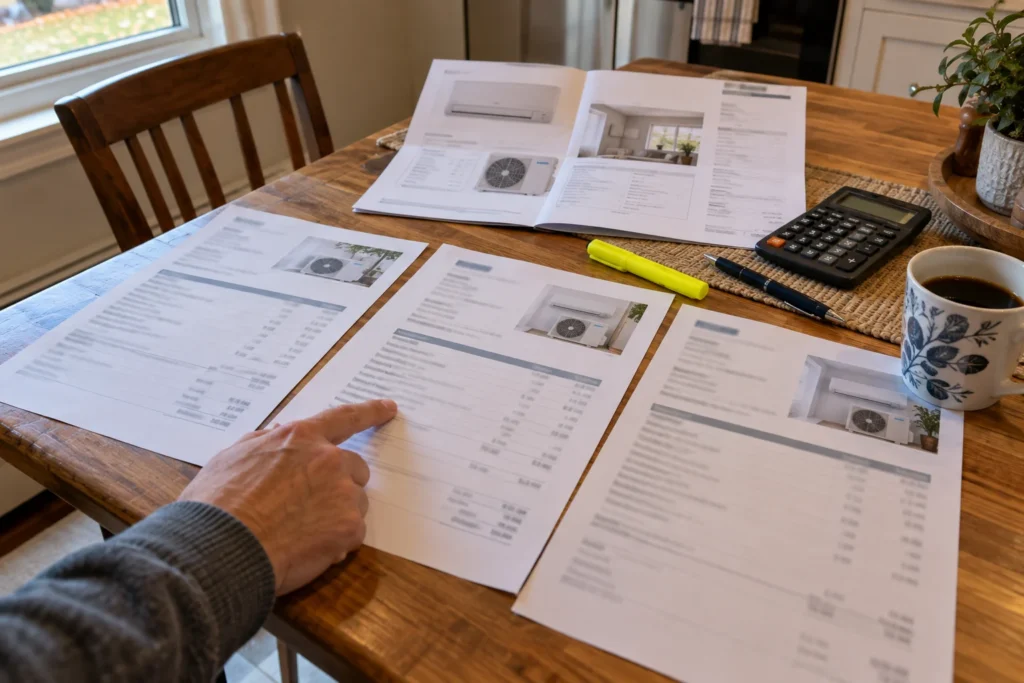
These examples use illustrative quotes chosen inside the published 2026 ranges. Rebates follow the official rules above. Your contractor’s quote and the model’s listed capacity decide the real numbers.
Example 1: baseboard-heated bungalow, ductless multi-zone
| Item | Amount |
|---|---|
| Cold-climate multi-zone system, 3 indoor heads, installed | $12,500 |
| Electrical panel upgrade (100 A to 200 A) | $2,500 |
| Total before rebate | $15,000 |
| Home Renovation Savings: 3.0 tons × $1,250 (electric-heated home) | − $3,750 |
| Net cost | $11,250 |
If the same bungalow were income-eligible, the Energy Affordability Program could cover the heat pump installation instead; the two cannot both pay for the same equipment.
Example 2: Enbridge gas home, hybrid with existing ducts
| Item | Amount |
|---|---|
| Ducted cold-climate heat pump, rated 3.2 tons at 8.3°C, furnace kept as backup | $11,000 |
| Home Renovation Savings: 3.2 tons × $500 (Enbridge gas home) | − $1,600 |
| Net cost | $9,400 |
| Same home heated by oil: 3.2 tons × $1,250 | − $4,000 (net $7,000) |
Notice how much the starting fuel matters: the same equipment earns $1,600 in a gas-heated home and $4,000 in an oil-heated one. In gas-heated homes, the program’s participant agreement also warns that installing a heat pump “has the potential to increase overall home energy bills,” so ask your contractor for an operating-cost estimate, not just the installed price.
Purchase price is only half of the decision. In a gas-heated home, a heat pump can also cost more to run than the furnace at current Ontario rates: our comparison of heat pump vs furnace running costs works through the numbers with November 2026 electricity prices and Enbridge gas rates.
Checklist before you sign a heat pump quote
- Get at least three written quotes for the same type and size of system.
- Check that the exact outdoor and indoor model numbers are on the quote, and that the pairing is on NRCan’s cold-climate list if you want the rebate.
- Confirm the installer is on the Home Renovation Savings participating contractor list, and get pre-approval before any work starts.
- Ask for the heat loss calculation and the tonnage it gives.
- Ask whether the price includes the electrical work, permit, line set, condensate drain, wall bracket or stand, removal of old equipment and HST.
- Ask what backup heat you will have below the unit’s rated temperature.
- Compare warranties on parts, compressor and labour; the national retailer’s page, for example, lists a 1-year labour warranty.
- Keep every invoice: the rebate and any future federal rebate will ask for them.
Common mistakes that raise the cost
- Installing before approval. Home Renovation Savings refuses installations done before pre-approval.
- Buying a standard model to save $1,000 to $3,000. In an electric- or oil-heated home, that can mean giving up a rebate of several thousand dollars.
- Comparing quotes for different systems. A single-zone ductless quote and a central ducted quote do not heat the same space.
- Forgetting the panel. An electrical upgrade of several thousand dollars discovered after signing changes the budget.
- Sizing by square footage only. Oversized and undersized units both cost you over time.
Comparing against a new gas furnace? Our guide to furnace replacement cost in Ontario lists 2026 installed prices by furnace type.
After installation, plan the routine upkeep too: Natural Resources Canada says to change or clean a heat pump air filter every 3 months, and our guide on how often to change a furnace filter shows how that fits with MERV ratings.
To estimate the installed price before rebates tailored to your home’s square footage and configuration, use our heat pump cost calculator (typical 18k BTU cold-climate ductless unit: $4,300 to $6,450; 3-ton central: $9,700 to $14,900, with the detailed budget as a PDF).
Frequently asked questions
What is the average heat pump cost in Ontario?
Most published 2026 ranges put a whole-home ducted cold-climate heat pump at $6,000 to $18,000 installed, with a typical 3-ton job in a home with good ducts at about $7,500 to $12,000. A single-zone ductless unit is about $3,500 to $9,000. These figures are before rebates.
How much is a heat pump for a 2,000 sq ft house in Ontario?
An Ottawa-area contractor lists 2.5 to 3.5 tons and $7,500 to $10,000 for homes of 1,500 to 2,200 sq ft. Insulation, windows and air leakage can change the size you need, so ask for a heat loss calculation.
Is a heat pump cheaper than a furnace and air conditioner?
Up front, usually not: the gas furnace and air conditioner are cheaper to buy. Over the life of the system, the Canadian Climate Institute found that in Toronto standard heat pumps are the lowest-cost option for nearly all households under mid-range assumptions.
How much is the heat pump rebate in Ontario?
Home Renovation Savings pays $1,250 per ton, up to $7,500, for a cold-climate air-source heat pump in homes heated by electricity, oil, propane or wood, and $500 per ton, up to $2,000, in Enbridge gas-heated homes. Ground-source systems get up to $12,000 or $3,000 flat.
Do I need to upgrade my electrical panel for a heat pump?
Not always. Homes on 60 A or 100 A service are the most likely to need it; Ontario contractors publish $500 to $5,500 for panel or service upgrades. A load calculation tells you before you sign.
Does the heat pump cost in Ontario include HST?
It depends on the installer. Of the eight price pages RénoClair reviewed, only one stated that its figures were plus HST. Ask each contractor to show HST separately.
How long does a heat pump installation take?
The national retailer’s Ottawa page says an installation usually takes about 8 hours. Ductless multi-zone, duct work and panel upgrades can add days, and Home Renovation Savings pre-approval must come first.
Planning a ductless system for a few rooms? Our guide to the mini split heat pump cost in Canada breaks down single-zone and multi-zone prices, extras and net cost after rebates.
Before you budget the net cost, check the federal heat pump rebate: $2,000, or up to $10,000 below the Ontario income limits, for installs from November 1, 2026.
The bottom line
In 2026, plan on about $3,500 to $9,000 for a single-zone ductless heat pump in Ontario, $8,000 to $15,000 for most multi-zone jobs and $7,500 to $12,000 for a typical 3-ton ducted cold-climate system in a home with good ducts. Electrical and duct work are the costs most often missing from the first number you hear. Choose a cold-climate model from NRCan’s list, use a participating contractor and get pre-approval, and the rebate can cut up to $7,500 from an air-source job in a home heated by electricity, oil, propane or wood, or up to $2,000 in an Enbridge gas-heated home. For the full program rules, read our Home Renovation Savings program guide; Quebec readers can see our installed heat pump cost guide for Quebec (in French).
Sources
- Home Renovation Savings, heat pumps (Save on Energy and Enbridge Gas), checked October 17, 2026 (no update date shown).
- Natural Resources Canada, Heating and cooling with a heat pump, updated December 24, 2025.
- Natural Resources Canada, Heat pump basics, updated July 21, 2025.
- Save on Energy, Energy Affordability Program, checked October 17, 2026.
- Canadian Climate Institute, Heat pumps pay off (report, September 2023, updated March 2024).
- Home Renovation Savings participant agreement and program requirements (version May 2025), read October 11, 2026.
- Installed prices: price guides of seven Ontario HVAC contractors (Toronto, Mississauga, Vaughan, Woodbridge, Oshawa and Greely/Ottawa; dated March to September 2026) and one national home-improvement retailer (Ottawa, undated), plus listed prices from a Markham retailer, all consulted October 17, 2026.