Official sources checked on November 20, 2026.
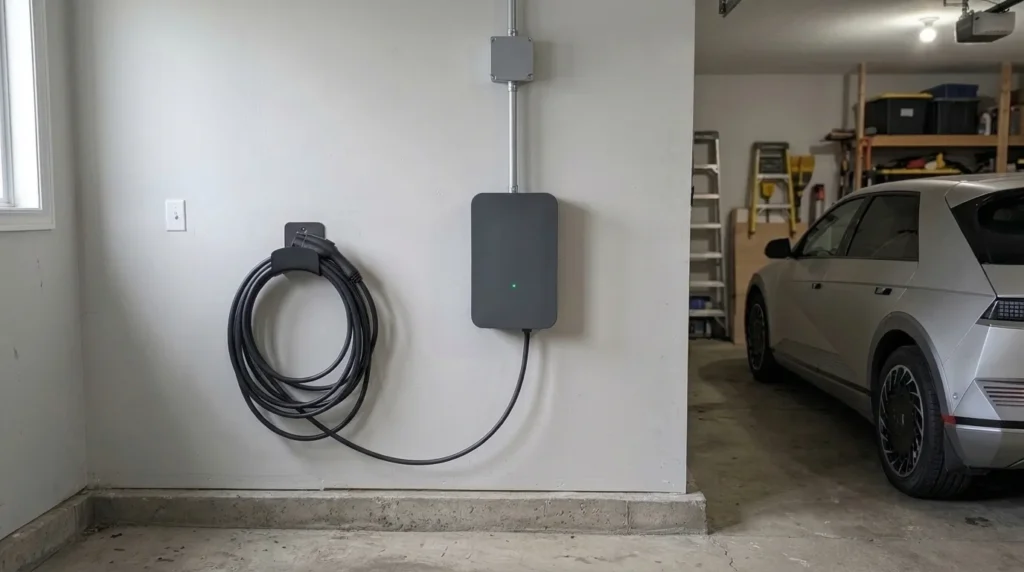
In Canada, the Level 2 EV charger installation cost for a hardwired 48A unit (< 15 ft) is $1,450–$2,900 before tax (typical: $2,000 ON/AB, $1,850 QC, $2,150 BC; November 2026). A 15–40 ft run averages $2,275–$2,625; install only runs $650–$1,650. Estimate yours in our EV charger installation cost calculator.
In this guide
Level 2 EV charger installation cost by province
Quotes on identical suburban homes easily swing by $1,500+ before tax. A CSA-certified 40A–48A smart charger accounts for only $650 to $800; 6 AWG copper wire footage ($6 to $11/ft installed), finished ceilings, permits and 100A load management drive the spread.
| Scope & add-ons (Nov 2026, before tax) | Ontario (13% HST) | Quebec (14.975%) | BC (5% GST*) | Alberta (5% GST) | Reliability |
|---|---|---|---|---|---|
| Hardwired 48A + 60A circuit (< 15 ft, unit incl.) | $1,550–$2,700 Typ. $2,000 | $1,450–$2,500 Typ. $1,850 | $1,650–$2,900 Typ. $2,150 | $1,550–$2,700 Typ. $2,000 | Cross-checked |
| NEMA 14-50 GFCI + 40A plug-in (< 15 ft) | $1,450–$2,550 Typ. $1,900 | $1,350–$2,350 Typ. $1,750 | $1,550–$2,750 Typ. $2,050 | $1,450–$2,550 Typ. $1,900 | Cross-checked |
| Install only (your charger, < 15 ft) | $750–$1,550 Typ. $1,050 | $650–$1,350 Typ. $900 | $800–$1,650 Typ. $1,150 | $750–$1,550 Typ. $1,050 | Cross-checked |
| Medium run (15–40 ft, open joists) | +$275–$700 Typ. +$450 | +$250–$650 Typ. +$425 | +$300–$750 Typ. +$480 | +$275–$700 Typ. +$450 | Cross-checked |
| Long / concealed run (40–80 ft) | +$650–$1,650 Typ. +$1,050 | +$600–$1,500 Typ. +$950 | +$700–$1,750 Typ. +$1,100 | +$650–$1,650 Typ. +$1,050 | Cross-checked |
| EVEMS load manager (100A panel) | +$800–$1,550 Typ. +$1,150 | +$750–$1,450 Typ. +$1,050 | +$850–$1,650 Typ. +$1,200 | +$800–$1,550 Typ. +$1,150 | Cross-checked |
| Outdoor weatherproof pedestal | +$375–$900 Typ. +$600 | +$350–$850 Typ. +$550 | +$400–$950 Typ. +$625 | +$375–$900 Typ. +$600 | Cross-checked |
BC runs 8% to 15% above Quebec on electrician labour and municipal permit fees, while Ontario and Alberta track within $50 to $150 pre-tax. Driveway trenching to detached garages (+$1,500–$3,500) and condo strata engineering sit outside these ranges.
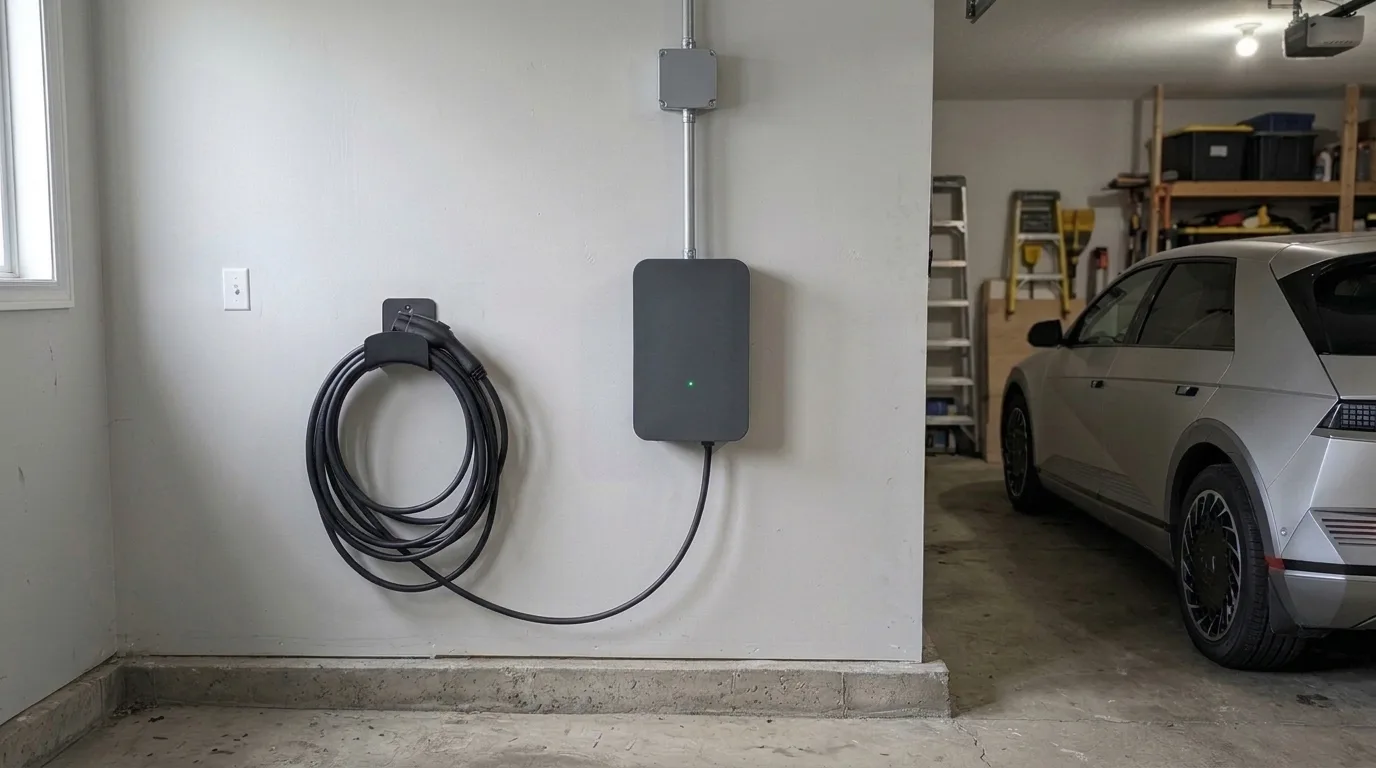
Hardwired 48A vs NEMA 14-50: hidden GFCI code costs
Asking for a 240V NEMA 14-50 outlet rarely saves $500 anymore. Once built to Canadian Electrical Code (CEC) and Ontario Electrical Safety Code (OESC) standards, a plug-in setup saves only $100 before tax ($1,900 vs $2,000 typical in ON/AB) because garage receptacles require a 50A Class A GFCI breaker (+$140–$250) plus an industrial EV-rated 14-50 outlet ($80–$120).
| Technical factor | Hardwired 48A (60A circuit) | NEMA 14-50 (40A plug-in) | Hardwired 48A + EVEMS |
|---|---|---|---|
| Typical ON/AB price (< 15 ft, pre-tax) | $2,000 | $1,900 | $3,150 |
| Max continuous output (80% rule) | 48A / 11.5 kW | 40A / 9.6 kW | 40A–48A managed |
| Range added / hour (NRCan) | 55–75 km/hr | 45–60 km/hr | 45–75 km/hr |
| 50A GFCI panel breaker required? | No (internal GFCI) | Yes (+$140–$250) | No if hardwired |
| Best fit | Homeowners (90% of jobs) | Renters / short stay | 100A panels avoiding 200A |
Hardwiring also prevents double-GFCI nuisance trips common when plug-in cords meet panel GFCI breakers in damp winter garages, and cuts a 10%–90% charge on a 75 kWh SUV from 6.3 hours down to 5.2 hours—fitting inside Ontario’s 8-hour overnight rate window.
When NOT to spend $2,000+: 120V, 100A panels and EVEMS
Three common scenarios let Canadian homeowners skip $1,500 to $3,800 in unnecessary electrical upgrades:
- Under 45 km/day or driving a PHEV: per Natural Resources Canada (NRCan), a dedicated 120V/15A outlet (1.44 kW) delivers 6–8 km/hr—15.8 kWh over 11 overnight hours (45–55 km at -15 °C, or a full 14–18 kWh PHEV pack). Pay $150–$250 for an electrician to verify a dedicated circuit before buying Level 2.
- 100A service pushed toward a 200A upgrade: a 100A-to-200A overhead upgrade costs $2,500–$5,000 before tax in ON/AB (typical $3,600) and $2,700–$5,400 in BC (typical $3,900), plus $1,500–$3,500 if underground (see our 200 amp panel upgrade cost guide). Demand a CEC Section 8-200 load calculation first: dialing a hardwired unit to 24A/32A or adding a CEC Rule 8-500 EVEMS ($1,150 typical ON/AB; $1,200 BC; $1,050 QC) saves $2,400–$4,000+.
- Supplying your own CSA-certified unit: buying an eligible charger ($650–$800) and hiring installation only ($750–$1,650 short run) avoids $150–$300 in contractor markup—just confirm provincial rebate lists before ordering.
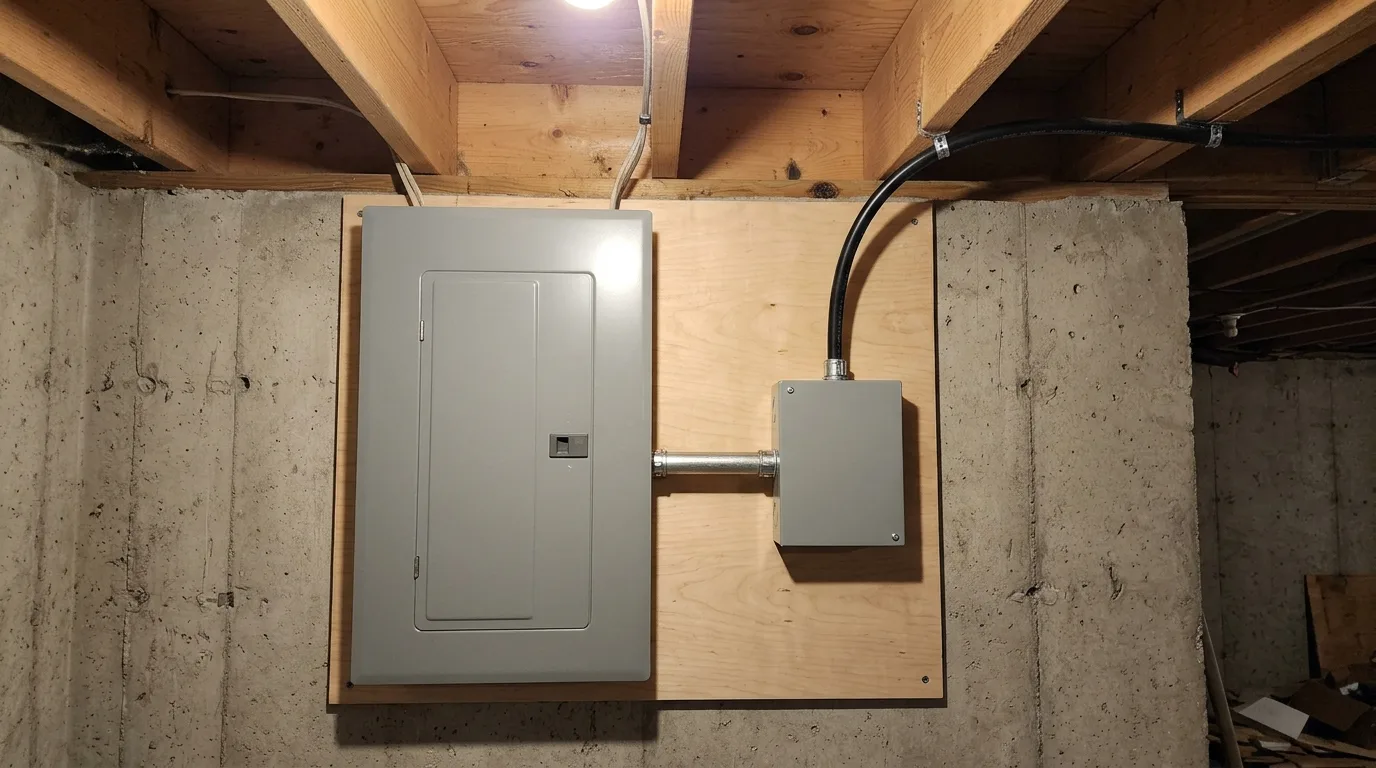
2-minute homeowner self-check before getting quotes
Run these five quick checks before calling 2 or 3 licensed electricians to lock accurate quotes within 15%:
- Read main breaker amps and spare slots: open the panel door (not the screwed cover), confirm 100A vs 200A, and check for 2 adjacent full-size slots (a full panel adds $150–$250 for approved tandem breakers).
- Measure actual wire routing: trace joists and walls, never straight-line distance. Under 15 ft = $0; 15–40 ft = +$250–$750; 40–80 ft = +$600–$1,750.
- Check ceiling finish: open floor joists fish in under an hour; finished basement drywall requires access holes (patching excluded) or exterior rigid conduit.
- Verify EV charge-port corner: standard cords reach 20–25 ft (6.1–7.6 m); poor placement forces an unplanned $375–$950 outdoor pedestal.
- Send 4 photos upfront: open panel with directory, wide shot 2 m back, target garage wall and basement ceiling path for apples-to-apples fixed quotes.
5 hidden traps in lowball EV charger quotes
A “$599 or $699 flat-rate EV install” almost always cuts one of five code-mandatory items ($350–$1,100 in hidden exposure):
- No electrical permit: skipping ESA (ON), CMEQ/RBQ (QC), TSBC (BC) or Safety Codes (AB) “saves” $150–$300, disqualifies rebates and jeopardizes home insurance.
- $15 stove outlet instead of EV-rated 14-50: builder-grade stove outlets loosen and melt under continuous 40A 6-hour loads. Specify industrial EV-rated hardware torqued to spec or go hardwired.
- Missing 50A GFCI breaker: omitting the required $140–$250 GFCI breaker is the #1 shortcut in lowball NEMA 14-50 bids.
- Undersized 8 AWG cable or no load calculation: 48A continuous output requires a 60A breaker and 6 AWG copper (125% rule); skipping a Section 8-200 calculation on 100A risks winter main-breaker trips.
- Excluded firestopping and drywall repair: confirm garage firestop caulking, exterior silicone, breaker and commissioning are written in; budget $150–$450 separately for finished drywall patching.
Worked example: 4-province detached home totals with tax
Take a typical 200A detached suburban home with open basement joists and a 28 ft (medium) 6 AWG copper run to an attached garage for a hardwired 48A smart charger—plus the 100A EVEMS row below.
| Line item (28 ft run, hardwired 48A) | Ontario (13% HST) | Quebec (14.975%) | BC (5% GST*) | Alberta (5% GST) |
|---|---|---|---|---|
| 48A smart charger unit (CSA-certified) | $780 | $750 | $800 | $780 |
| Labour, 60A breaker, permit (< 15 ft base) | $1,220 | $1,100 | $1,350 | $1,220 |
| Medium 15–40 ft 6 AWG copper run | $450 | $425 | $480 | $450 |
| Subtotal before tax (200A home) | $2,450 | $2,275 | $2,630** | $2,450 |
| Sales tax on invoice | $319 | $341 | $132 | $123 |
| Total with tax (before rebates) | $2,769 | $2,616 | $2,762 | $2,573 |
| Provincial single-family rebate (Nov 2026) | $0 | -$600 | -$350 | $0 |
| Net cost (200A home) | $2,769 | $2,016 | $2,412 | $2,573 |
| Optional 100A EVEMS add-on (incl. tax) | +$1,300 ($4,069) | +$1,207 ($3,223 net) | +$1,260 ($3,672 net) | +$1,208 ($3,781) |
Adjust wire length, NEMA 14-50 or outdoor pedestal options in our EV charger installation cost calculator. If you are also budgeting a cold-climate heat pump on a 100A service, compare upgrades in our electrical panel upgrade cost calculator.
Permits, rebates and overnight charging rates
Permitting, incentives and overnight electricity rates vary widely by province in November 2026:
- Ontario: hire an ECRA/ESA Licensed Electrical Contractor to file a Notification of Work with the Electrical Safety Authority (ESA) and collect your Certificate of Acceptance. No provincial home-charger rebate exists in Nov 2026, but the OEB Ultra-Low Overnight rate (3.7 ¢/kWh from 11 p.m. to 7 a.m., effective Nov 1, 2026, commodity rate) cuts a 40 kWh charge to ~$1.48.
- Quebec: CMEQ master electrician (RBQ subclass 16) is mandatory. The Quebec Écorecharge program pays $600 toward buying a listed connected Level 2 unit priced over $600 before tax (labour excluded; connected units mandatory since April 1, 2026). At Hydro-Québec Tier 2 Rate D (11.142 ¢/kWh), 40 kWh costs $4.46 pre-tax.
- British Columbia: Technical Safety BC (or municipal) electrical permit required. Under the BC Hydro / CleanBC single-family rebate, eligible homes get 50% of purchase + install up to $350 (apply within 180 days).
- Alberta: Safety Codes Act electrical permit required via municipality or accredited agency; no provincial home-charger rebate in Nov 2026 (specify -40 °C cold-rated cables for outdoor stalls).
RénoClair tip: Verify two items in writing before signing: (1) the contractor’s active provincial electrical licence number and permit inclusion, and (2) an adjustable-amperage hardwired 48A charger (24A/32A/40A/48A) so you can scale output down on a 100A panel without replacing hardware.
Frequently asked questions
What is the average Level 2 EV charger installation cost in Canada?
In November 2026, a hardwired 48A charger with hardware on a short run (< 15 ft) costs $1,450 to $2,900 before tax (typical: $2,000 ON/AB, $1,850 QC, $2,150 BC), or $2,275–$2,625 with a 15–40 ft cable run. Customize your setup in our EV charger installation cost calculator.
How much is EV charger installation if I already own the unit?
For a short run under 15 ft, installation only costs $650–$1,350 before tax in Quebec (typical $900), $750–$1,550 in Ontario and Alberta (typical $1,050), and $800–$1,650 in BC (typical $1,150).
Is a NEMA 14-50 outlet cheaper than hardwiring a Level 2 charger?
Barely: once built to code, a NEMA 14-50 outlet saves only ~$100 before tax ($1,900 vs $2,000 in ON/AB) because it requires a 50A GFCI breaker (+$140–$250) and an industrial EV-rated outlet (+$80–$120), while delivering 20% slower charging (40A vs 48A).
Can I install a Level 2 EV charger on a 100-amp panel?
Yes, in most homes. After a CEC Section 8-200 load calculation, an electrician can either commission a hardwired unit at 24A/32A or install a CEC Rule 8-500 EVEMS load manager ($1,050–$1,200 typical before tax), saving $2,400+ vs a 200A upgrade.
Which Canadian provinces offer a home EV charger rebate in November 2026?
Quebec pays $600 via Écorecharge on listed connected chargers priced over $600 pre-tax (labour excluded). BC pays 50% of purchase and install up to $350 via CleanBC / BC Hydro. Ontario and Alberta offer no provincial single-family rebate.
Do I need an electrical permit for a home EV charger in Canada?
Yes, in every province (ESA Notification of Work in Ontario, CMEQ/RBQ in Quebec, Technical Safety BC or municipal permit in BC, Safety Codes Act permit in Alberta). Keep the final certificate for home insurance and resale.
How much does overnight EV charging cost at home in Canada?
A 40 kWh charge (~200 km) costs roughly $1.48 in commodity electricity on Ontario’s Ultra-Low Overnight rate (3.7 ¢/kWh from 11 p.m.–7 a.m., before delivery) or $4.46 pre-tax ($5.12 incl. tax) on Hydro-Québec Tier 2 Rate D (11.142 ¢/kWh).
The bottom line
Budgeting for a realistic Level 2 EV charger installation cost in Canada means planning $1,850 to $2,150 before tax on a short run, or $2,275 to $2,625 before tax on a typical 15–40 ft run (minus $600 in Quebec or up to $350 in BC). Choose hardwired 48A over a NEMA 14-50 outlet, price an EVEMS ($1,050–$1,200) before paying $3,600+ for a 200A upgrade, and gather three written licensed quotes from the same four site photos.
Looking to pair home EV charging with rooftop generation? Review our breakdown of solar panel installation cost across Ontario, Quebec, BC and Alberta, including battery and rebate trade-offs.
Sources
- Electrical Safety Authority (ESA Ontario): Ontario Electrical Safety Code EVSE permitting and Licensed Electrical Contractor rules (checked November 20, 2026).
- Natural Resources Canada (NRCan): Level 1 vs Level 2 charging speed and home EV charger installation guidance (checked November 20, 2026).
- BC Hydro / CleanBC (single-family $350 rebate) and Government of Quebec Écorecharge ($600 connected-charger grant), checked November 20, 2026.
- RénoClair pricing dataset (2026.Q4-ev-2) and OEB Ultra-Low Overnight rates (Nov 1, 2026); see our sources and methodology.