Official sources and rates checked on November 28, 2026.
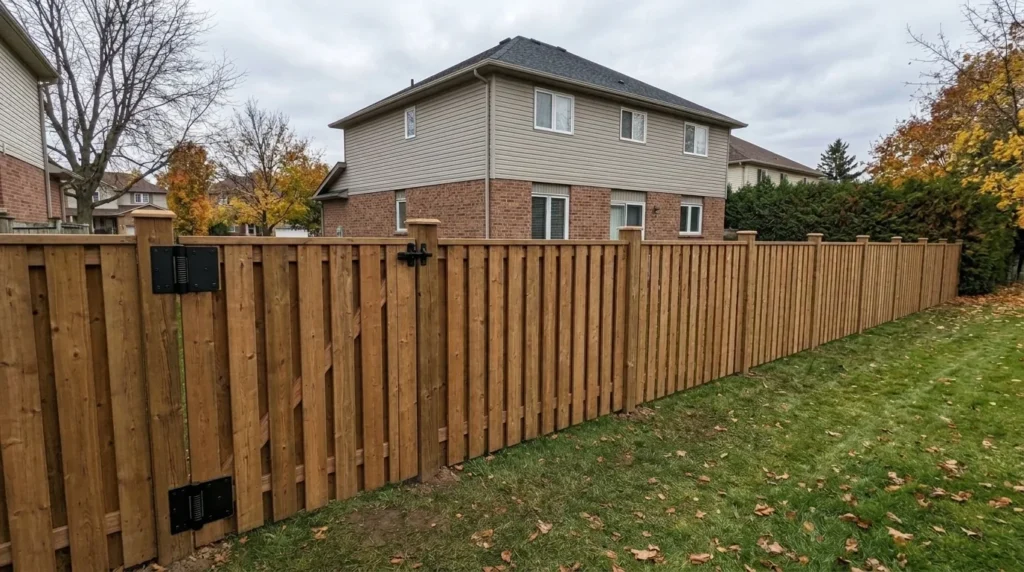
In Canada, installed fence installation cost runs $18 to $122/lin. ft before tax: typical Ontario rates are $28/ft for chain link, $45 for 6 ft treated wood, $58 for cedar and $68 for aluminum or PVC. For 120 lin. ft of treated wood with one gate, budget $5,900 pre-tax in Ontario ($6,667 with 13% HST). Estimate your yard in our fence installation cost calculator.
In this guide
Fence installation cost by material and Canadian province
Linear-foot costs vary sharply across Canada because frost depth, soil rockiness, lumber freight and crew wages differ by province. The November 2026 rates below cover supply, augered concrete footings, installation and standard hardware in pre-tax CAD, aligned with RénoClair’s calculator. Materials alone in Ontario run roughly $11–$20/lin. ft for chain link, $22–$36 for treated wood, $30–$50 for cedar and $34–$58 for aluminum or PVC, making labour and equipment 35% to 50% of the contract.
| Item (pre-tax CAD, typical) | Ontario (13% HST) | Quebec (14.975%) | BC (5% GST*) | Alberta (5% GST) |
|---|---|---|---|---|
| Chain-link (galv. / vinyl) | $28/ft ($18–$42) | $27/ft ($18–$40) | $35/ft ($26–$48) | $33/ft ($24–$46) |
| Pressure-treated wood (6 ft) | $45/ft ($32–$65) | $43/ft ($30–$62) | $64/ft ($48–$84) | $60/ft ($45–$78) |
| Cedar / steel-post hybrid | $58/ft ($42–$80) | $56/ft ($40–$78) | $82/ft ($62–$108) | $76/ft ($58–$100) |
| Aluminum or PVC | $68/ft ($48–$100) | $68/ft ($48–$100) | $92/ft ($70–$122) | $86/ft ($65–$115) |
| Single gate (self-closing) | +$500 ($300–$800) | +$500 ($300–$800) | +$650 ($400–$900) | +$600 ($375–$850) |
| Double gate (8–10 ft) | +$1,050 ($700–$1,500) | +$1,000 ($700–$1,400) | +$1,500 ($950–$2,200) | +$1,400 ($900–$2,050) |
| Old fence removal | +$7/ft ($4–$11) | +$6/ft ($3–$10) | +$12/ft ($8–$18) | +$11/ft ($7–$16) |
*BC tax rule: under BC Bulletin PST 501 (Real Property Contractors), permanent fences become real property, so the contractor pays 7% PST on materials and embeds it in the contract price; only 5% GST appears on your invoice. For 120 lin. ft new with one gate in Ontario (pre-tax), expect $3,850 for chain link, $5,900 for treated wood, $7,450 for cedar and $8,650 for aluminum or PVC. Coordinating outdoor work? Compare schedules via our deck cost calculator and driveway paving cost calculator before fence posts block machine access.

Chain-link, treated wood, cedar or PVC over 25 years
The lowest linear-foot bid rarely wins on 25-year ownership cost in Canadian freeze-thaw soils. Treated pine saves roughly 32% upfront over PVC or aluminum in Ontario, yet wood posts buried in damp clay rot at grade in 15 to 20 years and boards require staining every 3 to 4 years. Here is the 25-year comparison for 120 lin. ft plus one gate in Ontario (constant pre-tax CAD):
| Material (120 lin. ft + 1 gate) | New install ON | Typical lifespan | 25-year upkeep & rebuild | 25-year total (est.) |
|---|---|---|---|---|
| Chain-link (galv. / vinyl) | $3,850 | 25–35 years | Tension / latch tune-up (~$300) | ~$4,150 |
| Pressure-treated wood (6 ft) | $5,900 | 15–20 years | Stain every 3–4 yrs + rebuild year 18 | ~$12,000–$13,800 |
| Cedar / steel-post hybrid | $7,450 | 20–30 years | Oil/stain every 4–5 yrs (~$2,000) | ~$9,450 |
| Aluminum or PVC | $8,650 | 30–40+ years | Annual wash + hinges (~$200) | ~$8,850 |
A steel-post hybrid (galvanized steel posts with cedar or treated panels) removes wood-to-soil contact, preventing 80% of premature failures. If you plan to sell within 5 to 7 years, pressure-treated wood or black vinyl chain link keeps upfront spend under $6,500 pre-tax.
When not to replace the whole fence: 4 cheaper fixes
Before approving a $6,500 to $11,000 tear-out, inspect whether the failure is localized. Roughly one-third of full-replacement inquiries can be fixed for under $2,000:
- 2 to 5 leaning or grade-rotted posts: if boards and rails are sound, swapping 3–5 posts in concrete (or adding steel post-mender spurs) runs $800–$1,900 pre-tax versus $6,740 for full replacement.
- Sagging gate or failed pool latch: rebuilding one pedestrian gate with a diagonal brace, spring hinges and a top magnetic latch costs $500–$950 without disturbing 115 lin. ft of solid fence.
- Sound chain-link needing privacy or tighter mesh: inserting UV-stabilized privacy slats runs $8–$14/lin. ft installed ($960–$1,680 for 120 ft) rather than pulling deep footings.
- Written 50/50 neighbour split: securing a signed agreement before work starts halves your cost on shared flanks, typically saving $2,200–$3,600 tax-included.
Skip spot repairs only when over 35% of posts rock at grade or bottom rails are crumbling across spans: paying twice for crew mobilization and dump bins wastes money within three winters.
2-minute homeowner inspection checklist before quoting
Take two minutes with a tape measure and your property survey (or Alberta Real Property Report) before inviting estimators:
- Rock every corner and gate post (30 s): movement over 2 cm (3/4 in.) at grade points to rotted heartwood or frost heave from footings dug above 48 in.
- Measure net linear footage minus house walls (30 s): log straight runs, 90-degree corners and subtract house/garage spans. Over-measuring by 15 ft inflates a treated wood bid by $675 pre-tax.
- Verify legal lot pins and easements (30 s): never assume an old hedge marks the boundary. Encroaching 15 cm onto a neighbour’s lot can trigger a forced $2,500+ move.
- Flag trees, slopes and buried drops (30 s): slopes dropping over 15 cm per 8 ft bay require stepped panels, and roots within 1.5 m slow augering. If exterior cladding is next, verify yard clearance in our siding replacement cost guide.
Neighbour laws, pool bylaws, utility locates and taxes
Four provincial and municipal frameworks directly affect cost-sharing, permits and liability across Canada:
- Neighbour sharing is not automatic: Ontario’s Line Fences Act (R.S.O. 1990, c. L.17) sets a fence-viewer arbitration process, yet major cities including Toronto, Mississauga and Brampton opt out or limit forced sharing. Never build first and bill afterwards without written consent (the same prior-agreement rule applies under Quebec Civil Code art. 1002).
- Height limits and pool-enclosure permits: standard rear-yard caps sit near 2.0 m (6.5 ft) and front yards at 1.0–1.2 m. Under City of Toronto Municipal Code Chapter 447 (Fences), any pool holding 60 cm+ of water requires a Zoning Certificate, Pool Fence Enclosure Permit, a 1.2 m barrier with self-closing/latching gate and city inspection before filling. Quebec enforces a September 30, 2027 compliance cutoff for pre-2010 pools (1.2 m height, 10 cm sphere test, 30 mm max mesh or slats).
- Mandatory free utility locates: book a free locate at least 5 business days before digging via Ontario One Call (Ontario Dig Authority), BC 1 Call, Utility Safety Partners (Alberta) or Info-Excavation (Quebec) to avoid severe utility-strike liability.
- Licensing and deposit protection: in Alberta, contractors signing at your home and taking deposits must hold a bonded Alberta Prepaid Contracting Licence. In Quebec, check RBQ sub-category 2.7 or 5.2; across Ontario and BC, confirm WSIB/WorkSafeBC clearance and $2M liability insurance.
RénoClair tip: Put the neighbour split and locate ticket in writing before signing: Never let an auger dig on a shared property line on a handshake. Draft a one-page email naming style, finished side, linear footage and dollar split signed by both owners, and confirm in writing who pulls the free utility locate 5 business days ahead.
5 hidden traps in low-ball fence quotes
When one bid for 120 lin. ft undercuts two rivals by $1,800 to $2,500, the gap almost always hides one of these five omissions:
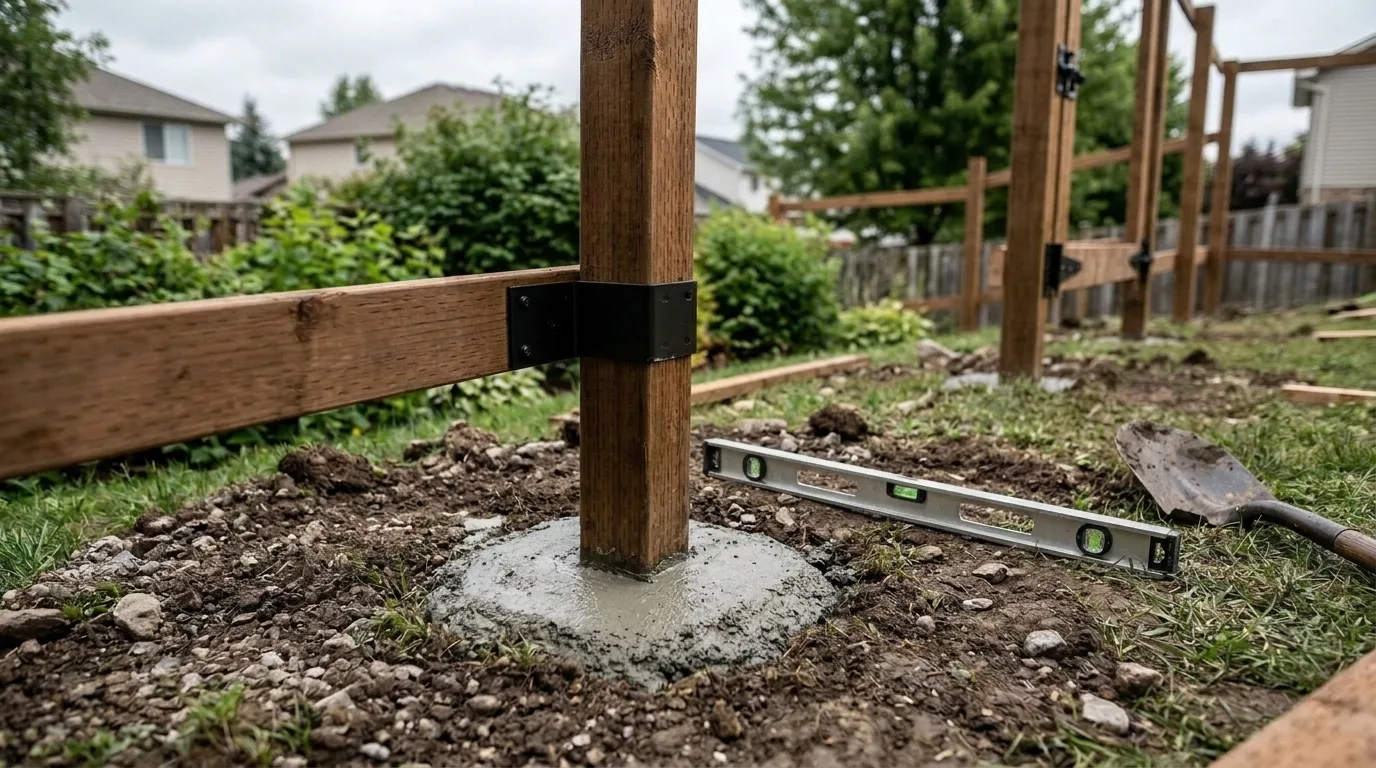
- 1. Shallow holes above the frost line (24–30 in. vs 48 in.): shallow augering cuts concrete 40%, but frost heave lifts posts out of plumb within two winters. Require 42–48 in. depth (36 in. min in coastal BC) in writing.
- 2. Undersized 4×4 wood gate posts: a rain-soaked 42 in. wood gate weighs 50–65 lb and twists a 4×4 inside two seasons, preventing pool latches from catching. Specify 6×6 treated or steel gate posts.
- 3. Old fence removal and concrete extraction excluded: budget bids often assume a cleared line, adding $7–$12/lin. ft ($840–$1,440 on 120 ft) plus $350–$650 in bin fees on dig day.
- 4. Uncapped rock-digging extras: hitting limestone shelf or mature maple roots halts standard augers. Lock a written per-hole rock-breaker cap ($75–$180/hole) before signing.
- 5. Pool-grade hardware omitted: a basic $300 gate fails pool inspection. Specify adjustable spring hinges and a key-lockable top magnetic latch (+$150–$280).
Worked example with tax: 120 linear foot suburban backyard
Worked example: a standard 40 × 40 ft suburban rear lot (120 linear feet across three sides) built in 6 ft pressure-treated privacy wood with one self-closing gate and old-fence removal, showing exact November 2026 pre-tax and tax-included totals across four provinces:
| Line item (120 lin. ft PT wood + gate + tear-out) | Ontario (13% HST) | Quebec (14.975%) | BC (5% GST*) | Alberta (5% GST) |
|---|---|---|---|---|
| Pressure-treated 6 ft fence (120 ft) | $5,400 ($45/ft) | $5,160 ($43/ft) | $7,680 ($64/ft) | $7,200 ($60/ft) |
| Single self-closing gate | $500 | $500 | $650 | $600 |
| Old fence removal & disposal (120 ft) | $840 ($7/ft) | $720 ($6/ft) | $1,440 ($12/ft) | $1,320 ($11/ft) |
| Pre-tax subtotal (with removal) | $6,740 | $6,380 | $9,770 | $9,120 |
| Sales tax | $876 (13%) | $955 (14.975%) | $489 (5%*) | $456 (5%) |
| Total tax-included | $7,616 | $7,335 | $10,259 | $9,576 |
| New install (no removal, pre-tax / tax-incl.) | $5,900 / $6,667 | $5,650 / $6,500 | $8,350 / $8,768 | $7,800 / $8,190 |
Hold a 10% to 15% contingency reserve ($675–$1,015 in Ontario, $975–$1,465 in BC) for rocks, roots or permit fees. Splitting 80 shared linear feet 50/50 with neighbours in Ontario lowers your full-replacement share from $7,616 to roughly $5,300 tax-included. Recalculate your exact footage, double gate or cedar/PVC option in our fence installation cost calculator.
Frequently asked questions
What is the average fence installation cost in Canada for a backyard?
For 120 linear feet of new 6 ft pressure-treated wood with one gate (no removal), typical pre-tax totals are $5,900 in Ontario ($6,667 with 13% HST), $5,650 in Quebec ($6,500 tax-included), $8,350 in BC ($8,768 with 5% GST) and $7,800 in Alberta ($8,190). Check your length in our fence installation cost calculator.
How much does chain-link fence installation cost per linear foot?
Installed chain-link runs $18–$42/lin. ft before tax in Ontario (typical $28), $18–$40 in Quebec ($27), $26–$48 in BC ($35) and $24–$46 in Alberta ($33), roughly 35%–45% cheaper than treated wood.
Does my neighbour have to pay half the cost of a boundary fence?
No, not automatically. Ontario’s Line Fences Act sets a fence-viewer process, yet Toronto, Mississauga and Brampton opt out or cap forced splits; always sign a cost-sharing agreement before building.
Do I need a building permit for a residential fence in Canada?
Usually no for a standard backyard fence within local height limits (typically 2.0 m rear, 1.0–1.2 m front), but yes for any swimming pool enclosure (60 cm+ depth) and over-height or corner-lot variances.
Why does a BC fence contract only bill 5% GST instead of 12%?
Under BC Bulletin PST 501, installed fences are real property improvements: the contractor pays 7% PST on materials and embeds it into the contract rate, billing only 5% GST to the homeowner.
How deep should fence posts be set in Canadian frost zones?
Auger 42 to 48 inches deep (1.1–1.2 m) in Ontario, Quebec and Alberta to sit below frost depth, and at least 36 inches in coastal BC, using crowned concrete footings or steel helical piles in heavy clay.
What contingency should I hold above a fence quote?
Set aside 10% to 15% of the pre-tax contract ($600–$1,500 on 120 lin. ft) to cover rock-breaking, stump removal, old concrete extraction or survey verification.
The bottom line: confirm lot lines and net linear footage first, put neighbour splits and utility locates in writing, require 48 in. frost-depth footings, 6×6 or steel gate posts and capped rock-digging rates, and verify provincial licensing (Alberta Prepaid Contracting Licence, RBQ 2.7/5.2 or WSIB/WorkSafeBC). Test your material and tax scenarios in RénoClair’s tool before comparing three written quotes.