Official sources and rates checked on November 27, 2026.
In Canada, installed siding replacement cost ranges from $6.50 to $52.00/sq ft before tax: typical rates are $8.75–$10.25/sq ft for vinyl, $14.50–$17.00/sq ft for engineered wood and $18.50–$22.00/sq ft for fibre cement. For 1,500 sq ft with tear-off, vinyl totals $17,800 pre-tax in Ontario ($20,114 with 13% HST) and $19,300 in BC. Estimate your walls with our siding cost calculator.
In this guide
Siding replacement cost by material and Canadian province
Installers price exterior cladding per net wall square foot (windows and doors deducted), not floor area. The rates below match our November 2026 four-province benchmark across independent Canadian contractor and retailer price guides, including cladding, starter strips, corner trim, flashings, labour and basic scaffolding.
| Item (pre-tax CAD, typical) | Ontario (13% HST) | Quebec (14.975%) | BC (5% GST*) | Alberta (5% GST) |
|---|---|---|---|---|
| Vinyl siding (low–high) | $9.50/sq ft ($7.00–$12.50) | $8.75/sq ft ($6.50–$11.50) | $10.25/sq ft ($7.50–$13.50) | $9.00/sq ft ($6.75–$12.00) |
| Engineered wood | $15.50/sq ft ($12.00–$20.50) | $14.50/sq ft ($11.00–$19.00) | $17.00/sq ft ($13.00–$22.50) | $15.50/sq ft ($12.00–$20.50) |
| Fibre cement | $20.00/sq ft ($15.00–$26.50) | $18.50/sq ft ($14.00–$24.50) | $22.00/sq ft ($16.50–$29.00) | $20.50/sq ft ($15.50–$27.00) |
| Brick / stone veneer | $35.00/sq ft ($26.00–$48.00) | $32.00/sq ft ($24.00–$44.00) | $38.00/sq ft ($28.00–$52.00) | $34.50/sq ft ($26.00–$47.00) |
| Tear-off & bin disposal | +$2.35/sq ft ($1.60–$3.40) | +$2.20/sq ft ($1.50–$3.20) | +$2.60/sq ft ($1.80–$3.80) | +$2.30/sq ft ($1.60–$3.30) |
| Rigid insulation + strapping | +$3.60/sq ft ($2.60–$5.00) | +$3.40/sq ft ($2.40–$4.75) | +$3.90/sq ft ($2.80–$5.40) | +$3.60/sq ft ($2.60–$5.00) |
| Soffit, fascia, eavestroughs | +$3,900 ($2,600–$5,800) | +$3,600 ($2,400–$5,400) | +$4,200 ($2,800–$6,200) | +$3,800 ($2,500–$5,600) |
*Per BC Bulletin PST 501, real property contractors pay 7% PST on materials and include it in the contract price, adding only 5% GST to the invoice. In Ontario, retail materials alone run $2.60–$4.50/sq ft for vinyl, $5.50–$9.00/sq ft for engineered wood and $7.00–$11.20/sq ft for fibre cement, leaving 55%–65% for skilled labour, flashings and scaffolding.

Vinyl, engineered wood, fibre cement or brick over 30 years
Regional weather changes the 30-year winner. Along Alberta’s hail corridor, standard vinyl turns brittle below −20 °C and fractures in summer storms, making fibre cement ($20.50/sq ft) or heavy engineered wood ($15.50/sq ft) cheaper long term than repeated claims. In coastal BC, a 10 mm drained rainscreen cavity behind the cladding matters more than the panel itself.
| Factor | Vinyl | Engineered wood | Fibre cement | Brick / stone |
|---|---|---|---|---|
| 1,500 sq ft + tear-off (ON) | $17,800 ($12,900–$23,900) | $26,800 ($20,400–$35,900) | $33,500 ($24,900–$44,900) | $56,000 ($41,400–$77,100) |
| Expected lifespan | 20–30 years | 30–40 years | 40–50 years | 50+ years |
| Hail & fire resilience | Brittle below −20 °C | High impact resistance | Non-combustible, hail-resistant | Non-combustible |
| 30-year upkeep | Wash; caulk every 10 yrs | Repaint every 12–15 yrs | Repaint every 10–15 yrs | Repoint every 25–30 yrs |
When not to replace all your siding: 4 cheaper fixes
Before approving a $20,000 to $45,000 full strip-and-reside, rule out four targeted repairs that regularly solve the problem for under $5,800.
- One weathered wall face: residing only the sun-baked south or west elevation (350–500 sq ft) costs $3,800–$6,800 pre-tax instead of replacing three dry elevations.
- Water stains above windows: missing metal Z-flashing or cracked sealant usually fixes for $450–$1,200. If your windows also need replacing, coordinate both scopes via our Ontario window replacement cost guide so trim is only paid for once.
- Faded but intact engineered wood or fibre cement: with zero bottom-edge swelling, washing and two coats of exterior acrylic ($3,200–$5,800 for 1,500 sq ft) buys 10–12 more years.
- Spot impact under 15% of wall area: unzipping and swapping 5–15 cracked vinyl planks costs $400–$900 in half a day when matching profiles exist.
2-minute homeowner inspection checklist before quoting
Complete these six perimeter checks with a tape measure before estimators arrive so hidden rot and inflated wall measurements never catch you off guard.
- Press the bottom two courses: soft movement under windows or outside corners signals wet OSB or plywood sheathing underneath.
- Verify 150 mm (6 in) grade clearance: siding closer to soil or concrete wicks snowmelt into engineered wood and fibre cement butt joints.
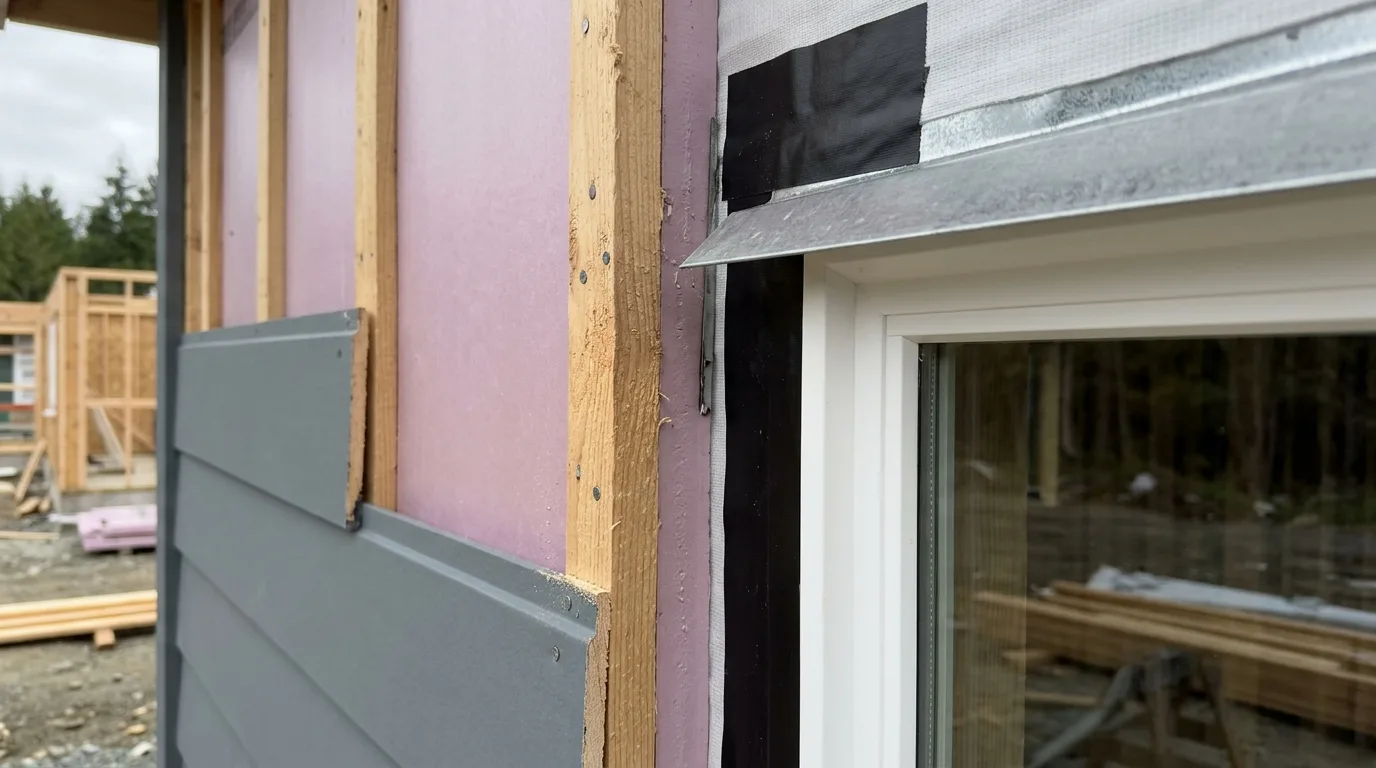
- Confirm sloped metal Z-flashing at window heads: metal drip caps must tuck behind the weather barrier rather than relying on surface caulk.
- Check drainage gaps and soffit vents: bottom starter tracks must drain freely and eaves must stay unobstructed for attic ventilation (1/300 ratio).
- Look for interior cold walls or paint blistering: windward drafts make tear-off the ideal time to add continuous rigid foam; compare materials in our wall insulation guide.
- Measure your own net wall area: perimeter × wall height + gables minus ~15 sq ft per window and 21 sq ft per door. Question any bid exceeding your figure by over 10%.
Rainscreen code (9.27), safety rules and wall rebates
National and provincial codes (Section 9.27) require exterior cladding plus a continuous weather-resistive barrier lapped at least 100 mm horizontally. In high-moisture coastal areas under the BC Building Code 2024 (Sentence 9.27.2.2), walls must include a 10 mm minimum drained and vented capillary break—commonly built with 19 mm (1×3) vertical wood strapping, insect screens at the base and projecting head flashings.
On job-site safety, verify workers’ compensation coverage (WSIB in Ontario, WorkSafeBC in BC, WCB in Alberta) before crews erect scaffolding. In Ontario, installers working at 3 metres (10 ft) or above must hold CPO-approved Working at Heights training (O. Reg. 297/13); Quebec crews need an active RBQ 7.0 licence (4.1/4.2 for masonry).
RénoClair tip — Don’t count on siding rebates without qualifying insulation: Siding alone earns $0 across all four provinces. In Ontario, Home Renovation Savings pays up to $3,600 for exterior wall insulation only on the bundled track (pre- and post-audit plus two qualifying upgrades—verify post-November 30, 2026 booking rules before signing). In Quebec, Rénoclimat pays $3.50/sq ft (up to $7,000) only when a licensed RBQ contractor adds R-9+ over 300+ sq ft—thin R-5 foam qualifies for $0.
5 hidden traps in low-ball siding quotes
Quotes sitting 25% to 35% below competing bids almost always strip out essential envelope protection. Check every written estimate for these five omissions.
- 1. Installing over old siding: cuts $2.35/sq ft ($4,230 on 1,800 sq ft) by skipping tear-off and disposal, but seals rot inside the wall and ruins flashing ties.
- 2. Skipping rainscreen strapping and head Z-flashings: saves $2,000–$3,500 upfront, breaches BC/QC moisture rules and voids cladding warranties.
- 3. Unpriced OSB sheathing repairs: vague “rot extra” clauses trigger $140–$180 per 4×8 sheet bills instead of a pre-agreed $65–$95 installed rate; hold 10%–15% contingency.
- 4. Excluding soffits, fascia, trim and scaffolding: low square-foot pricing often leaves out window capping, scaffolding ($1,000–$3,000) and soffits/eavestroughs ($2,600–$5,800 in ON).
- 5. Uninsured crews or skipped heritage permits: while like-for-like swaps rarely need permits, heritage zones and exterior rigid insulation changes often require city approval, and uninsured falls create homeowner liability.
Worked example with tax: 1,800 sq ft two-storey home
Here are two itemized budgets for a typical Canadian detached two-storey home with 1,800 sq ft of net wall area in Ontario (November 2026 typical rates + 13% HST).
| Scope item (1,800 sq ft net wall, ON) | Scenario A: Vinyl + tear-off + soffits | Scenario B: Fibre cement + tear-off + rigid foam |
|---|---|---|
| Siding supply, trim, flashing & labour | 1,800 × $9.50 = $17,100 | 1,800 × $20.00 = $36,000 |
| Tear-off & bin disposal ($2.35/sq ft) | $4,230 | $4,230 |
| Option (soffits/gutters OR insulation) | Soffit, fascia & gutters: $3,900 | 1,800 × $3.60 = $6,480 |
| Subtotal before tax | $25,230 | $46,710 |
| Ontario HST (13%) | $3,280 | $6,072 |
| Total with 13% HST | $28,510 | $52,782 |
| Sheathing rot reserve (10%–15%) | $2,500 to $3,800 | $4,650 to $7,000 |
Upgrading from vinyl with new soffits ($28,510 tax-in) to insulated fibre cement ($52,782 tax-in) adds $24,272 in Ontario. For the same 1,800 sq ft home in engineered wood with tear-off and continuous rigid insulation, tax-included totals run $43,629 in Ontario (13% HST), $41,598 in Quebec (14.975%), $44,415 in BC (5% GST) and $40,446 in Alberta (5% GST). Re-run these numbers with your own walls in our siding cost calculator.
Frequently asked questions
What is the average siding replacement cost in Canada?
For 1,500 sq ft of net wall with tear-off, typical pre-tax vinyl costs are $17,800 in Ontario ($20,114 with 13% HST), $16,400 in Quebec, $19,300 in BC and $17,000 in Alberta. Engineered wood runs $25,100–$29,400 and fibre cement $31,100–$36,900; estimate your home in our siding cost calculator.
How do I calculate net wall area instead of floor area?
Multiply house perimeter by wall height, add gable triangles (base × height ÷ 2), and subtract doors and windows. A 1,000 sq ft bungalow averages 1,100–1,400 sq ft of net wall; a two-storey home runs 1,400–2,200 sq ft.
Do Canadian rebates pay for new exterior siding?
No: cladding alone earns $0 across QC, ON, BC and AB. Only exterior wall insulation added underneath qualifies—up to $3,600 in Ontario’s Home Renovation Savings bundled track (requiring pre-/post-audits) or $3.50/sq ft up to $7,000 in Quebec’s Rénoclimat when adding R-9+ over 300+ sq ft.
Is a 10 mm drained rainscreen cavity mandatory?
Yes in coastal BC under BC Building Code 2024 (Sentence 9.27.2.2) and in Quebec for most claddings, typically built using 19 mm (1×3) vertical wood strapping. Even where optional inland, strapping prevents trapped moisture behind fibre cement and engineered wood.
Why do BC siding invoices only show 5% GST?
Under BC Bulletin PST 501, real property contractors pay 7% PST on materials and embed it into their installed contract rate, so only 5% GST appears on the homeowner’s final bill.
Can new vinyl siding be nailed over old siding?
Overlaying saves $1.50–$2.60/sq ft in tear-off, but hides damp OSB rot, blocks proper window flange taping and can void warranties. Strip to the sheathing on any house older than 25 years.
How much contingency should I hold for rotted sheathing?
Set aside 10% to 15% of the pre-tax contract ($2,500–$7,000 on an 1,800 sq ft home) and lock a written per-sheet rate for 4×8 OSB/plywood replacement before tear-off begins.
The bottom line: measure your net wall area first, insist on full tear-off, 19 mm rainscreen strapping, taped Z-flashings and a written per-sheet OSB rate, verify WSIB/WorkSafeBC/RBQ credentials, and hold 10%–15% for sheathing repairs. Test your scenarios in RénoClair’s independent tool before collecting three itemized written quotes.