
Official sources checked on October 19, 2026.
Heat pump vs furnace: at Ontario’s electricity prices effective November 1, 2026 and Enbridge’s gas rates effective October 1, 2026, a 95% efficient gas furnace delivers heat for about 2.5 to 2.8 cents per kWh, while an air-source heat pump costs about 4.2 to 5.5 cents per kWh of heat, so gas usually remains cheaper to run. The picture flips if you heat with electric baseboards, oil or propane, if you would buy central air anyway, or if switching lets you close your gas account and drop its monthly charge of about $28. Comfort differs as well: a heat pump delivers cooler air (25 to 45°C) over longer cycles, a furnace shorter blasts of 55 to 60°C air.
This guide compares the two systems with real, dated Ontario rates and a full worked example, then covers comfort, cold-weather performance, hybrid systems and the rebates that change the math. For installed prices, see our separate guide to heat pump cost in Ontario.
In this guide
Heat pump vs furnace at a glance
| Point of comparison | Gas furnace (95% AFUE) | Air-source heat pump |
|---|---|---|
| How it makes heat | Burns natural gas; at least 95% seasonal efficiency for new models made since July 3, 2019 | Moves heat from outdoor air with electricity; NRCan cites a COP of 2.0 to 5.4 at 8°C and 1.1 to 3.7 at –8°C |
| Energy cost per kWh of heat (Ontario, before HST) | About 2.5¢ (Union South zone) to 2.8¢ (Enbridge Gas Distribution zone) | About 4.2¢ to 5.5¢ at a seasonal COP of 2.5 to 3, depending on your price plan |
| Against electric baseboards (about 12.6¢ per kWh of heat) | Much cheaper | Cuts heating energy cost by about 60 to 67% |
| Supply air temperature | 55 to 60°C | 25 to 45°C, higher airflow |
| Very cold weather | Full output at any temperature | Most models stop between –15°C and –25°C; cold-climate units are rated to keep working lower, with backup heat below that |
| Air conditioning | No, needs a separate A/C | Yes, same unit |
| Fixed monthly charge | Gas customer charge: $27.69 (EGD zone) or $28.91 (Union South) | None extra if you close the gas account |
| Ontario rebate (Home Renovation Savings) | None for a furnace | Cold-climate unit: up to $2,000 for gas-heated homes, up to $7,500 for electric, oil, propane or wood |
Prices in this table are energy charges only, before HST, for the cases described in the sections below. Your own result depends on your utility, your price plan, the efficiency of your equipment and how well your house is insulated.
How each system heats your home
A furnace converts fuel into heat; a heat pump moves heat that already exists outside. That single difference explains why one is measured in percent and the other in multiples.
For a gas furnace, the yardstick is the Annual Fuel Utilization Efficiency. NRCan’s guide Heating with Gas (revised 2012) defines AFUE as “the metric used to express seasonal efficiency”, and notes that one cubic metre of natural gas contains approximately 37.5 MJ of energy, which is about 10.4 kWh. Since July 3, 2019, federal energy efficiency regulations require a minimum AFUE of 95% for most new residential gas furnaces, so a furnace bought today turns at most 95 to 98% of the gas it burns into heat.
A heat pump is rated by its coefficient of performance (COP): the heat it delivers divided by the electricity it uses. On its page Heating and cooling with a heat pump (modified December 24, 2025), Natural Resources Canada explains that if a heat pump uses 1 kW of electricity to transfer 3 kW of heat, the COP is 3. NRCan gives a COP range of 2.0 to 5.4 at 8°C and 1.1 to 3.7 at –8°C for air-source units, because the colder the air, the harder the unit must work.
Over a whole winter, the useful figure is the seasonal rating. NRCan reports Heating Seasonal Performance Factors (HSPF) of 7.1 to 13.2 for market-available units in Region V, a climate similar to Ottawa. Dividing by 3.412 converts that into an average seasonal COP of roughly 2.1 to 3.9. That is the range we use in the cost comparison below.
Running costs: heat pump vs furnace with 2026 Ontario rates
Per unit of heat, gas is still cheaper in most of Ontario: a heat pump needs a seasonal COP of about 4.3 to 4.9 to match a 95% furnace on energy cost, and most installed units average well below that. The method is simple: take the price of one unit of energy, divide by how much heat it produces.
Natural gas: what one cubic metre really costs
Enbridge Gas publishes a rate notice for each zone. In the former Enbridge Gas Distribution zone (Rate 1, effective October 1, 2026), a cubic metre used above 170 m³ in a month costs 12.2850¢ in delivery, 5.4818¢ in transportation, 9.4741¢ in gas supply and 0.5322¢ in cost adjustment, for a total of about 27.8¢ before HST. In the Union South zone (Rate M1, also effective October 1, 2026), delivery above 250 m³ is 7.4325¢ and the total effective gas supply rate is 17.7009¢, for about 25.1¢ per cubic metre. Each zone also charges a fixed customer charge: $27.69 a month (EGD zone) and $28.91 a month (Union South).
The federal fuel charge no longer applies: the Department of Finance confirms that “beginning on April 1, 2025, the fuel charge ceases to apply.” Enbridge’s notices still show a small facility carbon charge of 0.0145¢ per m³, already included in delivery. The Ontario Energy Board’s gas rate page lists the supply rate for each zone if you are on another Enbridge zone.
With 10.4 kWh in each cubic metre and a 95% efficient furnace, one cubic metre gives about 9.9 kWh of heat. Heat therefore costs about 2.8¢ per kWh in the EGD zone and 2.5¢ in Union South, before HST.
Electricity: what one kWh really costs a heat pump
The Ontario Energy Board announced on October 16, 2026 the Regulated Price Plan prices effective November 1, 2026. Winter Time-of-Use: 9.1¢ off-peak (weekdays 7 p.m. to 7 a.m., weekends and holidays), 14.6¢ mid-peak and 18.9¢ on-peak. Tiered: 11.2¢ for the first 1,000 kWh per month, then 13.2¢. Ultra-Low Overnight: 3.7¢ from 11 p.m. to 7 a.m., but 37.7¢ on weekdays from 4 to 9 p.m. The Ontario Electricity Rebate changes to 15.7% on the same date.
Those are commodity prices. Your local utility adds per-kWh delivery and regulatory charges. Hydro Ottawa, for example, lists a transmission charge of 2.16¢, a wholesale market service charge of 0.53¢ and a line loss charge of 3.32% of the electricity charge; Toronto Hydro lists 2.241¢ for transmission and the same 0.53¢. Using Hydro Ottawa’s charges, a Time-of-Use customer whose heat pump runs evenly around the clock pays an average of about 14.9¢ per kWh, or about 12.6¢ after the 15.7% rebate, before HST. On the Tiered plan, each kWh above 1,000 a month costs about 13.7¢ after the rebate.
| Electricity plan (Hydro Ottawa example, after OER, before HST) | Cost per kWh of electricity | Heat cost at seasonal COP 2.5 | Heat cost at seasonal COP 3.0 | COP needed to match gas (EGD zone) |
|---|---|---|---|---|
| Time-of-Use, even use around the clock | 12.6¢ | 5.0¢ | 4.2¢ | 4.5 |
| Tiered, above 1,000 kWh/month | 13.7¢ | 5.5¢ | 4.6¢ | 4.9 |
| Tiered, first 1,000 kWh/month | 12.0¢ | 4.8¢ | 4.0¢ | 4.3 |
| Ultra-Low Overnight period only (11 p.m. to 7 a.m.) | 5.5¢ | 2.2¢ | 1.8¢ | 2.0 |
Reading the table: only the Ultra-Low Overnight price brings a heat pump below gas, and only for the hours from 11 p.m. to 7 a.m. A house that needs heat all day cannot stay on that price, and the same plan charges 37.7¢ on weekday evenings, when heating demand is often highest. These figures leave out the furnace blower and the heat pump’s indoor fan, which both use electricity.
Worked example: a gas-heated house in the Enbridge Gas Distribution zone
For a house that needs 20,000 kWh of heat a year, gas costs about $560 in energy, a heat pump about $840 to $1,000, and electric baseboards about $2,500, before HST and fixed charges. Here is how the numbers are built, using Hydro Ottawa’s delivery charges on Time-of-Use and the EGD gas zone, so you can redo them with your own bill.
- Heat needed: 20,000 kWh a year (an assumption for illustration). With a 95% furnace, that takes about 2,020 m³ of gas, close to the 2,400 m³ a year Enbridge uses as its typical residential customer.
- Gas, EGD zone: 2,020 m³ × 27.8¢ = about $561 in variable charges. The customer charge adds $27.69 × 12 = $332 a year.
- Heat pump at a seasonal COP of 3.0: 20,000 ÷ 3 = 6,667 kWh × 12.6¢ = about $837. At a COP of 2.5: 8,000 kWh × 12.6¢ = about $1,004.
- Electric baseboards (COP 1): 20,000 kWh × 12.6¢ = about $2,511.
- If the heat pump lets you close the gas account completely (no gas water heater, stove or fireplace), compare $837 to $1,004 with $561 + $332 = $893 for gas. The gap shrinks to almost nothing, or reverses at a COP of 3.
| Scenario (20,000 kWh of heat/year) | Annual energy cost before HST | Monthly fixed gas charge |
|---|---|---|
| Gas furnace 95%, EGD zone | About $561 | $332/year (still paid) |
| Gas furnace 95%, Union South zone | About $508 | $347/year (still paid) |
| Heat pump, seasonal COP 3.0, gas account kept | About $837 | $332/year (still paid) |
| Heat pump, seasonal COP 3.0, gas account closed | About $837 | $0 |
| Heat pump, seasonal COP 2.5 | About $1,004 | Depends on gas account |
| Electric baseboards | About $2,511 | None |
Two conclusions stand out. First, a gas-heated home that keeps gas for other appliances will usually see higher heating bills after switching to an all-electric heat pump. The Home Renovation Savings participant agreement itself warns that a heat pump in a natural gas home “has the potential to increase overall home energy bills.” Second, for a home on baseboards, the heat pump saves roughly $1,500 to $1,700 a year in this example. Oil and propane homes also tend to benefit, but we have not verified current Ontario oil and propane prices, so we do not give a figure here.
When a heat pump wins, and when a furnace still makes sense
The heat pump vs furnace decision depends mostly on what you heat with today and whether you need air conditioning.
- Electric baseboards, oil or propane: a heat pump is the clear choice on running cost, and these homes qualify for the higher Ontario rebate (up to $7,500 for a cold-climate air-source unit).
- Gas furnace near the end of its life and no central air: if you were going to buy an air conditioner anyway, a heat pump covers both. The Canadian Climate Institute’s 2023 study Heat Pumps Pay Off found that “in Toronto, standard heat pumps are the lowest-cost option for nearly all households under mid-range assumptions,” counting equipment and energy over the system’s life. That study predates the April 2025 removal of the consumer carbon charge.
- Gas furnace in good shape, existing central A/C: energy costs favour keeping gas. A hybrid system (below) is the middle ground.
- Gas used for water heating, cooking or a fireplace: you keep paying the gas customer charge, which removes one of the heat pump’s advantages.
- Old, small ductwork: NRCan notes that heat pumps run at higher airflows than furnaces, so some ducts need modifications to avoid noise and extra fan energy. That cost belongs in your comparison.
Comfort: why a heat pump feels different from a furnace
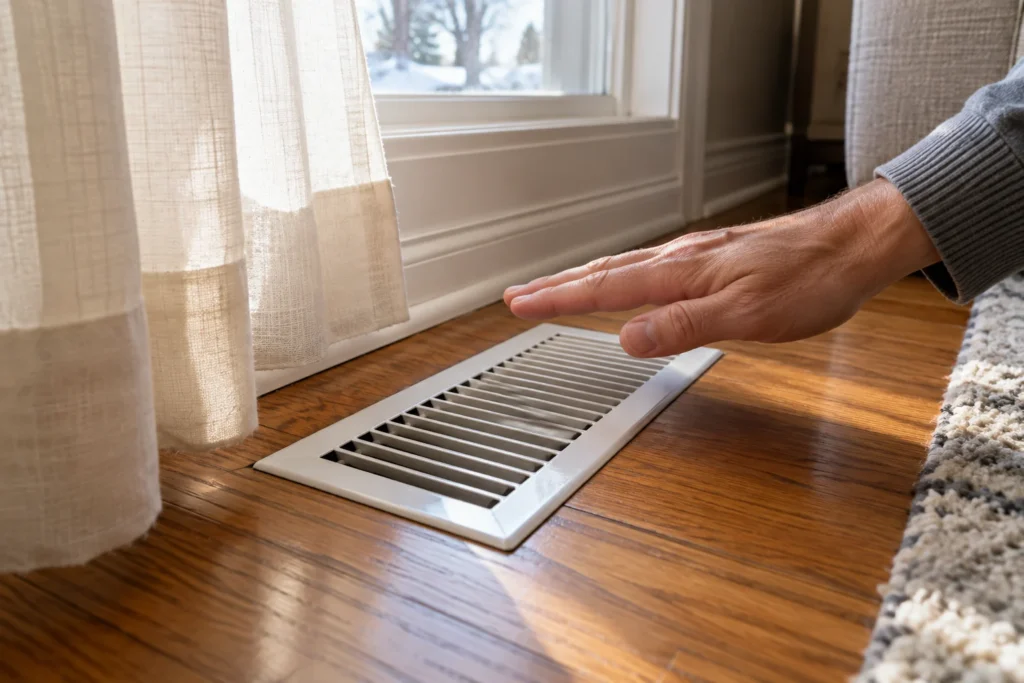
A furnace delivers short bursts of hot air; a heat pump delivers a larger volume of warm air for longer. NRCan puts it this way: heat pumps heat air “to a lower temperature (normally between 25 and 45°C)”, while furnaces “heat that air to higher temperatures (between 55°C and 60°C).” If you are used to a furnace, air at the register can feel cool to the hand even when the room is at the right temperature.
- Steadier temperatures: longer, gentler cycles reduce the hot-then-cool swings typical of an oversized furnace.
- Defrost cycles: in cold, humid weather an air-source unit periodically defrosts its outdoor coil. NRCan notes supplementary heat may be needed during defrost, and that demand-defrost controls are more efficient than timed defrost.
- Noise: NRCan states that most heat pumps have a sound rating of 76 dB or lower. Place the outdoor unit away from bedroom windows and property lines.
- Summer comfort: the same unit cools and dehumidifies, which a furnace cannot do.
- Sizing matters: an undersized heat pump leans on backup heat; an oversized one “cycles on and off leading to discomfort, wear on the heat pump, and stand-by electric power draw,” according to NRCan.
Cold weather: backup heat and hybrid systems
Most air-source heat pumps need a backup below a certain outdoor temperature; the question is whether that backup is electric or gas. NRCan explains that most models have a minimum operating temperature between –15°C and –25°C, and that below the “thermal balance point” the heat pump supplies only part of the heat the house loses. Cold-climate models are designed to keep working at lower temperatures, which is why Ontario’s rebate for air-source units covers only cold-climate models listed by NRCan.

- All-electric backup: resistance elements in the air handler take over or help. They work at any temperature but cost as much as baseboards per kWh of heat (about 12.6¢ in our example), so a well-sized cold-climate unit matters.
- Hybrid (dual fuel): the heat pump runs most of the season and a gas furnace takes over in deep cold. Given the per-kWh costs above, a hybrid set to switch to gas when the heat pump’s COP drops below about 4.5 (EGD zone, Time-of-Use) would run on gas more often than many owners expect. Ask your installer how the switchover temperature is set and whether you can adjust it.
- Keep your gas furnace as a backup: Ontario’s Home Renovation Savings program allows a backup heat source to stay in place, but does not pay for it.
Once a heat pump is installed, a little upkeep keeps those running costs low. Our heat pump maintenance guide covers filters every 3 months, snow and ice on the outdoor unit, and the yearly service visit.
Rebates that change the heat pump vs furnace math
In Ontario, rebates reduce the purchase price of a heat pump, not the running cost; the amount depends on how you heat today. The Home Renovation Savings heat pump page (checked October 19, 2026) lists:
| Current primary heating | Cold-climate air-source heat pump | Ground-source heat pump |
|---|---|---|
| Enbridge natural gas | $500 per ton, up to $2,000 | $3,000 |
| Electricity, oil, propane or wood | $1,250 per ton, up to $7,500 | $2,000 per ton, up to $12,000 |
| Rented equipment (any fuel) | $500 per ton, up to $2,000 | $3,000 |
Pre-approval is mandatory: “Installations done before approval are not eligible for rebates,” and you must use a contractor from the program’s participating list. No rebate is offered for a new gas furnace under this stream. Our guides to the Ontario heat pump rebate and the Home Renovation Savings program explain eligibility step by step, and the heat pump rebate calculator estimates your amount.
At the federal level, the Government of Canada announced a National Heat Pump Rebate on October 8, 2026, backed by $2 billion over eight years. The announcement mentioned $2,000 for eligible homeowners and up to $10,000 for households with income below the median, but as of October 19, 2026 the official page still gives no launch date, final eligibility rules or application portal. Do not count on it until the program opens.
Common mistakes when comparing a heat pump and a furnace
- Comparing only the commodity price. The 9.1¢ off-peak electricity price and the 9.1¢ gas supply rate are not the whole bill: delivery, transmission and regulatory charges add a large share on both sides.
- Using the best-case COP. A COP of 5 at 8°C says little about January. Use the seasonal rating (HSPF for Region V) and ask for the unit’s output and COP at –15°C.
- Forgetting the fixed gas charge. About $330 to $350 a year disappears only if you close the gas account.
- Ignoring air conditioning. If you need cooling, the furnace option must include an air conditioner.
- Treating a sales estimate of “savings” as a fact. Ask for the assumptions: heat load, COP, electricity plan, gas zone and whether fixed charges are counted.
- Installing before pre-approval. It cancels the Ontario rebate.
Checklist: how to compare with your own bills
- Add up last winter’s gas use in m³ from your Enbridge bills, and check your rate zone on the notice.
- Multiply by 10.4 kWh and by your furnace’s AFUE (0.95 for a new condensing furnace, lower for an older one) to get the heat your house needed.
- Find your electricity plan (Time-of-Use, Tiered or ULO) and your utility’s per-kWh transmission and regulatory charges.
- Ask each installer for the model’s HSPF (Region V) and its capacity at –15°C; divide the HSPF by 3.412 for an approximate seasonal COP.
- Divide the heat needed by that COP to estimate the kWh the heat pump will use, then multiply by your all-in electricity price.
- Decide whether you would keep gas for other appliances, and include or remove the monthly customer charge accordingly.
- Subtract the rebates you qualify for from the installed price, not from the energy bill.
Planning a straight furnace swap instead? See our guide to the furnace replacement cost in Ontario for installed prices, permit fees and TSSA rules.
Whichever system you choose, a clean filter keeps airflow and efficiency up; see how often to change a furnace filter (heat pumps included) for the official intervals.
If you decide to keep a gas furnace, remember that Ontario now requires carbon monoxide alarms next to the bedrooms and on every storey of homes with a fuel-burning appliance. See the carbon monoxide detector law in Ontario.
To estimate the installed price before rebates, use our heat pump cost calculator (low, typical and high, with the detailed budget as a PDF).
Frequently asked questions
Heat pump vs furnace: which is cheaper to run in Ontario?
Usually the gas furnace. At November 2026 electricity prices and October 2026 Enbridge rates, a 95% furnace delivers heat for about 2.5 to 2.8¢ per kWh, versus about 4.2 to 5.5¢ for an air-source heat pump with a seasonal COP of 2.5 to 3.
Is a heat pump cheaper than electric baseboards?
Yes. With a seasonal COP of 2.5 to 3, a heat pump uses 60 to 67% less electricity than baseboards for the same heat.
What COP does a heat pump need to beat gas in Ontario?
About 4.3 to 4.9 in the Enbridge Gas Distribution zone, depending on your electricity plan, and about 4.7 to 5.4 in the Union South zone. Most air-source units average less over a winter.
Does a heat pump work at –25°C?
Most air-source models stop working between –15°C and –25°C, according to NRCan. Cold-climate models are designed to keep working at lower temperatures, but a backup heat source is still recommended.
Why does air from a heat pump feel cooler than from a furnace?
Heat pumps deliver more air at 25 to 45°C, while furnaces deliver less air at 55 to 60°C, according to NRCan. The room reaches the same temperature, but the air at the vent feels less hot.
Is there still a carbon tax on natural gas in Ontario?
No. The federal fuel charge stopped applying on April 1, 2025. Enbridge bills still include a small facility carbon charge of 0.0145¢ per m³ in delivery.
Should I keep my furnace as a backup?
It can make sense in a hybrid setup. Ontario’s Home Renovation Savings program allows a backup system to stay, but does not pay for it, and keeping gas means keeping the monthly customer charge.
Homes without ducts usually go ductless: see the mini split heat pump cost in Canada for single-zone and multi-zone prices.
The bottom line
On running cost alone, the heat pump vs furnace question still favours gas in most of Ontario at the rates in effect for winter 2026–2027: a heat pump needs a seasonal COP above about 4.5 to match a new 95% furnace. A heat pump wins clearly when it replaces baseboards, oil or propane, when you would buy air conditioning anyway, or when it lets you close your gas account. Comfort is a matter of preference: steadier, cooler air and summer cooling on one side, hot air at the register and full output in any cold on the other. Run the checklist above with your own bills before you sign.
Sources
- Ontario Energy Board, RPP prices effective November 1, 2026 (news release, October 16, 2026)
- Enbridge Gas, Rate 1 system notice and Rate M1 Union South notice (effective October 1, 2026)
- Ontario Energy Board, natural gas rates (October 1, 2026)
- Hydro Ottawa, your bill and rates explained (rates as of June 1, 2026) and Toronto Hydro, rates (delivery and regulatory charges effective January 1, 2026)
- Natural Resources Canada, Heating and cooling with a heat pump (modified December 24, 2025)
- Natural Resources Canada, Heating with Gas (revised October 2012) and Gas furnaces, energy efficiency regulations (modified November 6, 2025)
- Department of Finance Canada, removing the consumer carbon price (March 2025)
- Home Renovation Savings, heat pumps and Government of Canada, National Heat Pump Rebate (modified October 8, 2026)
- Canadian Climate Institute, Heat Pumps Pay Off (2023)