
Official sources checked on November 1, 2026.
Heat pump maintenance in Canada comes down to three habits: clean or change the air filter about every 3 months, keep the outdoor unit clear of snow, ice and yard debris all year, and have a qualified contractor service the system once a year. That is the advice of Natural Resources Canada (NRCan), whose heat pump guide was last modified on December 24, 2025. Everything else is seasonal: settings and a service visit in the fall, a snow and ice watch in winter, and debris and coil checks in spring and summer.
This guide turns NRCan and Canadian utility advice into a season-by-season checklist for air-source (central or ductless) and ground-source heat pumps, explains why official sources give different service intervals, shows how to clear ice safely, and works through what skipping maintenance can cost.
In this guide
Heat pump maintenance at a glance
Here is the full routine on one screen. The frequencies come from the official sources linked in each section; where they disagree, the table shows the range.
| Task | How often | Who | Main source |
|---|---|---|---|
| Clean or change the air filter | Every 3 months (check monthly on a new ductless unit) | Homeowner | NRCan; Save Energy NB |
| Keep vents and registers unblocked | Ongoing | Homeowner | NRCan |
| Clear snow and drifts around the outdoor unit | After each snowfall | Homeowner | Save Energy NB |
| Clear leaves, grass and debris around the outdoor unit | Each season, especially spring and fall | Homeowner | Save Energy NB; BC Hydro |
| Rinse a dirty outdoor coil (power off) | When it looks dirty | Homeowner | U.S. DOE |
| Wipe dust off a ductless indoor unit | Monthly | Homeowner | Save Energy NB |
| Professional service (refrigerant, electrical, airflow) | Once a year (some utilities: every 12 to 24 months) | Qualified contractor | NRCan; Save Energy NB; BC Hydro |
| Deep cleaning of a ductless indoor coil and blower | When warning signs appear | Contractor | Save Energy NB |
How often should a heat pump be serviced? What official sources say
Plan on one professional visit a year. NRCan says you should have a qualified contractor do annual maintenance on an air-source heat pump, and gives the same once-a-year advice for ground-source systems. Two Canadian utility programs are a little looser, and a U.S. federal page agrees with NRCan:
| Source | Professional service | Filters | Page date |
|---|---|---|---|
| NRCan, Heating and cooling with a heat pump | Annual maintenance by a qualified contractor | Change or clean every 3 months | Modified December 24, 2025 |
| Save Energy NB (ductless units) | Contractor inspection once every 12 to 18 months | Check monthly at first; every 2 or 3 months is adequate | No date shown |
| BC Hydro, Tips to maintain your heat pump | Every 1 to 2 years, alternating the season | Clean regularly | No date shown |
| U.S. Department of Energy | At least once a year | Every 3 months or as the manufacturer says | No date shown |
Why the difference? The New Brunswick and B.C. advice is written mostly for ductless mini-splits, where the homeowner already cleans the filters and the indoor unit. A ducted system has more parts a homeowner cannot see (blower, indoor coil, ductwork), so the yearly visit recommended by NRCan is the safer default. Your manufacturer’s manual and warranty terms come first: NRCan notes that warranties vary between manufacturers, so check the fine print.
Fall: get the heat pump ready for heating
Fall is the most important season for heat pump maintenance in Canada, because the system is about to run every day through the cold months. Do these before the first hard frost:
- Clean or replace the filter. NRCan says clogged filters decrease airflow and reduce efficiency. Washable ductless filters are rinsed and dried; ducted systems use disposable filters (see our guide on how often to change a furnace filter, which also covers heat pump air handlers).
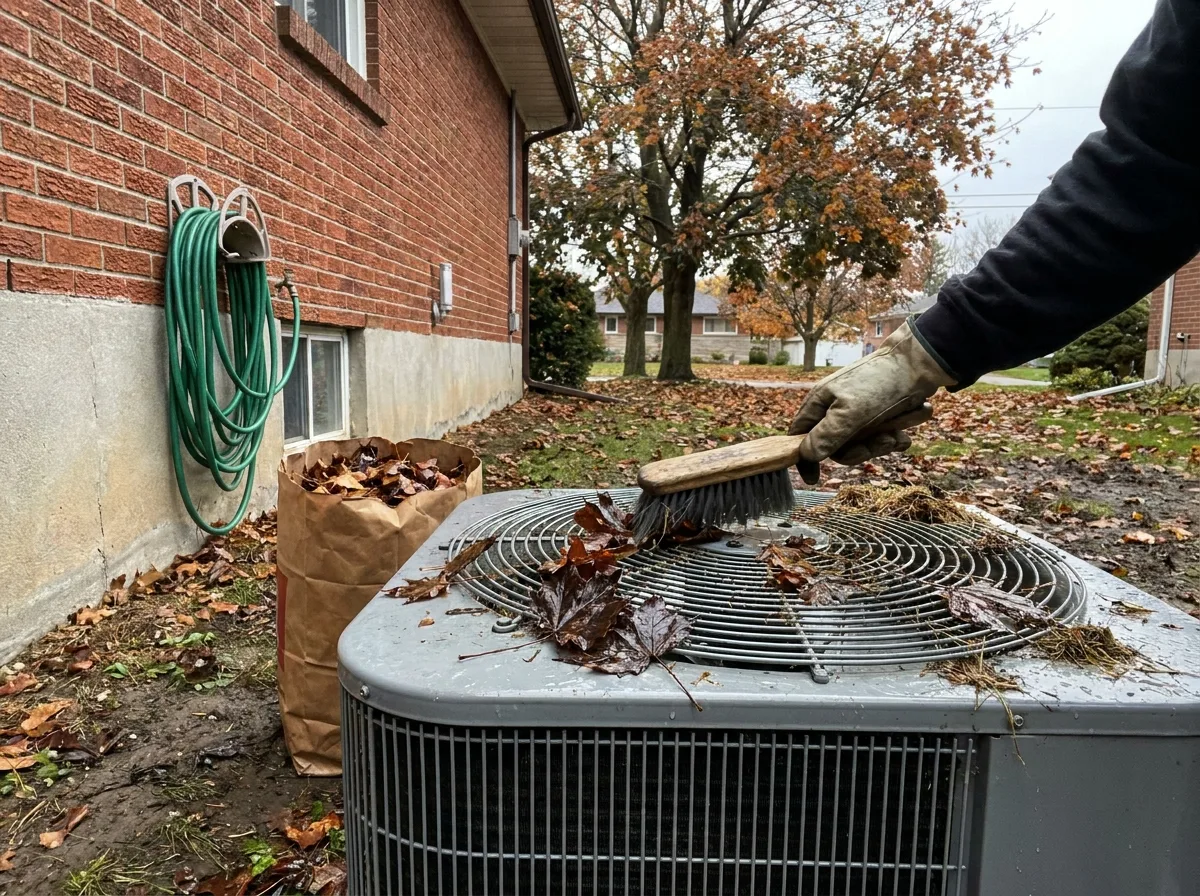
- Clear the outdoor unit. Remove leaves, grass clippings and anything that could get caught in the fan, as Save Energy NB recommends between fall and winter.
- Check vents and registers. NRCan warns that registers blocked by furniture or carpeting can shorten equipment life and reduce efficiency.
- Set the backup heat lower than the heat pump. If you have electric baseboards or duct heaters, NRCan recommends a backup set-point 2°C to 3°C below the heat pump set-point. Example: heat pump at 21°C, backup at 18°C to 19°C.
- Check the fan setting. For heating, NRCan recommends a high or Auto fan speed to get the most heat out of the unit.
- Book the annual service if it was not done in spring. BC Hydro suggests alternating the season from one visit to the next.
Winter: snow, ice and the defrost cycle
In winter, your main job is to keep air flowing through the outdoor unit. According to Save Energy NB, snow build-up around the outdoor unit starves the machine of air, which often leads to the unit freezing up or, worse, a failure of the fan motor.
Light frost is normal, a block of ice is not
When the outdoor temperature is near or below freezing, moisture freezes on the outdoor coil. NRCan explains that the heat pump then runs a defrost cycle: it briefly switches to cooling mode to send hot gas to the outdoor coil, and shuts off the outdoor fan while the frost melts. On timer-based systems the cycle can start every 30, 60 or 90 minutes; demand-defrost systems start it only when needed. Save Energy NB adds that a thin white layer of frost is normal and should melt during the defrost cycle. Thick ice that stays on the coil or fan is the problem to act on.
During defrost, the house may need help from the backup heat: NRCan notes that supplementary heating may be required when the heat pump is defrosting. That is also why NRCan says the backup heat should be set below the heat pump, so it only fills the gap.
After each snowfall
- Check the outdoor unit after every snowfall for drifting or snow piled in front of it (Save Energy NB).
- Clear snow away from the unit when you shovel the driveway; do not let a plow or snowblower throw snow onto it.
- Clear ice and dripping water from above the unit; BC Hydro lists dripping water among the things to clear at the start of each season.
- Never chip at ice on the coil with a shovel or tool: the fins bend easily.
How to clear ice from a heat pump safely
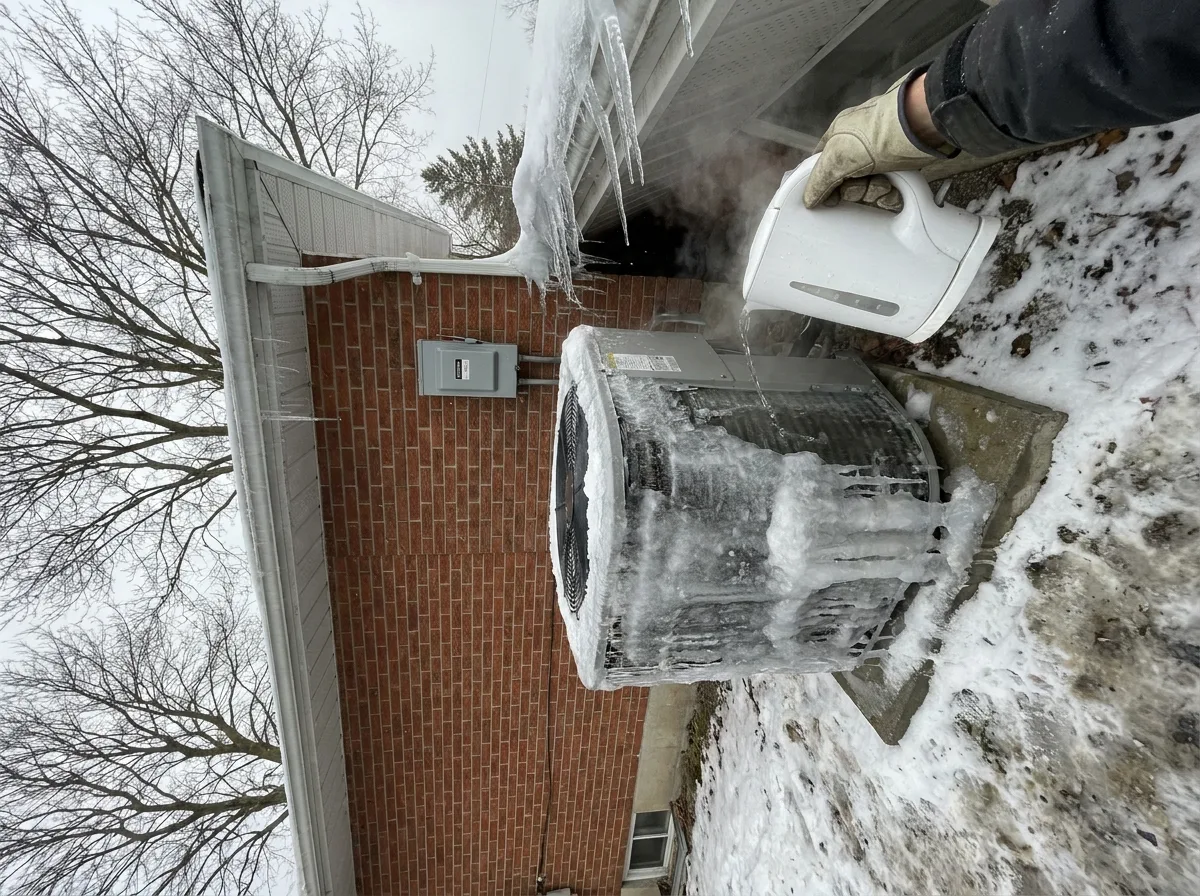
If the outdoor unit is encased in ice, Save Energy NB gives this procedure for ductless units. Follow your manufacturer’s manual first if it says otherwise.
- Turn off the indoor unit with the remote or thermostat.
- Turn off the breakers (or remove the fuses) for the indoor and outdoor units.
- Leave the power off for at least 30 minutes.
- Pour hot water on the ice until it is gone. Do not pick at the ice with a tool, and keep water away from electrical and electronic parts.
- Turn the power back on and wait another 30 minutes before restarting the indoor unit.
- Allow about 10 minutes for the unit to produce heat. If it still blows only cold air in fairly mild weather, call a certified HVAC technician.
RénoClair tip
If ice keeps coming back on the same spot, look up before you call for service. Water dripping from a roof edge or gutter onto the unit can be the cause, and moving the unit or adding a small roof over it is a job for your installer. Our guide to ice dams on roofs explains where that water comes from.
Thermostat setbacks: keep them small
Heat pumps respond more slowly than furnaces. NRCan recommends setbacks of no more than 2°C, or a smart thermostat that starts recovery early. The U.S. Department of Energy goes further: do not set back the heat pump’s thermostat if it causes the backup heating to come on, because electric backup heat costs more to run. Keeping setbacks small is one of the cheapest maintenance habits there is.
Spring and summer: debris, coils and cooling
Spring is clean-up time for the outdoor unit; summer is about airflow while the system cools.
- Clear the yard around the unit. Save Energy NB recommends weeding or mowing the area regularly and rinsing dirt or mud off with a garden hose if needed.
- Rinse the outdoor coil when it looks dirty, with the power to the fan turned off, as the U.S. Department of Energy advises. Use a gentle garden-hose spray, not a pressure washer.
- Keep filters on schedule. BC Hydro reminds owners to clean filters regularly and clear dust from the top of a ductless indoor head in cooling season.
- Use the right fan speed. In cooling, NRCan recommends the low fan speed to improve dehumidification.
- Clean supply and return registers and straighten bent fins, as the DOE recommends.
Ductless, ducted or geothermal: what changes
The basics are the same for every type; the filter location and the outdoor work differ.
| Type | Filter | Outdoor work | Professional service |
|---|---|---|---|
| Ductless mini-split or multi-split | Washable filters behind the indoor unit’s front panel; check monthly at first | Snow, ice and debris around the outdoor unit | Annual (NRCan); 12 to 18 months for ductless (Save Energy NB); deep clean of coil and blower when needed |
| Central (ducted) air-source | Disposable filter in the air handler or furnace cabinet, every 3 months | Same as ductless | Annual, including blower, indoor coil, ducts and airflow |
| Ground-source (geothermal) | Replace or clean every 3 months if the system uses air ducts | No outdoor coil to clear; the heat pump unit is inside the house | Annual (NRCan) |
NRCan gives these service lives: 15 to 20 years for air-source heat pumps, and about 20 to 25 years for ground-source heat pumps, whose ground loop can last close to 75 years. Good maintenance is how you reach the high end of those ranges.
What a technician checks during annual heat pump maintenance
The yearly visit covers what a homeowner cannot safely do: refrigerant, electrical connections and measured airflow. The U.S. Department of Energy lists these tasks for a professional service:
- Inspect ducts, filters, blower and indoor coil for dirt and obstructions.
- Diagnose and seal duct leaks.
- Verify airflow by measurement.
- Verify the refrigerant charge by measurement and check for refrigerant leaks.
- Inspect electrical terminals, clean and tighten connections, and apply a non-conductive coating if needed.
- Lubricate motors and inspect belts for tightness and wear.
- Check that heating and cooling are locked out from each other and that the thermostat works correctly.
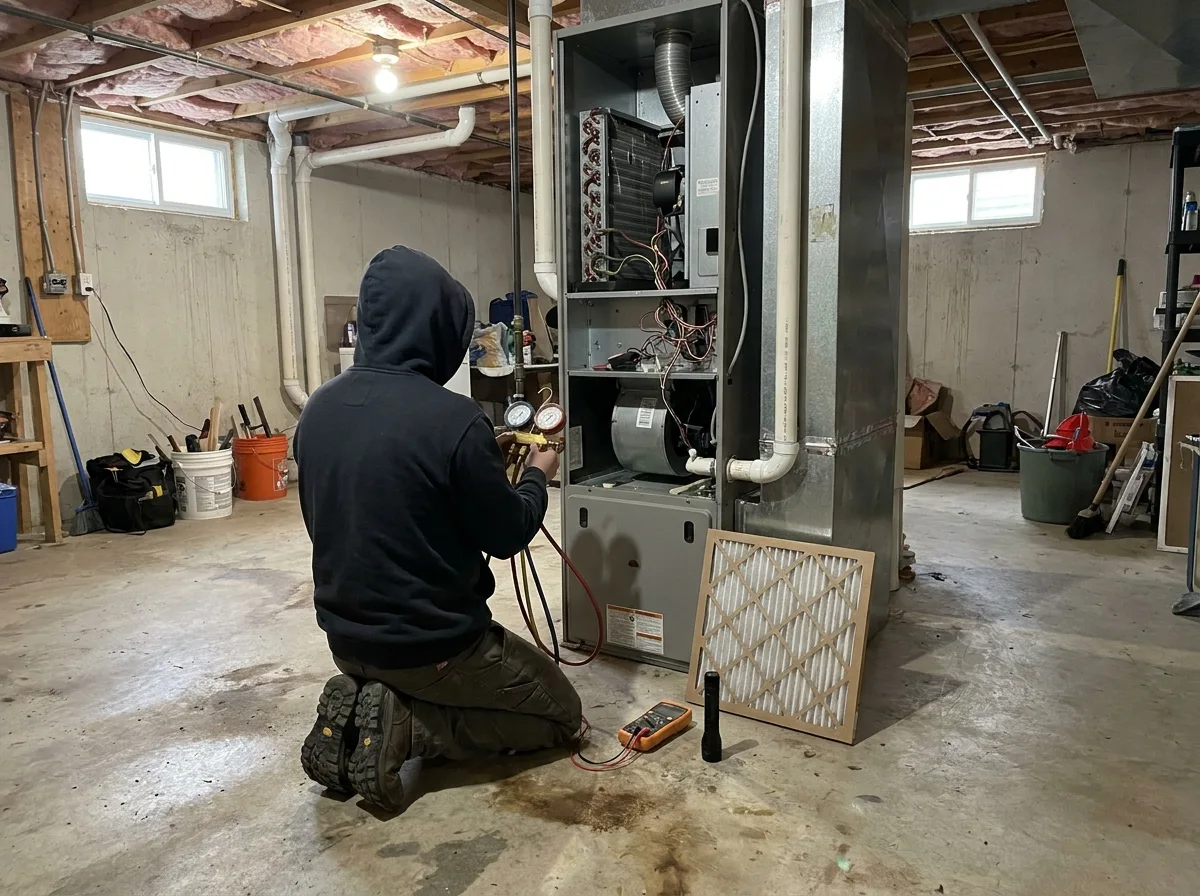
For a ductless unit, Save Energy NB adds a check of connections and wiring and, when needed, a deep cleaning of the indoor blower wheel and coil, where dust builds up even when filters are cleaned. Ask the technician to test the defrost cycle and look at the condensate pan and drain, which NRCan describes as the part that collects moisture from the indoor coil in cooling mode. Ask for a written report and keep it with your warranty papers.
Worked example: what skipping maintenance can cost
A neglected heat pump can use 10% to 25% more energy than a well-maintained one, according to the U.S. Department of Energy. Your own heating and cooling bill decides what that means in dollars. The two yearly amounts below are illustrations, not averages: replace them with the electricity your heat pump actually uses.
| Yearly heat pump electricity cost (example) | Extra cost at 10% | Extra cost at 25% | Over 15 years (low to high) |
|---|---|---|---|
| Home A: $900 | $90 per year | $225 per year | $1,350 to $3,375 |
| Home B: $1,800 | $180 per year | $450 per year | $2,700 to $6,750 |
How to read it: in Home B, a heat pump that costs $1,800 a year to run and is badly neglected could waste $180 to $450 a year, or $2,700 to $6,750 over 15 years, the low end of NRCan’s 15 to 20 year service life for air-source units. The bigger risk is not the energy: Save Energy NB notes that snow-starved units can freeze up or lose their fan motor, and dust on the indoor coil leads to a more expensive deep clean. Compare those amounts with the written quote for a yearly service from two or three local contractors.
Signs your heat pump needs service now
Do not wait for the yearly visit if you notice any of these. The first six are the signs Save Energy NB lists as time to call a contractor for a deep cleaning of a ductless unit:
- Less heat or cooling than before.
- Visible mildew or dust in the indoor unit.
- A fan that is louder than before.
- Water flowing from the indoor unit.
- Small balls of debris coming out of the unit.
- Odours.
- Thick ice that does not melt during defrost cycles.
- Cold air only, in fairly mild weather, after you have cleared ice and restarted the unit (Save Energy NB says to call a certified technician).
Maintenance plans, warranties and door-to-door sellers in Ontario
Read the warranty before you sign any maintenance plan. NRCan says most heat pumps come with a one-year warranty on parts and labour plus a five- to ten-year warranty on the compressor (parts only), and that warranties vary between manufacturers. Ask whether your warranty requires proof of regular service, and keep every invoice.
- Door-to-door sales: under Ontario’s Consumer Protection Act, furnaces, water heaters, air conditioners, air cleaners and duct cleaning services cannot be sold door to door unless you contacted the seller first, according to Community Legal Education Ontario (page dated September 2025). Heat pumps are not named on that list, so treat any unsolicited visit with caution.
- Cooling-off period: for door-to-door contracts over $50, CLEO says you can cancel within 10 days without giving a reason, and the seller then has 15 days to refund you.
- Rebate scams: the Ontario Home Renovation Savings program says its approved organizations will never contact you first, and warns about fake websites that push loans or payment plans. If you got a rebate, see our guide to the heat pump rebate in Ontario.
Common heat pump maintenance mistakes
- Skipping filters because the system “seems fine”: airflow drops slowly before comfort does.
- Chipping ice off the coil with a tool instead of letting defrost (or hot water, power off) do the work.
- Deep night-time setbacks that make the electric backup heat take over.
- Setting the backup heat at or above the heat pump set-point, so the backup runs first.
- Pressure-washing the outdoor coil and bending the fins.
- Blocking indoor vents or the ductless unit with furniture or curtains.
To estimate the installed price before rebates, use our heat pump cost calculator (low, typical and high, with the detailed budget as a PDF).
Frequently asked questions
How often does a heat pump need maintenance?
Once a year by a qualified contractor, according to NRCan, plus filter cleaning or replacement about every 3 months. Save Energy NB accepts a contractor visit every 12 to 18 months for ductless units, and BC Hydro every 1 to 2 years.
Can I do heat pump maintenance myself?
Partly. You can clean or change filters, wipe a ductless indoor unit, keep the outdoor unit clear of snow and debris and rinse a dirty coil with the power off. Refrigerant, electrical connections and airflow measurement are for a qualified technician.
How often should I clean ductless heat pump filters?
Save Energy NB suggests checking them monthly at first; every two or three months is usually adequate once you know how fast they get dirty. NRCan’s general rule is every 3 months.
Is ice on my heat pump normal in winter?
A thin layer of frost is normal and should melt during the defrost cycle. A thick block of ice that stays on the coil or fan is not normal: switch the unit off, clear it safely and call a technician if it comes back.
Should I clear snow from my heat pump?
Yes. Save Energy NB recommends checking the outdoor unit after each snowfall, because snow build-up starves it of air and can lead to freezing or a fan motor failure.
Should I turn my heat pump down at night?
Only a little. NRCan recommends setbacks of no more than 2°C, or a smart thermostat that starts recovery early, so the electric backup heat does not take over.
Does a geothermal heat pump need maintenance?
Yes. NRCan recommends annual maintenance by a qualified contractor and, for systems with air ducts, replacing or cleaning the filter every 3 months. There is no outdoor coil to clear.
Buying a ductless system? The mini split heat pump cost in Canada guide covers what is included in the price and what a quote should list.
The bottom line
Good heat pump maintenance is mostly simple habits: a clean filter every 3 months, an outdoor unit kept clear of snow, ice and debris, small thermostat setbacks, backup heat set 2°C to 3°C below the heat pump, and one professional visit a year. Learn what normal frost looks like, clear ice only with the power off, and keep your service invoices with the warranty. For readers in Quebec, our winter heat pump checklist (in French) covers the same topic for Quebec homes.
Sources
- Natural Resources Canada, Heating and cooling with a heat pump (modified December 24, 2025; read November 1, 2026): annual maintenance, filters every 3 months, set-points, setbacks, defrost cycle, service life, warranties, ground-source maintenance.
- Save Energy NB, Maintaining your heat pump (no date shown; read November 1, 2026): monthly, seasonal and annual tasks for ductless units, snow, ice procedure, warning signs.
- BC Hydro, Tips to maintain your heat pump (PDF, no date shown; read November 1, 2026): service every 1 to 2 years, seasonal outdoor checks.
- U.S. Department of Energy, Operating and maintaining your heat pump (no date shown; read November 1, 2026): technician checklist, 10% to 25% energy difference, coil cleaning.
- Community Legal Education Ontario, Door-to-door sales (September 2025; read November 1, 2026).
- Home Renovation Savings, Protect yourself from rebate scams (no date shown; read November 1, 2026).