Official sources checked on October 27, 2026.
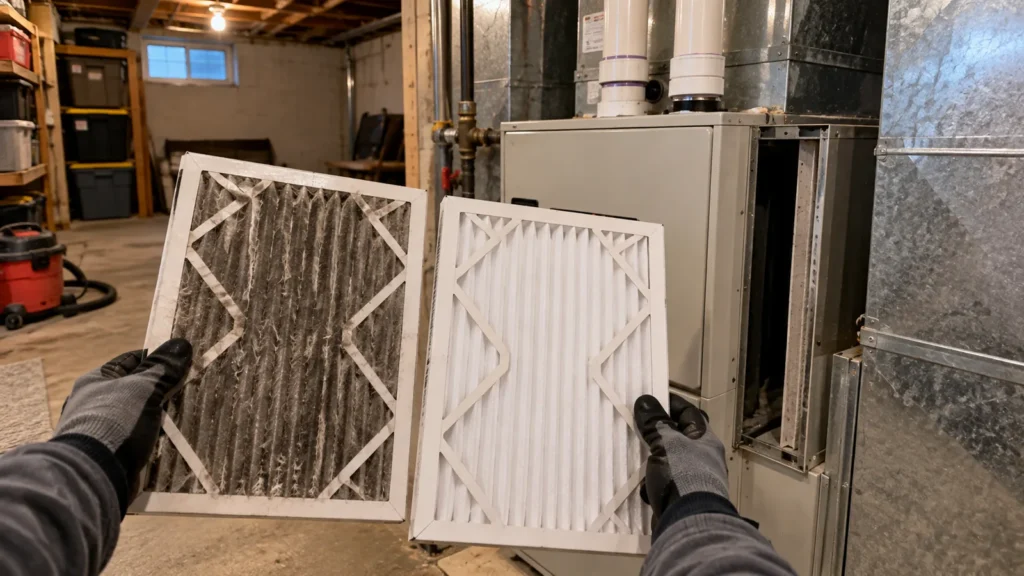
How often to change furnace filter? For a standard 1-inch pleated filter, plan on every 1 to 3 months: Natural Resources Canada says to change or clean the filter every 3 months, the U.S. EPA notes that manufacturers typically recommend every 60 to 90 days, and CMHC advises checking it every month during the heating season. Thick 4- or 5-inch media filters last longer (usually labelled “up to 12 months”), and for most Canadian homes the right buy is the highest MERV, typically between MERV 8 and MERV 13, that your furnace fan and filter slot can handle.
If your furnace is near the end of its life, compare the cost of a replacement heat pump with our heat pump cost calculator (currently based on Québec prices).
This guide covers the official intervals, what changes them (heat pumps, pets, renovation dust, wildfire smoke), how to read a MERV rating, when a high-MERV filter can cause airflow problems, and a worked example of how many filters two typical Ontario homes go through in a year.
In this guide
How often to change furnace filter: the quick answer
The interval depends mostly on the filter’s thickness and on how many hours your blower runs. The table sums up what official agencies and product labels say. When two sources differ, follow the shorter interval until you know how fast your own filter gets dirty.
| Filter or system | Check | Replace or clean | Where the rule comes from |
|---|---|---|---|
| 1-inch fibreglass or pleated furnace filter | Every month during the heating season | Every 1 to 3 months, sooner if visibly dirty | CMHC maintenance schedule; NRCan; EPA (60 to 90 days) |
| 1-inch pleated filter, store packaging | Every month | “Up to 90 days” on the label | Packaging of filters sold by major Canadian retailers, October 2026 |
| 4- to 5-inch media filter (deep cabinet) | Every 3 months | Labelled “up to 12 months”; replace earlier if loaded | Packaging of filters sold by major Canadian retailers, October 2026 |
| Washable or permanent filter | Every month in heating season | Clean as the manufacturer specifies | CMHC (“clean or replace”) |
| Air-source heat pump air handler | Every 3 months | Change or clean every 3 months | NRCan heat pump guide |
| Heat recovery ventilator (HRV) filters | Every 2 months | Clean or replace as needed | CMHC maintenance schedule |
| During or after wildfire smoke | More often | Change regularly; replace after the event | Government of Canada wildfire smoke guidance |
RénoClair tip
Write the install date on the edge of the new filter with a marker, and set a phone reminder 30 days out. A monthly look takes 30 seconds and tells you more about your home than any generic schedule.
What official Canadian guidance says about furnace filters
There is no law or code that sets a single replacement date for a residential furnace filter. Instead, federal agencies publish maintenance advice, and they all point in the same direction: look often, replace when dirty, and never go a whole season without checking.
Natural Resources Canada: every 3 months for heat pumps
NRCan’s guide Heating and Cooling With a Heat Pump (page modified December 24, 2025) tells owners of air-source heat pumps to “change or clean your air filter every 3 months, as clogged filters will decrease airflow and reduce the efficiency of your system.” It gives the same 3-month interval for ground-source systems that use ducts. Because a heat pump moves air for heating in winter and cooling in summer, its filter works almost year-round, unlike a furnace that sits idle from May to September.
Heat pumps have their own routine beyond the filter, from clearing snow off the outdoor unit to the yearly service visit. See our heat pump maintenance guide for a season-by-season checklist.
CMHC: check monthly during the heating season
CMHC’s Home Maintenance Schedule (About Your House, revised 2010) repeats the same line in its fall, winter and spring checklists: “Check and clean or replace furnace air filters each month during the heating season.” It also says HRV filters should be checked every two months, and that a gas furnace should be serviced by a qualified company every two years (every year for an oil furnace), or as the manufacturer recommends. NRCan’s ENERGY STAR home maintenance page (modified March 19, 2025) likewise says natural gas and propane furnaces should be serviced at least every two years and asks owners to keep return air grilles clear of furniture.
EPA: 60 to 90 days is the usual label, not a rule
The U.S. Environmental Protection Agency’s Guide to Air Cleaners in the Home (updated October 1, 2026) is the clearest source on intervals. It says to replace filters according to the manufacturer, notes that “many factors can affect how quickly filters get dirty,” and that manufacturers “typically recommend replacement every 60 to 90 days.” If a filter looks heavily soiled when you pull it, the EPA says you should consider changing it more often.
When to change your furnace filter more often
The 1-to-3-month range is a starting point. These situations load a filter faster, so check it every few weeks while they last:
- Renovation dust. Drywall sanding, flooring removal or demolition can clog a 1-inch filter in days. Cover return grilles in the work area and check the filter weekly until the dust is gone.
- Wildfire smoke. The Government of Canada’s wildfire smoke guidance (modified July 20, 2026) recommends “using the highest quality air filter that your ventilation system can handle based on the manufacturer’s recommendations,” changing filters regularly during smoke events, and cleaning or replacing them afterwards. It warns that clogged filters are not effective against smoke and “may cause the fan to overheat and lead to fires.”
- Pets that shed and busy households. More hair, dander and foot traffic means more particles reaching the return ducts.
- A fan that runs continuously. More air through the filter means it captures more, and fills faster.
- A heat pump or central air conditioner. The filter keeps working through the cooling season, so count summer months too.
- A new home or recent duct work. Construction debris often keeps showing up on the first few filters.
Why blower run time matters more than the calendar
A furnace filter only cleans air while the blower is moving it. The EPA points out that “furnace and HVAC filters work to filter the air only when the system is operating,” and that in most cases HVAC systems run only when heating or cooling is needed, usually less than 25% of the time during those seasons. That is why the same filter can last three months in a mild October and feel overloaded after a cold January: the calendar did not change, the run time did.
Which MERV furnace filter to buy
MERV (Minimum Efficiency Reporting Value) comes from ASHRAE Standard 52.2. According to the EPA’s MERV explainer (updated January 14, 2026), it reports a filter’s ability to capture particles between 0.3 and 10 microns, and the higher the MERV, the better the filter traps those particle sizes. The table below shows the minimum capture rates for common residential ratings, taken from the January 2026 user guide published by the National Air Filtration Association.
| MERV | 0.3–1.0 µm (smoke, fine particles) | 1.0–3.0 µm | 3.0–10.0 µm (dust, pollen) | Typical use |
|---|---|---|---|---|
| MERV 1–4 | Not rated | Not rated | Under 20% | Basic fibreglass, equipment protection |
| MERV 8 | Not rated | At least 20% | At least 70% | Standard pleated residential filter |
| MERV 11 | At least 20% | At least 65% | At least 85% | Better residential filtration |
| MERV 13 | At least 50% | At least 85% | At least 90% | EPA’s suggested minimum when upgrading; smoke |
| MERV 16 | At least 95% | At least 95% | At least 95% | Hospital-grade; rarely fits a home furnace |
MERV 8 vs MERV 11 vs MERV 13
- MERV 8 protects the blower and coil from dust and catches most pollen-size particles. It is the default choice for an older furnace or a tight 1-inch slot.
- MERV 11 adds real capture of the finest range (at least 20%) and is a common upgrade for homes with pets or allergies.
- MERV 13 is what the EPA recommends if you upgrade: “choose a filter with at least a MERV 13 rating, or as high a rating as your system fan and filter slot can accommodate.” It is also the best match for wildfire-smoke season.
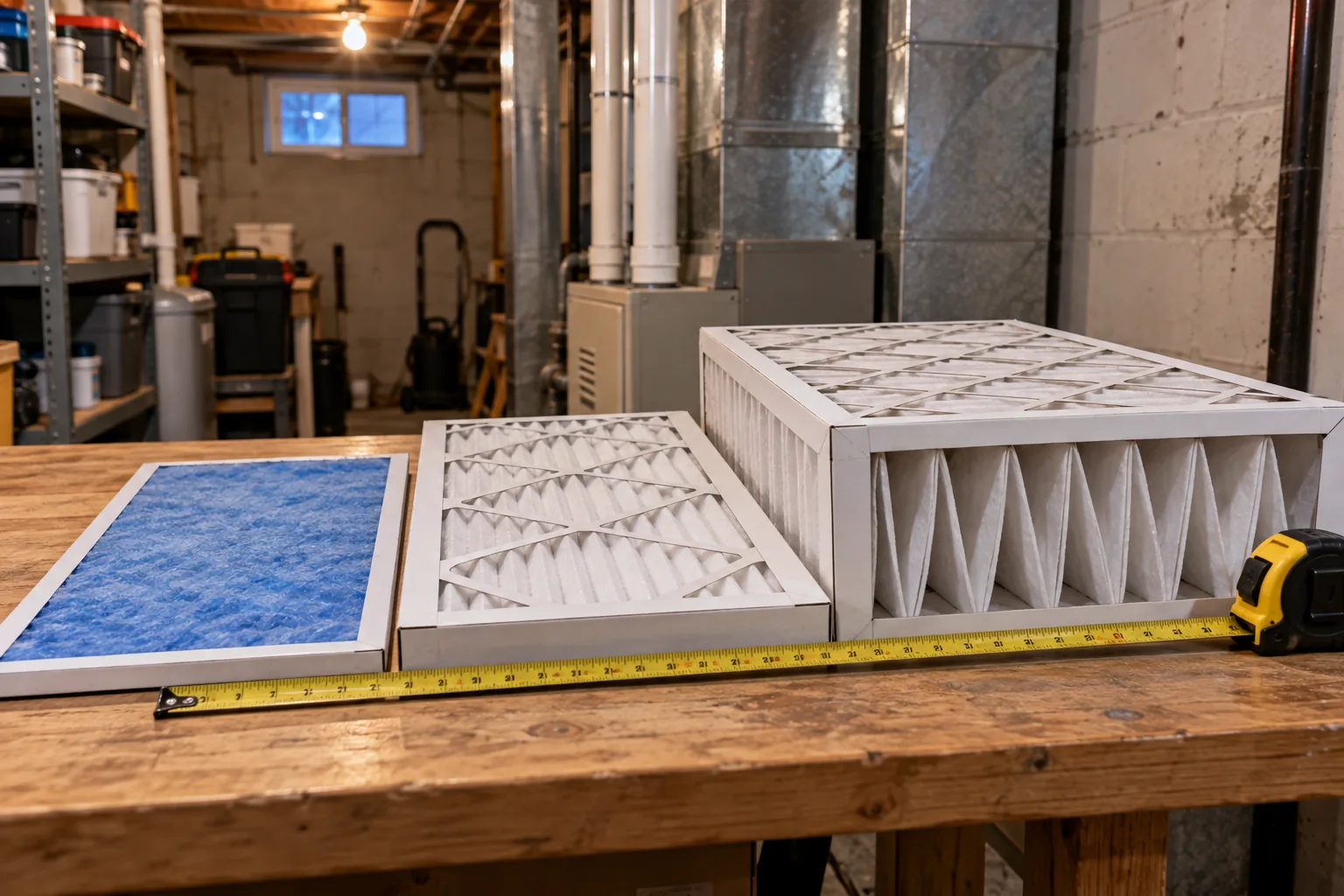
Some store brands print their own scale (such as MPR or FPR) in large type. Those scales are not MERV. Look for the MERV number on the package before comparing products.
1-inch filter or a 4- to 5-inch media cabinet?
The EPA notes that furnace filters commonly come in thicknesses of 1 to 5 inches. Thick media filters sold in Canada are typically labelled to last up to 12 months, against up to 90 days for 1-inch pleated filters. If your furnace has only a 1-inch slot, a deeper media cabinet has to be installed by a heating contractor; ask about it at your next service visit, especially if you plan to keep the furnace for years. If you are weighing a replacement instead, see our guide to furnace replacement cost in Ontario.
Can a high-MERV filter hurt your furnace?
It can if it does not suit your system. A denser filter, or one left in too long, restricts airflow, and NRCan’s heat pump guide says plainly that clogged filters decrease airflow and reduce efficiency. The EPA’s position is balanced: “most furnaces and HVAC systems can accommodate a MERV 13 filter without creating equipment problems, provided that the filter is replaced frequently,” but you may need an HVAC technician to confirm the highest-efficiency filter your system can use, and a technician can also modify the system to accept one.
In practice, the risk is less about the MERV number and more about a high-MERV filter that is not changed on time. Signs that airflow is too restricted:
- weak airflow at the registers far from the furnace;
- the filter bowing or being pulled into the blower side;
- a whistling sound around the filter slot;
- rooms that take much longer to reach the set temperature;
- a furnace that shuts off and restarts in short cycles.
If you notice any of these after switching to a denser filter, go back to the previous rating and ask your technician at the next service.
Worked example: how many filters two Ontario homes use in a year
These two cases apply the official intervals above to typical situations. They count filters, not dollars, because filter prices vary widely by size and brand.
Home A: gas furnace, central air, 1-inch MERV 8 filter
- Heating season assumed from October to April (7 months), central air in July and August.
- CMHC rule: check every month during the heating season, so 7 checks, plus 2 checks during air-conditioning months.
- Label and EPA rule: replace about every 90 days if the filter is not heavily soiled.
- Result: about 4 filters a year (October, January, April, July). If the January check shows a grey, loaded filter, add one change in late February: 5 filters.
Home B: cold-climate heat pump with gas backup, 4-inch MERV 11 media filter, two cats
- The air handler runs for heating and cooling, so the filter works about 12 months a year.
- NRCan rule for heat pumps: change or clean every 3 months, so 4 checks a year.
- Label: up to 12 months for this media filter, but pet hair loads it faster.
- Result: 4 checks and usually 2 media filters a year, one in October before heating season and one in April before cooling season.
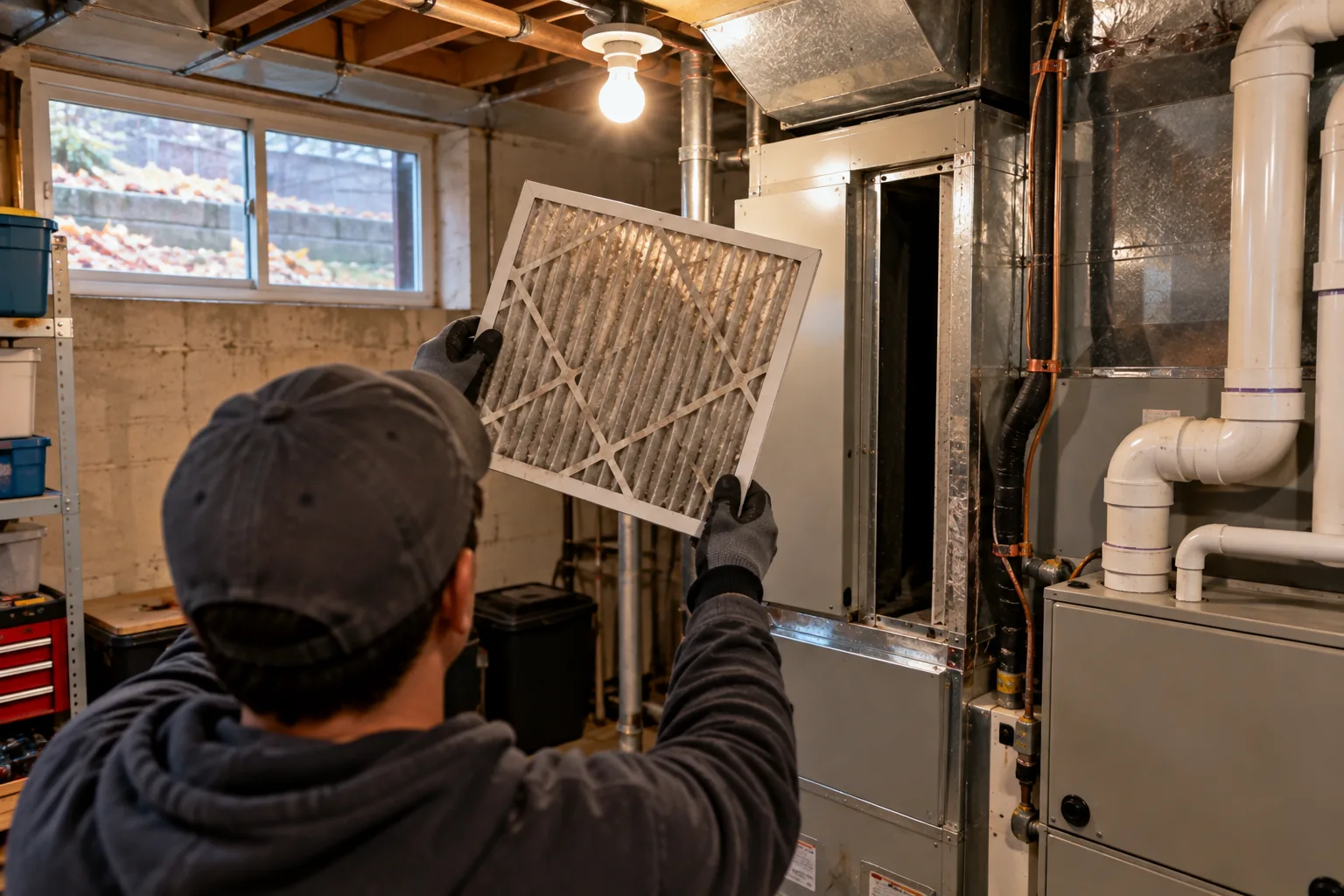
The lesson from both cases: the label gives you the maximum, the monthly check gives you the real number. If you are deciding between equipment types, our comparison of heat pump vs furnace covers running costs, and the heat pump cost guide for Ontario covers installed prices.
How to change a furnace filter in 6 steps
- Set the thermostat to off (or turn off the furnace switch) so the blower does not start while the slot is open.
- Find the filter: usually in a slot between the return duct and the blower, or behind the lower front panel.
- Read the size printed on the old filter’s frame (for example 16 x 25 x 1). The nominal size is slightly larger than the actual size; buy the same nominal size.
- Note the airflow arrow on the frame. It must point in the direction the air moves: away from the return duct and toward the blower.
- Slide the new filter in. The EPA says it should fit snugly so air does not leak around it, without being bent or crushed.
- Write the date on the frame, close the panel, and turn the system back on.
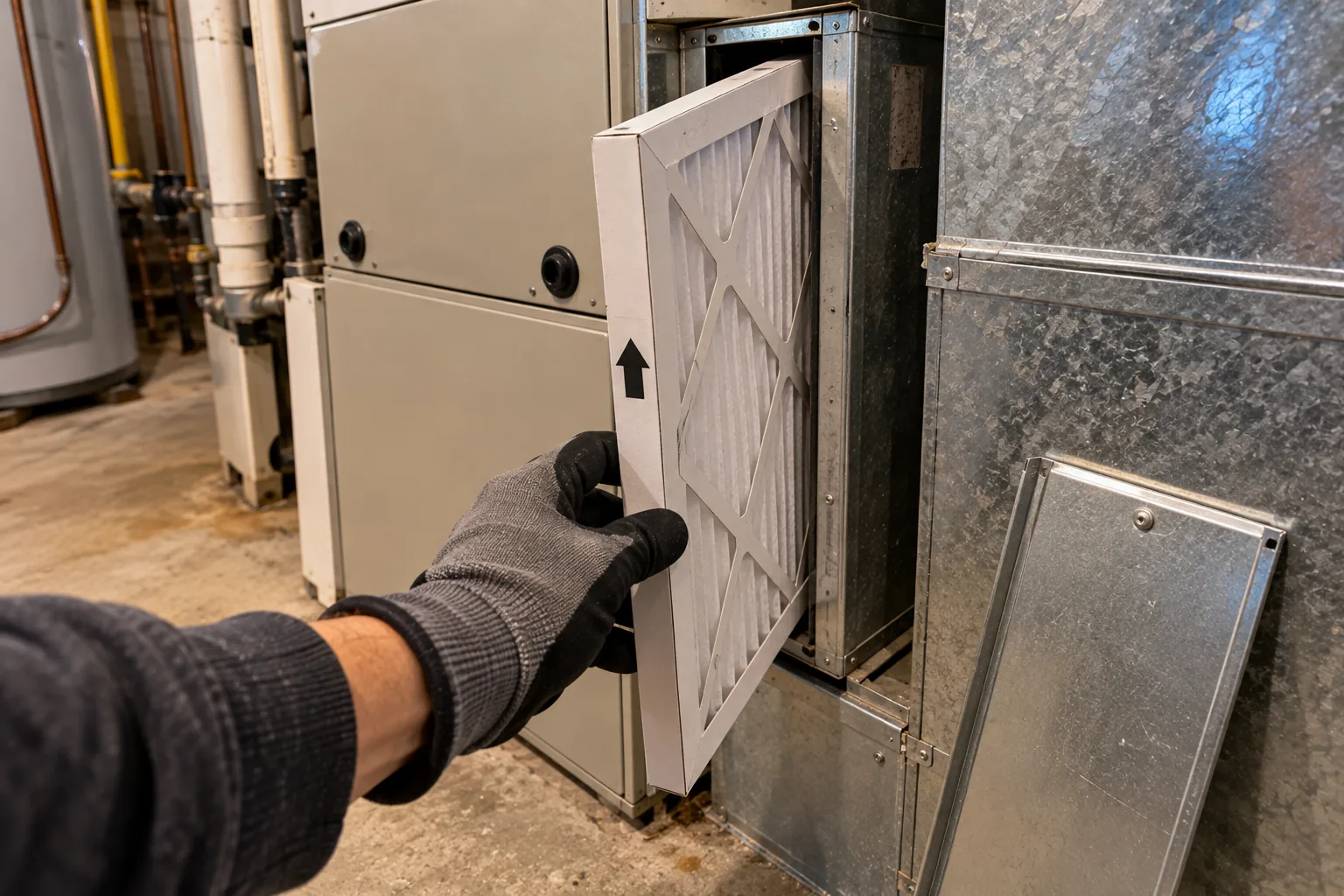
For a washable filter, follow the manufacturer’s cleaning instructions and let it dry completely before you put it back.
Common mistakes with furnace filters
- Following the label only. “Up to 90 days” is a maximum under normal use, not a promise.
- Forgetting the summer. With central air or a heat pump, the filter keeps working after the heating season ends.
- Jumping to MERV 13 or higher and then forgetting it. A dense filter left in too long is the worst combination for airflow.
- Leaving gaps. A filter that is too small lets dust bypass it, whatever its MERV.
- Blocking return grilles. NRCan asks owners to keep return air grilles and vents clear of furniture.
- Skipping professional service. Changing the filter does not replace the service visit CMHC and NRCan recommend for gas furnaces every two years.
- Ignoring the HRV. Its filters have their own schedule: CMHC says to check them every two months.
Ventilation affects humidity as well: if your windows fog every morning, check the limits in our guide to condensation on windows in winter.
A well-maintained furnace is also a safer one: Ontario advises a yearly professional inspection of fuel-burning appliances before cold weather, and requires carbon monoxide alarms in homes that have one. See the carbon monoxide detector law in Ontario.
Frequently asked questions
How often to change furnace filter in winter?
Check it every month during the heating season, as CMHC recommends, and replace a 1-inch filter every 1 to 3 months depending on how dirty it looks. Cold spells make the blower run longer, so January and February filters often fill fastest.
Is it OK to change a furnace filter every 6 months?
Only for a thick 4- or 5-inch media filter that still looks clean at its 3-month check. A 1-inch filter is typically labelled for up to 90 days, and NRCan says to change or clean heat pump filters every 3 months.
What MERV rating should I use for my furnace?
For most homes, MERV 8 to MERV 11 is a safe baseline. If you upgrade, the EPA recommends at least MERV 13 or as high as your system fan and filter slot can accommodate, so ask your technician if you are unsure.
Is MERV 13 too high for a residential furnace?
Not for most systems. The EPA says most furnaces can accommodate a MERV 13 filter without equipment problems, provided the filter is replaced frequently. Older furnaces or tight 1-inch slots may need a technician’s check first.
What happens if you don’t change your furnace filter?
A clogged filter reduces airflow and efficiency, according to NRCan. The Government of Canada also warns that clogged filters may cause the fan to overheat and lead to fires, and they stop removing smoke and fine particles.
How often should I change the filter on a heat pump?
Every 3 months, according to Natural Resources Canada, and sooner if it looks dirty. Because a heat pump heats and cools, its filter works almost all year.
Which way does the arrow go on a furnace filter?
The arrow points in the direction of airflow: away from the return duct and toward the blower and furnace. A filter installed backwards fits, but filters less effectively.
Do I need a professional to change a furnace filter?
No. Changing a standard filter is a homeowner task that takes a few minutes. You do need a qualified company for the furnace service itself, which CMHC recommends every two years for a gas furnace and every year for an oil furnace.
Furnace filters are one job on a longer cold-season list. Our winter home maintenance checklist for Ontario puts them next to the pipe, gas meter, alarm and emergency-kit tasks that belong with them.
The bottom line
Check your furnace filter every month in the heating season, replace a 1-inch filter every 1 to 3 months and a heat pump filter at least every 3 months, and let a thick media filter go longer only if it still looks clean. Buy the highest MERV your system handles comfortably, usually MERV 8 to MERV 13, and change it on time. The monthly 30-second check is what keeps airflow, efficiency and indoor air in good shape.
Sources
- Natural Resources Canada, Heating and Cooling With a Heat Pump (modified December 24, 2025; checked October 27, 2026)
- Natural Resources Canada, ENERGY STAR new homes: maintenance (modified March 19, 2025; checked October 27, 2026)
- CMHC, About Your House: Home Maintenance Schedule (revised 2010; checked October 27, 2026)
- Government of Canada, Wildfire smoke: protecting your physical and mental health (modified July 20, 2026; checked October 27, 2026)
- U.S. EPA, What is a MERV rating? (updated January 14, 2026; checked October 27, 2026)
- U.S. EPA, Guide to Air Cleaners in the Home (updated October 1, 2026; checked October 27, 2026)
- National Air Filtration Association, Understanding MERV (ANSI/ASHRAE 52.2) (January 2026; checked October 27, 2026)
- Filter packaging (“up to 90 days” for 1-inch pleated, “up to 12 months” for 4-inch media): products listed by three major Canadian retailers, October 2026.