Official sources checked on November 22, 2026.
The ground source heat pump cost in Ontario usually falls between $20,000 and $45,000 before HST for a whole-home retrofit, and drilled vertical loops on small lots sit at the top of that range or above it. The Home Renovation Savings program pays $2,000 per ton of closed-loop heating capacity, up to $12,000, in homes heated with electricity, oil, propane or wood, or a flat $3,000 in homes heated with Enbridge natural gas, and only if the project is pre-approved before work starts. A vertical closed loop that goes deeper than 5 metres also needs an Environmental Compliance Approval from the province.
Want a baseline to compare against? Our heat pump cost calculator prices air-source systems for Ontario, British Columbia and Alberta (it does not price ground loops), which shows how much of a geothermal quote is the loop itself.
In this guide
Ground source heat pump cost at a glance
| Item | Ontario figure (2026) | Source |
|---|---|---|
| Typical installed cost, whole-home retrofit | $20,000 to $45,000 before HST | Ontario contractor price pages and cost guides, October–November 2026 |
| City of Toronto reference | Up to $30,000 for a 3.5 to 4 ton retrofit in a Toronto neighbourhood | City of Toronto heat pump page, modified March 6, 2026 |
| Rebate, home heated with electricity, oil, propane or wood | $2,000 per ton of closed-loop heating capacity, up to $12,000 | Home Renovation Savings, checked November 22, 2026 |
| Rebate, Enbridge gas-heated home or rented equipment | $3,000 flat | Home Renovation Savings |
| HST | 13% | Ontario |
| Provincial approval | Environmental Compliance Approval for vertical closed loops deeper than 5 m (application fee $1,400) | Ontario.ca |
| Electrical service | 200 A normally required | Natural Resources Canada |
| Lifespan | Heat pump about 20 to 25 years; ground loop approaching 75 years | Natural Resources Canada |
| Closed-loop efficiency | Heating COP 3.2 to 4.2 for products on the market; around 3 in the coldest months | Natural Resources Canada |
What a ground source heat pump costs in Ontario, by loop type
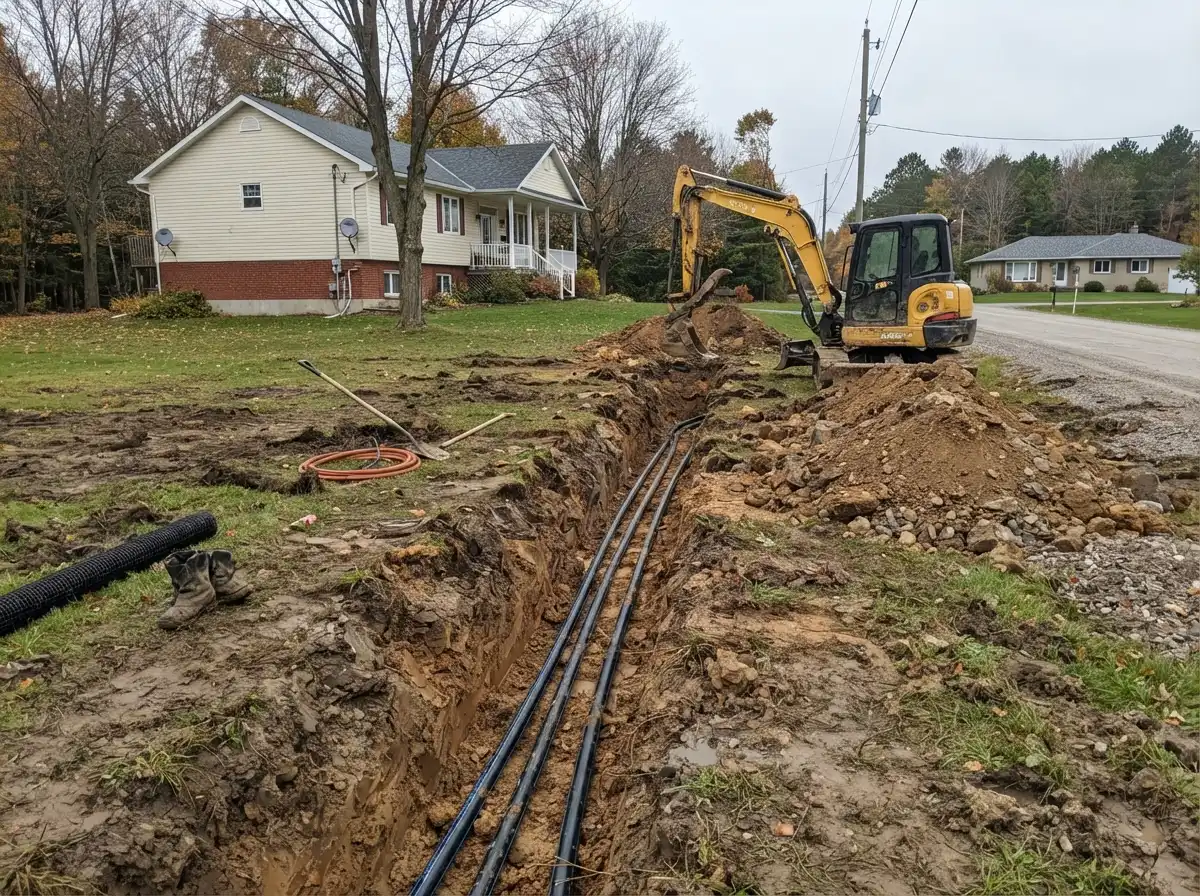
The price of a geothermal system is two projects in one: the heat pump inside the house and the ground loop outside it. The loop is what makes geothermal cost two to four times more than an air-source system, and the loop type is decided by your lot, not by preference.
| Loop type | How it is built (NRCan) | Where it fits | Price position |
|---|---|---|---|
| Horizontal closed loop | Pipe in trenches 1.0 to 1.8 m deep; about 120 to 180 m of pipe per ton | Rural and larger lots with room to dig | Usually the lower part of the range |
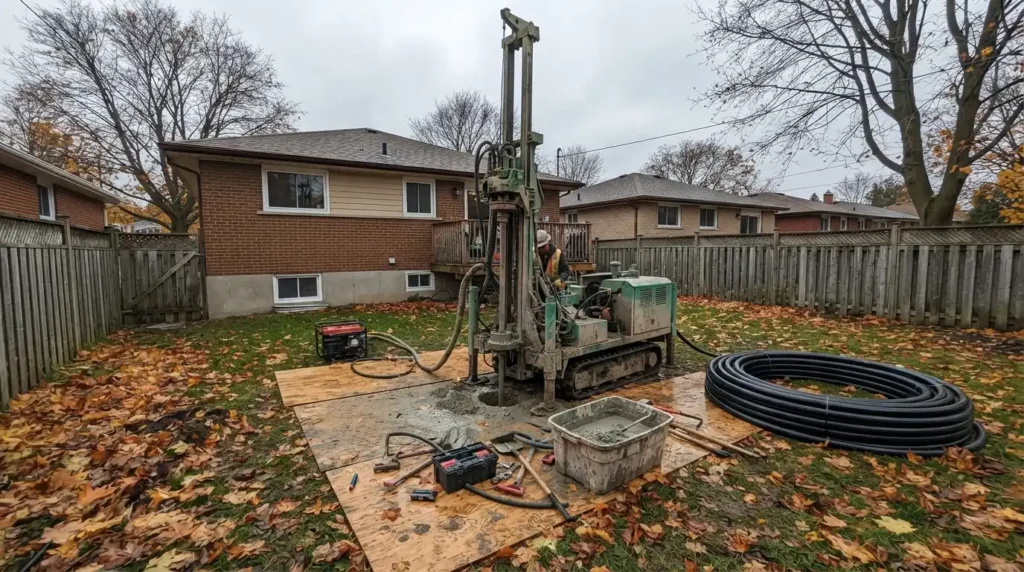
| Vertical closed loop | Boreholes about 150 mm wide, 45 to 150 m deep | Suburban lots where space is limited | The top of the range; drilling is the biggest single cost |
| Open loop (well water) | Water drawn from a well to the heat pump; a 10 kW unit uses 0.45 to 0.75 L/s while running | Homes with a strong, clean aquifer | Lower loop cost, but well, discharge and water-taking rules apply |
| Direct expansion (DX) | Refrigerant circulates in copper loops in the ground | Rare in retrofits | Not eligible for Home Renovation Savings |
Published Ontario prices line up with that order. The figures below come from Ontario HVAC contractor price pages read for our heat pump cost in Ontario guide in October 2026, a 2026 Ontario builder’s cost guide and a dealer’s 2024 price sheet, all read in November 2026. Contractor and retailer names stay out of this guide on purpose.
- Typical whole-home retrofit: $20,000 to $45,000 before HST. This is the range most Ontario contractor pages publish, and the one we use across RénoClair.
- Split between unit and loop: one Ottawa-area contractor splits a typical job into $10,000 to $20,000 for the unit and $10,000 to $20,000 for the installation and loop.
- Drilled vertical loops: a 2026 Ontario cost guide puts horizontal systems at $25,000 to $40,000 and drilled vertical systems at $35,000 to $55,000, so a vertical job on a tight lot can land above our typical range.
- Per-ton add-on for vertical drilling: one Ontario dealer’s 2024 price sheet listed 3 to 4 ton closed-loop packages at $29,314 to $46,485 before HST, and added about $3,000 per ton for a vertical loop.
The City of Toronto’s heat pump page (modified March 6, 2026) gives its own reference: up to $30,000 for a single-home retrofit in a Toronto neighbourhood, assuming a 3.5 to 4 ton system. The city also warns that, given space constraints, ground-source systems may not suit most Toronto homeowners, and lists them as best for new construction and larger detached homes.
What pushes a geothermal quote up or down
- Capacity in tons. More tons mean more loop: more trench, or more and deeper boreholes.
- Soil and rock. Drilling through bedrock or unstable overburden takes longer; sand and clay change the loop length the designer needs.
- Access. A drill rig needs room to reach the yard; fences, decks and landscaping add restoration costs.
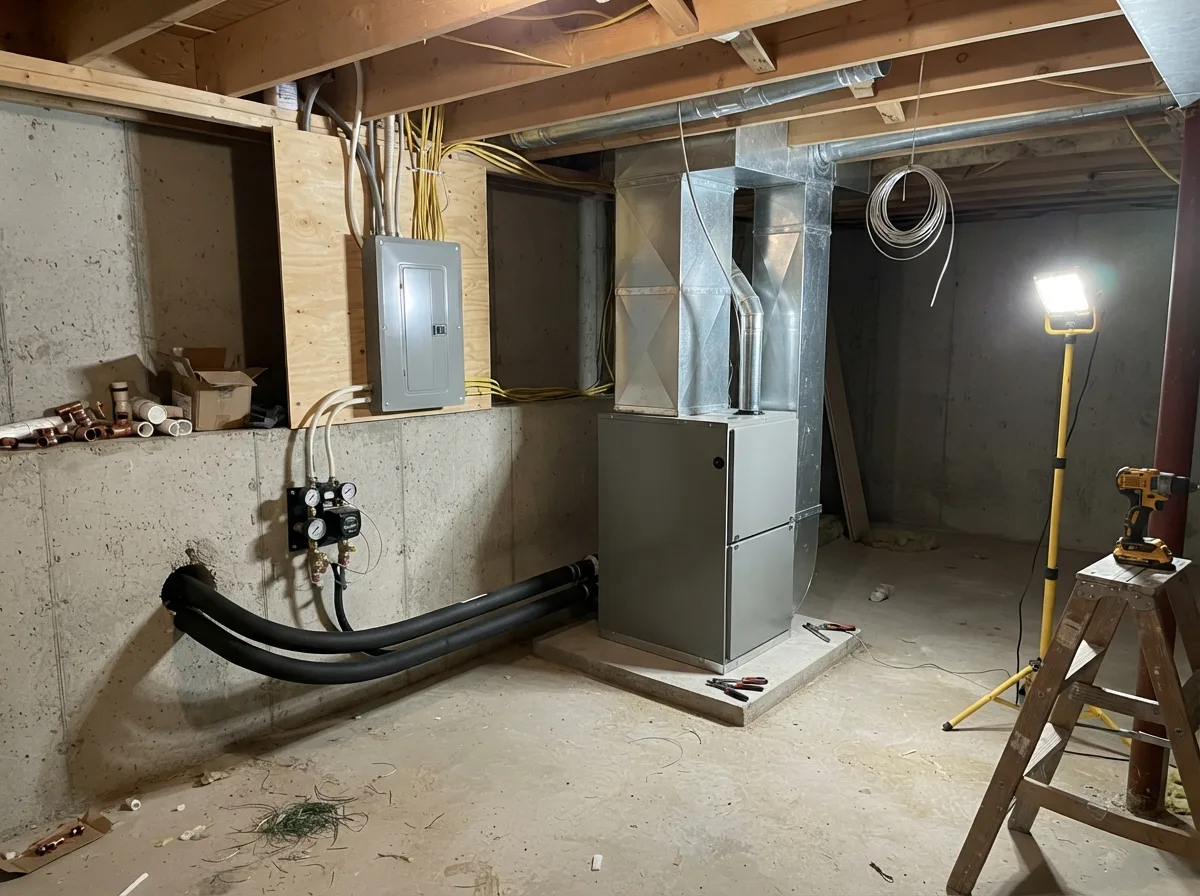
- Ductwork. A water-to-air unit needs ducts. Homes with electric baseboards or a boiler may need a new duct network or a water-to-water system with radiant or hydronic distribution.
- Electrical service. Natural Resources Canada says a 200 ampere service is normally required. In Ontario, our electrical panel upgrade cost calculator puts a 100 A to 200 A service upgrade at $2,500 to $5,000.
- Approvals. A vertical loop deeper than 5 m needs an Environmental Compliance Approval with a professional work plan, which adds fees and weeks to the schedule (see below).
- Desuperheater or hot-water add-ons. Optional; ask for them as separate lines.
RénoClair tip
Ask every contractor for the heat pump’s closed-loop heating capacity in tons on the quote, along with the model number. The Ontario rebate is calculated on that figure, unrounded, so a 3.6-ton unit and a “4-ton” unit do not get the same cheque.
Ground source heat pump rebates in Ontario
Ontario’s main incentive is Home Renovation Savings, run by Save on Energy and Enbridge Gas. The amounts below were checked on the program’s heat pump page on November 22, 2026 (the page shows no update date and lists no end date for the heat pump stream).
| Your main heating before the project | Ground source heat pump rebate | Cold-climate air-source rebate (for comparison) |
|---|---|---|
| Electricity, oil, propane or wood (home on the Ontario grid) | $2,000 per ton, up to $12,000 | $1,250 per ton, up to $7,500 |
| Natural gas, as an Enbridge Gas customer | $3,000 flat | $500 per ton, up to $2,000 |
| Rented heat pump (any eligible fuel) | $3,000 flat | $500 per ton, up to $2,000 |
- Closed-loop capacity. The program says incentives for ground source systems “are calculated based on closed loop capacity,” and tonnage is not rounded.
- Pre-approval is mandatory. In the program’s words: “Installations done before approval are not eligible for rebates.”
- Participating contractor. The contractor must be registered and listed before the installation.
- First heat pump only. Heat pump replacements are not eligible, and a home that already has a heat pump for space heating does not qualify.
- Listed equipment. Water-to-air units must be on Natural Resources Canada’s qualified products list; water-to-water units must be on the ENERGY STAR geothermal heat pump list and available in Canada.
- Payment. A cheque arrives by mail within 60 days of the post-installation application being approved.
- Owners only. Tenants cannot apply.
The program’s Heat Pump Program Stream Requirements (May 2025 version, last read by RénoClair on October 11, 2026) add two ground-source rules worth checking with your contractor: the installer must hold IGSHPA certification, and direct expansion (DX) ground systems are excluded. Our heat pump rebate Ontario guide covers the full eligibility list, and the heat pump rebate calculator gives your amount from your tonnage and current fuel.
Federal rebate and Toronto financing
The federal government’s campaign page (modified November 20, 2026) says the new national heat pump rebate is expected to launch in early 2027, with $2,000 for households above median income and up to $10,000 below it, for eligible installations from November 1, 2026. The page does not say whether ground source systems are on the eligible product list, and it states that program parameters are still being finalized. Do not count on it for a geothermal budget until the product list is published; our federal heat pump rebate guide tracks it.
In Toronto, the City’s Home Energy Loan Program lets homeowners borrow up to $125,000 for energy improvements including heat pumps, repaid through the property tax bill, according to the same City page.
Ontario rules for drilling a geothermal loop
Ontario regulates ground loops under the Environmental Protection Act (O. Reg. 98/12, Ground Source Heat Pumps). The province’s page on installing vertical closed loop ground source heat pumps sets out what the installer must do; the work and the paperwork are normally handled by the contractor, but the cost and the delay end up in your quote.
| Situation | What Ontario requires |
|---|---|
| Vertical closed loop deeper than 5 m | Environmental Compliance Approval (ECA) before drilling, with a work plan prepared by a professional geoscientist or licensed engineering practitioner; application fee $1,400; notice posted for at least 45 days on the Environmental Registry |
| Closed loop no deeper than 5 m | No ECA; the province’s earth energy bulletin says this includes most horizontal closed loops |
| Open loop using a well | Wells Regulation 903 applies (licensed well technician); an ECA for wastewater discharge and a Permit to Take Water where appropriate |
| Hazardous gas found while drilling | Must be reported immediately, including to the fire department, the Spills Action Centre and the municipality |
| Heat transfer fluid | Methanol is banned in new closed-loop systems; denatured ethanol, propylene glycol and ethylene glycol mixed with water are accepted |
The province’s technical bulletin Earth Energy Systems in Ontario (March 2013) also points to the CSA C448 standard for design and installation, and notes that the refrigeration connection to the heat pump needs a certified refrigeration and air conditioning mechanic. Natural Resources Canada recommends that all installations meet CSA C448 Series 16. Building permits are set by your municipality: ask your building department before signing.
Worked example: ground source heat pump cost after the rebate
The example uses assumptions you should replace with your own quote. Home: a detached house in Ontario heated by an electric furnace with existing ducts. Contractor proposal: a 4-ton water-to-air heat pump on a vertical closed loop, quoted at $38,000 before tax, inside the published range.
| Line | Amount |
|---|---|
| Quote before tax | $38,000 |
| HST (13%) | $4,940 |
| Total paid to the contractor | $42,940 |
| Home Renovation Savings rebate: 4 tons × $2,000 (under the $12,000 cap) | −$8,000 |
| Net cost, electrically heated home | $34,940 |
| Same system in an Enbridge gas-heated home (flat $3,000) | $39,940 |
If the home still has a 100 A service, add $2,500 to $5,000 for a 200 A upgrade in Ontario. A second case shows that tonnage is not rounded: a propane-heated rural home installing a 3.2-ton horizontal-loop system quoted at $30,000 before tax pays $33,900 with HST, receives 3.2 × $2,000 = $6,400, and nets $27,500.
Running cost and simple payback
Assume the electric furnace uses 20,000 kWh a year for heating (an assumption; check your bills). Natural Resources Canada says most ground-source systems run at a coefficient of performance (COP) of around 3 in the coldest months, so we use 3 for the whole season to stay conservative. Prices are the Ontario Energy Board’s regulated prices set for November 1, 2026: the winter Tier 2 price of 13.2¢/kWh applies to residential use above 1,000 kWh a month.
| Electric furnace | Ground source heat pump (COP 3) | |
|---|---|---|
| Electricity used for heating | 20,000 kWh | 6,667 kWh |
| Cost at 13.2¢/kWh (electricity price only) | $2,640 | $880 |
| Yearly saving | $1,760 (66.7% less) |
The 66.7% saving matches the order of magnitude Natural Resources Canada gives: heating energy cost savings of around 65% compared with electric furnaces. On these numbers, the $34,940 net cost takes about 19.9 years to repay from energy savings alone, close to the 20 to 25 year life NRCan gives for the heat pump (the ground loop lasts much longer). Delivery and regulatory charges on your bill would increase the saving somewhat; a gas-heated home would save far less, and the program’s participant agreement warns that switching a gas home to a heat pump can increase overall energy bills.
Run the air-source side of the comparison with your own house in our heat pump cost calculator: if a cold-climate air-source system costs a fraction of the geothermal quote, the difference is what the extra efficiency has to pay back.
Ground source vs air source heat pump: which is worth it in Ontario?
| Ground source (closed loop) | Cold-climate air source, central | |
|---|---|---|
| Typical Ontario price before HST | $20,000 to $45,000 | About $9,800 for 3 tons on existing ducts (typical, RénoClair calculator) |
| Rebate, electric/oil/propane/wood home | $2,000 per ton, up to $12,000 | $1,250 per ton, up to $7,500 |
| Rebate, Enbridge gas home | $3,000 flat | $500 per ton, up to $2,000 |
| Cold-weather behaviour | Runs regardless of outdoor temperature; no defrost cycle | Output drops as outdoor temperature falls; defrost cycles |
| Equipment life | About 20 to 25 years; loop approaching 75 years | Not compared here |
| Lot needed | Room for trenches, or a drill rig for boreholes | Space for one outdoor unit |
Geothermal makes the most sense for owners who plan to stay a long time, heat with electricity, oil or propane today, and have the land (or the budget for drilling). In a typical Toronto or suburban retrofit with ducts already in place, a cold-climate air-source system usually wins on upfront cost. Our 3 ton heat pump cost and sizing guide explains how to size either one.
Sizing differs too. NRCan says it is generally not a good idea to size a ground-source system to cover all of a house’s heat: it should cover the majority of the annual heating energy, with a supplementary system for peak cold days. An undersized or unbalanced borefield, on the other hand, can cool the ground over the years and lower efficiency, which is why the loop design matters as much as the unit.
Before you sign a geothermal quote: 8-point checklist
- The contractor is on the Home Renovation Savings participating contractor list, and your pre-approval is in writing before any drilling.
- The quote states the model number and its closed-loop heating capacity in tons, so you can check the rebate amount yourself.
- The loop type, total trench length or number and depth of boreholes, and the heat transfer fluid are written down.
- For a vertical loop deeper than 5 m: who obtains the Environmental Compliance Approval, who pays the $1,400 fee and the work plan, and how long it adds.
- The installer’s IGSHPA certification and the driller’s well technician licence where required.
- Ductwork, electrical service upgrade, desuperheater and lawn restoration are separate lines, not “to be confirmed”.
- A design based on a recognized heat-loss calculation, with the supplementary heat source identified.
- Warranty terms for the unit, the loop and the labour in writing; NRCan notes that most units carry only a one-year parts-and-labour warranty.
Common mistakes that raise the cost
- Starting before pre-approval. The program refuses installations done before approval, which can cost up to $12,000.
- Replacing an existing heat pump and expecting a rebate. Replacements are not eligible.
- Comparing quotes on “tons” alone. A short loop is cheaper today and costlier for 20 years.
- Ignoring the electrical service. A 200 A service is normally required.
- Counting on a federal rebate. Eligibility of ground-source systems for the 2027 federal rebate is not published.
Frequently asked questions
How much does a ground source heat pump cost in Ontario?
Most Ontario whole-home retrofits cost $20,000 to $45,000 before HST, and drilled vertical loops on tight lots can cost more. After the Home Renovation Savings rebate of up to $12,000, a 4-ton system quoted at $38,000 nets $34,940 with HST in an electrically heated home. For the air-source alternative, try our heat pump cost calculator.
Is a geothermal heat pump worth it in Ontario?
It can be for long-term owners who heat with electricity, oil or propane and have room for a loop. In our example, an electric-furnace home saves about $1,760 a year, so the net cost takes about 20 years to repay; a gas-heated home saves much less.
What rebate can I get for a ground source heat pump in Ontario?
Home Renovation Savings pays $2,000 per ton of closed-loop heating capacity, up to $12,000, in homes heated with electricity, oil, propane or wood, and a flat $3,000 in Enbridge gas-heated homes or for rented equipment. Pre-approval and a participating contractor are mandatory.
Do I need a permit to drill a geothermal loop in Ontario?
Yes for deep vertical loops: a vertical closed loop that extends more than 5 metres below ground needs an Environmental Compliance Approval, with a $1,400 application fee and a professional work plan. Most horizontal loops are 5 metres deep or less and do not need one; check building permits with your municipality.
How deep are geothermal boreholes?
Natural Resources Canada says vertical boreholes are about 150 mm wide and 45 to 150 m deep, depending on soil and system size. Horizontal loops are laid in trenches 1.0 to 1.8 m deep, with about 120 to 180 m of pipe per ton.
How long does a ground source heat pump last?
Natural Resources Canada gives the heat pump a life expectancy of about 20 to 25 years and says the ground loop itself approaches 75 years, so a future replacement usually reuses the loop.
Will the federal heat pump rebate cover geothermal?
Not confirmed. The federal page (modified November 20, 2026) says the rebate should launch in early 2027 for listed heat pumps, but it does not say whether ground source models are on the list and notes the rules are still being finalized.
The bottom line
A ground source heat pump in Ontario is a $20,000 to $45,000 project before HST, with the ground loop driving most of the difference between quotes. The rebate is generous for homes off natural gas ($2,000 per ton, up to $12,000) but small for Enbridge gas customers ($3,000), and it disappears if work starts before pre-approval. Get the loop type, tonnage and approvals written into every quote, and compare the total with an air-source estimate from our heat pump cost calculator before you decide.
Sources
- Home Renovation Savings, heat pumps page and help and support FAQ (Save on Energy and Enbridge Gas), checked November 22, 2026.
- Natural Resources Canada, Heating and cooling with a heat pump, read November 22, 2026.
- Ontario.ca, Installing vertical closed loop ground source heat pumps, read November 22, 2026.
- Ontario.ca, Earth Energy Systems in Ontario (bulletin, March 2013), read November 22, 2026.
- City of Toronto, Heating and cooling with a heat pump (modified March 6, 2026).
- Ontario Energy Board, current electricity prices (prices for November 1, 2026).
- Government of Canada, one million home energy retrofits (modified November 20, 2026).
- Installed prices: published price pages of Ontario HVAC contractors (October 2026), a 2026 Ontario builder’s cost guide and an Ontario dealer’s 2024 price sheet, read November 2026.