Official sources checked on November 21, 2026.
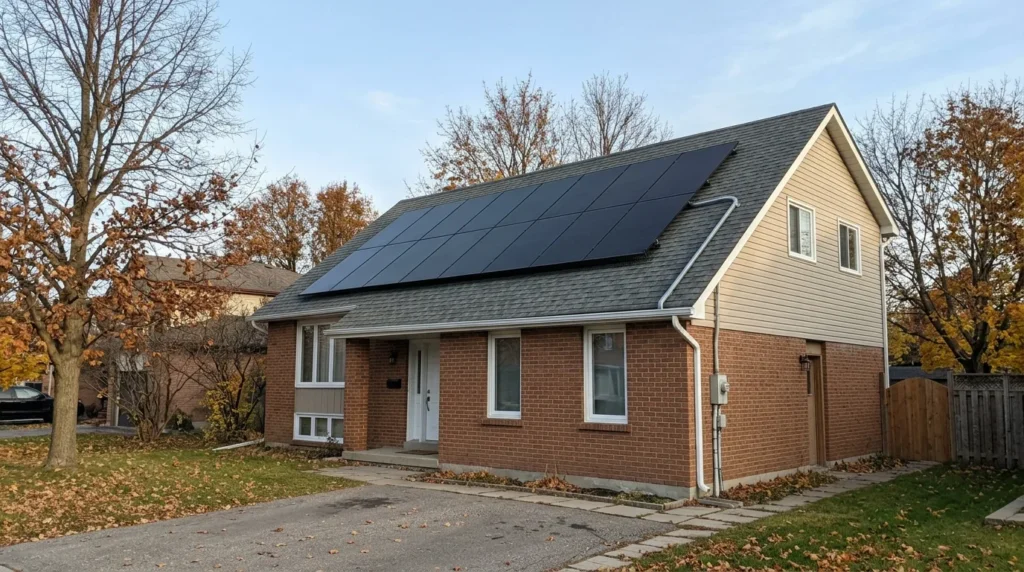
In Canada, the solar panel installation cost for an 8 kW asphalt-shingle system runs $19,600 to $26,400 before tax ($2.45–$3.30/W): typically $22,000 in Ontario and Alberta, $22,800 in BC, and $23,600 in Quebec. Size your roof and taxes in our solar panel cost calculator.
In this guide
Solar panel installation cost by province, size and roof type
Turnkey residential solar pricing in Canada (November 2026) spans $2,450 to $3,600 per kW DC before tax depending on province and roof type. Most detached homes install 6 kW to 10 kW (14 to 24 monocrystalline 400–450W panels). Hardware (panels, micro-inverters or string inverter, rails, AC disconnect) makes up 56% of the base bid, while labour, structural engineering, permits, and utility interconnection account for 44%.
| Province (shingle roof, before tax) | 6 kW typical | 8 kW (low / typical / high) | 10 kW typical | Sales tax |
|---|---|---|---|---|
| Ontario ($2,750/kW) | $16,500 | $19,600 / $22,000 / $24,400 | $27,500 | 13% HST |
| Quebec ($2,950/kW) | $17,700 | $20,800 / $23,600 / $26,400 | $29,500 | 14.975% GST+QST |
| British Columbia ($2,850/kW) | $17,100 | $20,400 / $22,800 / $25,600 | $28,500 | 5% GST (PST exempt) |
| Alberta ($2,750/kW) | $16,500 | $19,600 / $22,000 / $24,800 | $27,500 | 5% GST |
Roof construction adds predictable premiums across all four provinces (RénoClair 2026.Q4-solar-2 dataset): standing-seam metal clamps add $100/kW (+$800 on 8 kW) without roof penetrations, while flat-roof ballasted racking adds $300/kW (+$2,400 on 8 kW) for ballast and snow-load engineering. Three common options sit outside bare-bones quotes: critter guard and snow retention ($650–$1,600 before tax; $950 typical in QC/AB, $1,050 in ON/BC), solar-ready electrical or meter-base work ($1,200–$3,400; separate from a full 200 amp panel upgrade cost), and a 10–13.5 kWh LFP home battery ($11,500–$19,500 before tax; $14,500–$15,500 typical).
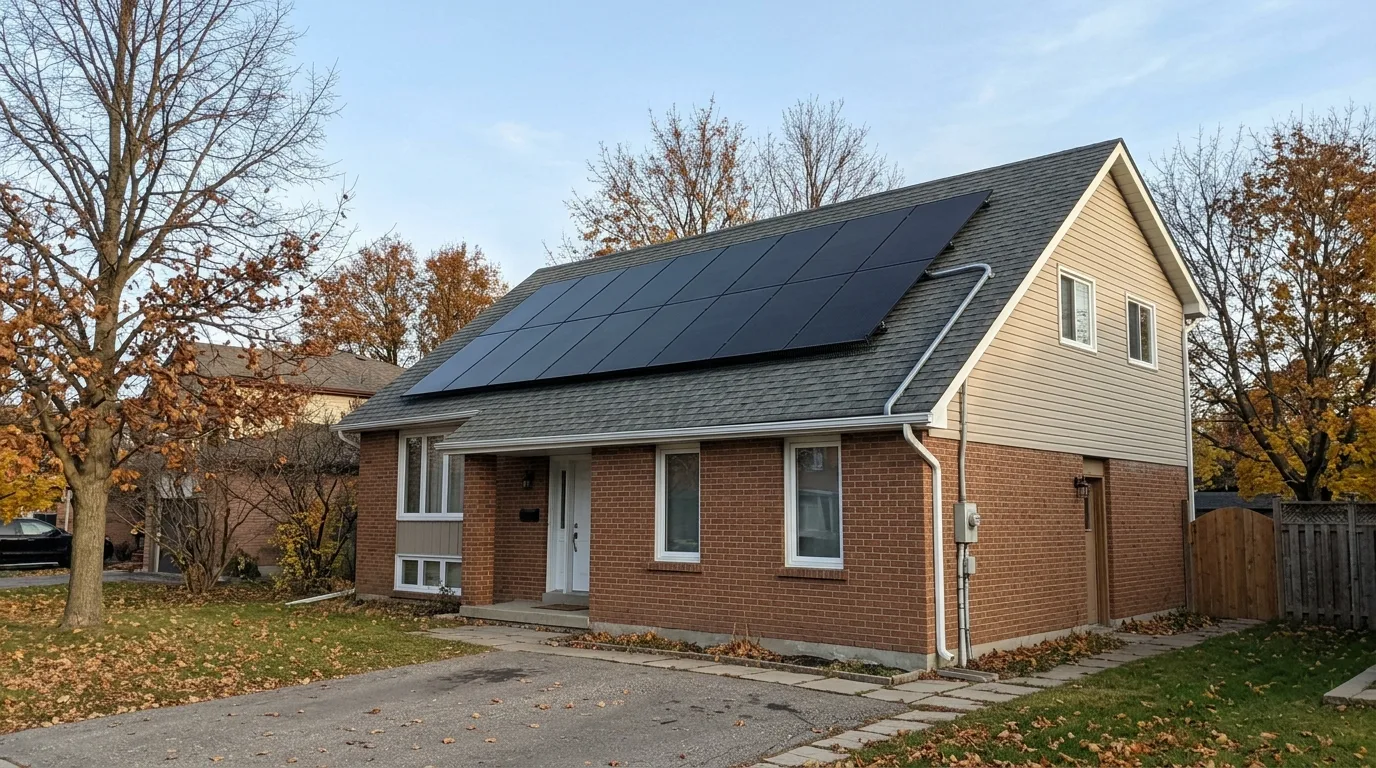
Provincial rebates, net metering traps and 2026 rates
No federal grant or 0% loan remains open to new applicants in November 2026: the Canada Greener Homes Loan is officially closed to new applications. Incentives now depend strictly on your province, with sharp eligibility traps in Ontario and BC.
| Province | 2026 Rebate / financing | Key eligibility rule | Est. yield (kWh/kW/yr) |
|---|---|---|---|
| Ontario | $1,000/kW solar (max $5,000) + $300/kWh battery (max $5,000) | Bans net metering (load displacement only); written pre-approval required first | ~1,160 (Toronto ~1,096) |
| Quebec | $1,000/kW solar (max 40% cost) via LogisVert | Installed on/after June 30, 2025; stacks with 1 MW net metering; CMEQ required | ~1,120 (Montreal ~1,129) |
| British Columbia | $1,000/kW solar (max $5,000) + $1,500 battery ($5,000 Peak Saver) | Installer must be in BC’s HPCN network (since June 1, 2026); BC PST exempt | ~1,050 (Vancouver ~938) |
| Alberta | No provincial grant; municipal CEIP property-tax loans | Solar Club seasonal export/import rates accelerate payback without grants | ~1,280 (Calgary ~1,228) |
The official Home Renovation Savings solar page (checked November 21, 2026) confirms that Ontario rebate recipients cannot join utility net metering (Cornwall Electric accounts are excluded altogether). Under Ontario Energy Board rates effective November 1, 2026, Time-of-Use runs 9.1 ¢ off-peak, 14.6 ¢ mid-peak, and 18.9 ¢/kWh on-peak, while Ultra-Low Overnight (ULO) hits 37.7 ¢/kWh on-peak (4–9 PM weekdays) vs 3.7 ¢/kWh overnight (with a 15.7% OER credit). Meanwhile, Hydro-Québec’s $1,000/kW grant pairs freely with net metering, and NRCan solar resource maps confirm Calgary leads major cities in annual kWh yield.
When NOT to spend $22,000+ on residential solar
An honest cost review starts with the five cases where rooftop solar destroys capital instead of building it:
- Asphalt shingles with under 10–12 years left: removing and reinstalling 16–20 panels during reroofing adds $2,500 to $4,500 in dead labour. Replace an aging roof first.
- North slopes or >20% tree shading: heavy shade cuts annual output 20–35%, stretching payback past 20 years.
- Under-insulated attic or aging heating gear: attic insulation and cold-climate heat pumps (see heat pump cost in Ontario) cut winter bills faster per dollar than solar.
- Taking Ontario’s $5,000 solar-only rebate without a battery: forfeiting 1:1 net metering wastes midday summer surpluses you cannot use live; skipping the rebate and choosing net metering often beats $5,000 upfront over 20 years.
- Buying a $15,000 battery purely for ROI on flat rates: in Quebec or non-TOU areas, batteries buy blackout backup, not faster payback. Only Ontario ULO peaks (37.7 ¢/kWh) paired with HRS rebates materially narrow the battery gap.
RénoClair tip: Never buy panels or pay an equipment deposit before receiving written program pre-approval (Ontario HRS, BC Hydro Self-Generation, or Hydro-Québec conditional connection approval). Purchasing early disqualifies your rebate permanently.
2-minute homeowner self-check before requesting quotes
Complete these five checks before inviting bids so every installer prices the exact same roof and electrical reality:
- 1. Total 12 months of kWh: sum one year of electric bills and divide by your provincial yield (1,160 ON, 1,120 QC, 1,050 BC, 1,280 AB) to avoid over-sizing past utility net-metering caps.
- 2. Measure clean roof area: budget 55 to 65 sq ft per kW (450–520 sq ft clear of vents and chimneys for 8 kW) on south, east, or west slopes.
- 3. Check your main panel (100A vs 200A): verify main breaker rating and two free breaker slots. Under Canadian Electrical Code 120% busbar limits, a 100A panel sharing space with a Level 2 EV charger installation may need a line-side tap or electrical upgrade ($1,200–$3,400).
- 4. Lock in your program track first: decide between Ontario Net Metering vs HRS Load Displacement, verify BC HPCN eligibility, or confirm whether your Alberta municipality’s CEIP window is open.
- 5. Send four standardized photos: open panel door (metal cover intact), exterior meter base, target roof slope from the street, and attic truss framing.
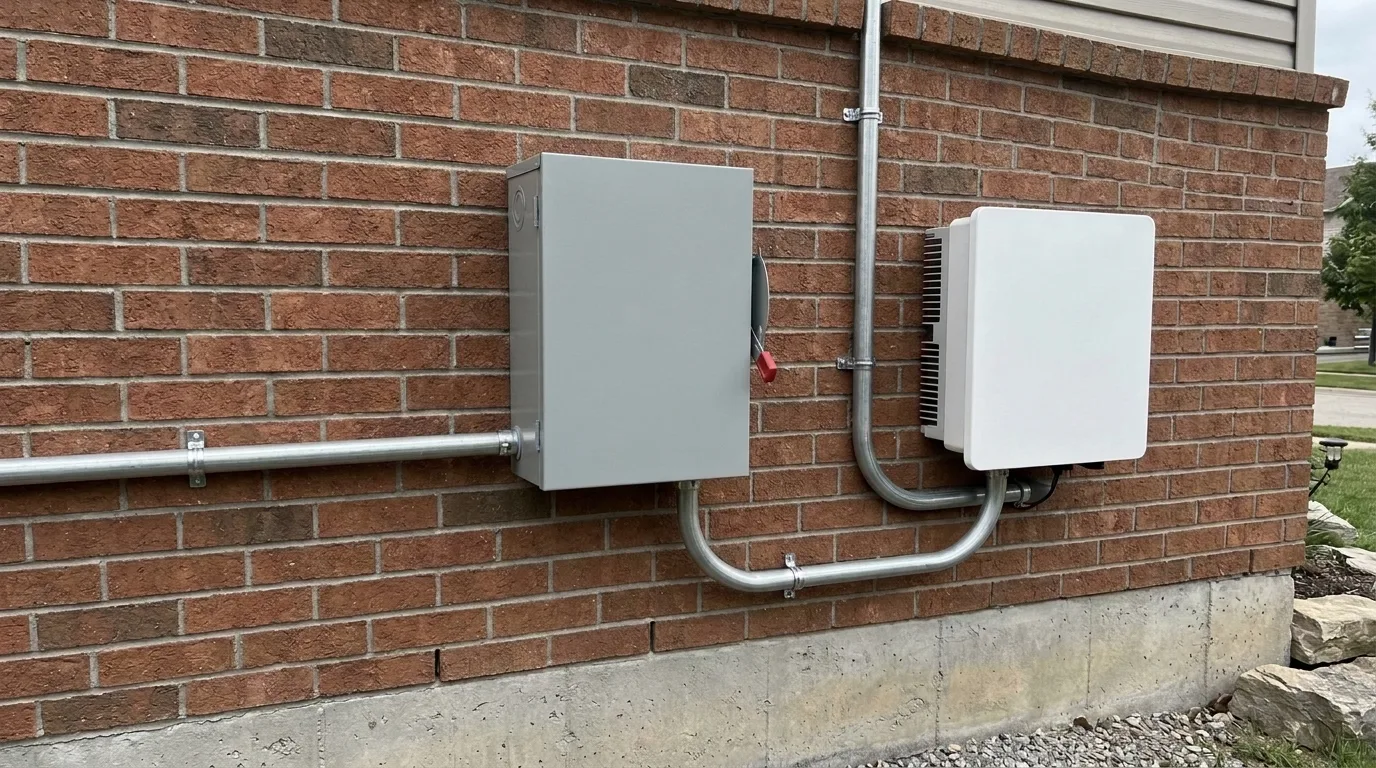
5 hidden traps in lowball solar panel installation quotes
Bids sitting $3,000 to $5,000 below local averages (under ~$2.35/W installed) almost always hide excluded permits, missing hardware, or steep dealer financing fees.
| Lowball quote trap | Hidden cost or penalty | Written requirement before deposit |
|---|---|---|
| Structural P.Eng. stamp omitted | $600 to $1,500+ | Confirm roof snow-load engineering letter and municipal building permit are included. |
| Critter & snow guards excluded | $650 to $1,600 | Itemize perimeter wire mesh and snow guards over walkways/driveways. |
| Unlicensed / non-HPCN installer | Lost $5,000–$10,000 rebate | Verify ESA/CMEQ/TSBC electrical licence (and active HPCN status in BC). |
| String inverter on shaded roof | 15%–30% yield penalty | Demand a shading report and micro-inverters or optimizers for partial shade. |
| Hidden dealer financing markup | 15%–25% inflated principal | Require a standalone cash price; reject pitches claiming the 0% federal loan is still open. |
Every province requires a licensed electrical contractor, electrical permit, and utility interconnection approval (ESA + LDC in Ontario, CMEQ + Hydro-Québec in Quebec, Technical Safety BC + BC Hydro in BC, and Safety Codes + Wire Service Provider in Alberta). Walk away from any contract that shifts permitting onto the homeowner.
Worked example: 4-province detached home totals with tax
Here is an identical 8 kW rooftop system on an asphalt-shingle detached home including critter guard and snow retention, calculated from RénoClair’s 2026.Q4-solar-2 rates and exact provincial sales taxes.
| Line item (8 kW shingle + critter/snow) | Ontario (13% HST) | Quebec (14.975%) | BC (5% GST) | Alberta (5% GST) |
|---|---|---|---|---|
| Base 8 kW system (56% gear / 44% labour) | $22,000 | $23,600 | $22,800 | $22,000 |
| Critter guard & snow retention | $1,050 | $950 | $1,050 | $950 |
| Subtotal before tax | $23,050 | $24,550 | $23,850 | $22,950 |
| Provincial / federal tax | $2,996.50 | $3,676.36 | $1,192.50 | $1,147.50 |
| Installed total with tax | $26,046.50 | $28,226.36 | $25,042.50 | $24,097.50 |
| Max solar-only rebate | Up to $5,000* | $8,000 | $5,000 | $0 |
| Net cost after solar rebate | $21,046.50* | $20,226.36 | $20,042.50 | $24,097.50 |
| Estimated annual output | ~9,280 kWh | ~8,960 kWh | ~8,400 kWh | ~10,240 kWh |
*Ontario Net Metering vs HRS Battery math: Skipping HRS to keep 1:1 net metering leaves the 8 kW project at $26,046.50 HST included. Adding a 13.5 kWh LFP battery ($15,000 before tax) under HRS load displacement brings the pre-tax subtotal to $38,050 ($42,996.50 with 13% HST); deducting $5,000 solar + $4,050 battery ($300/kWh = $9,050 total) yields $33,946.50 net, best suited to ULO households avoiding 37.7 ¢/kWh evening peaks who also want outage backup. Re-run these totals for your own roof and kW size in our solar panel cost calculator.
Frequently asked questions
What is the average solar panel installation cost in Canada?
An 8 kW grid-tied shingle-roof system costs $19,600 to $26,400 before tax ($2.45–$3.30/W): typically $22,000 in Ontario and Alberta, $22,800 in BC, and $23,600 in Quebec (November 2026). Check your exact home total in our solar panel cost calculator.
Can I take Ontario’s $5,000 solar rebate and still use net metering?
No. Home Renovation Savings solar (up to $5,000) and battery (up to $5,000) rebates apply strictly to load-displacement systems and disqualify you from signing a utility net-metering agreement.
Is the 0% Canada Greener Homes Loan still available?
No. The federal Canada Greener Homes Loan (up to $40,000 interest-free) is closed to new applicants after its full budget was committed.
How much does a home battery add to a solar installation?
A 10–13.5 kWh LFP battery adds $11,500 to $19,500 before tax installed ($14,500 typical in QC/AB, $15,000 in ON, $15,500 in BC), before eligible Ontario HRS or BC Hydro battery rebates.
Do solar panels produce power in Canadian winter snow?
Yes, though November through February generates only 15% to 20% of annual output due to short days and snow cover. Cold temperatures actually increase panel efficiency once snow slides off pitched roofs.
What installer licence is required in Ontario, BC and Quebec?
Every grid-tied job requires a licensed electrical contractor (ESA in Ontario, CMEQ/RBQ 16 in Quebec, Technical Safety BC in BC, Safety Codes in Alberta). BC Hydro rebates also mandate an HPCN-registered installer since June 1, 2026.
How long does a residential solar project take from contract to activation?
Roof and electrical installation takes 2 to 4 days, while engineering review, permits, rebate pre-approval, and utility meter swap typically span 6 to 14 weeks.
The bottom line
A realistic 8 kW solar panel installation cost in Canada lands between $24,100 and $28,200 with tax (including critter and snow guards), dropping near $20,000–$21,050 net where provincial solar grants apply. Verify your roof has 12+ years of remaining life, lock in written utility and rebate pre-approval before buying gear, and compare three licensed cash bids on identical site photos. Use our solar panel cost calculator to test your roof type and battery options before signing.
Sources
- Home Renovation Savings (Ontario): solar ($1,000/kW max $5,000) and battery ($300/kWh max $5,000) rules and net-metering exclusion, checked November 21, 2026.
- Ontario Energy Board (OEB): TOU and Ultra-Low Overnight electricity rates effective November 1, 2026, checked November 21, 2026.
- Hydro-Québec: $1,000/kW residential solar grant (up to 40%, LogisVert since June 30, 2025) and 1 MW net metering, checked November 21, 2026.
- Natural Resources Canada (NRCan): Photovoltaic potential and solar resource maps of Canada, checked November 21, 2026.
- RénoClair pricing dataset (2026.Q4-solar-2, November 2026); see our sources and methodology.