Official sources checked on November 26, 2026.
Under Section 9.19.1.2 of Canada’s National Building Code, attic ventilation requires at least 1/300 net free area of the insulated ceiling for roofs sloped 1:6 or steeper (1/150 below 1:6), split low and high. Expect $1,000 to $3,000 before tax for baffles, roof vents and ceiling air sealing—always sealing air leaks first.
If you are topping up blown-in insulation to R-50 or R-60 at the same time, run your provincial numbers (QC, ON, BC or AB) in our attic insulation cost calculator.
In this guide
Canadian attic ventilation code: NBC 9.19.1.2 and 1/300 ratio
During a Canadian cold snap, an unconditioned attic should stay near outdoor temperature. Passive intake-to-exhaust airflow flushes out indoor vapour leaking past ceiling fixtures before it frosts onto OSB sheathing and stops uneven snowmelt that triggers ice dams on roofs. In July, cross-flow caps attic deck heat above 60 °C so asphalt shingles reach their rated lifespan.
Planning a re-roof at the same time? Compare metal roof vs shingles in Canada before you choose, and check the attic first: a poorly ventilated attic shortens the life of either covering.
Provincial codes—including the Ontario Building Code (O. Reg. 332/12), Quebec Construction Code, BCBC 2024 and NBC(AE) 2023—mirror National Building Code Section 9.19:
- 1/300 Net Free Area (slope ≥ 1:6, or 2:12): a 1,000 sq ft ceiling needs 3.33 sq ft (480 sq in) of unobstructed Net Free Area (NFA), split 240 sq in low and 240 sq in high (576 sq in for 1,200 sq ft; 720 sq in for 1,500 sq ft).
- 1/150 Net Free Area (slope < 1:6 or roof-joist cathedral ceilings): shallow slopes cut natural stack effect, doubling the requirement to 960 sq in per 1,000 sq ft.
- Distribution (NBC 9.19.1.2(3)): uniform spacing on opposite sides with at least 25% of required NFA high and 25% low; best practice targets 50/50 or slightly intake-heavy to avoid negative pressure.
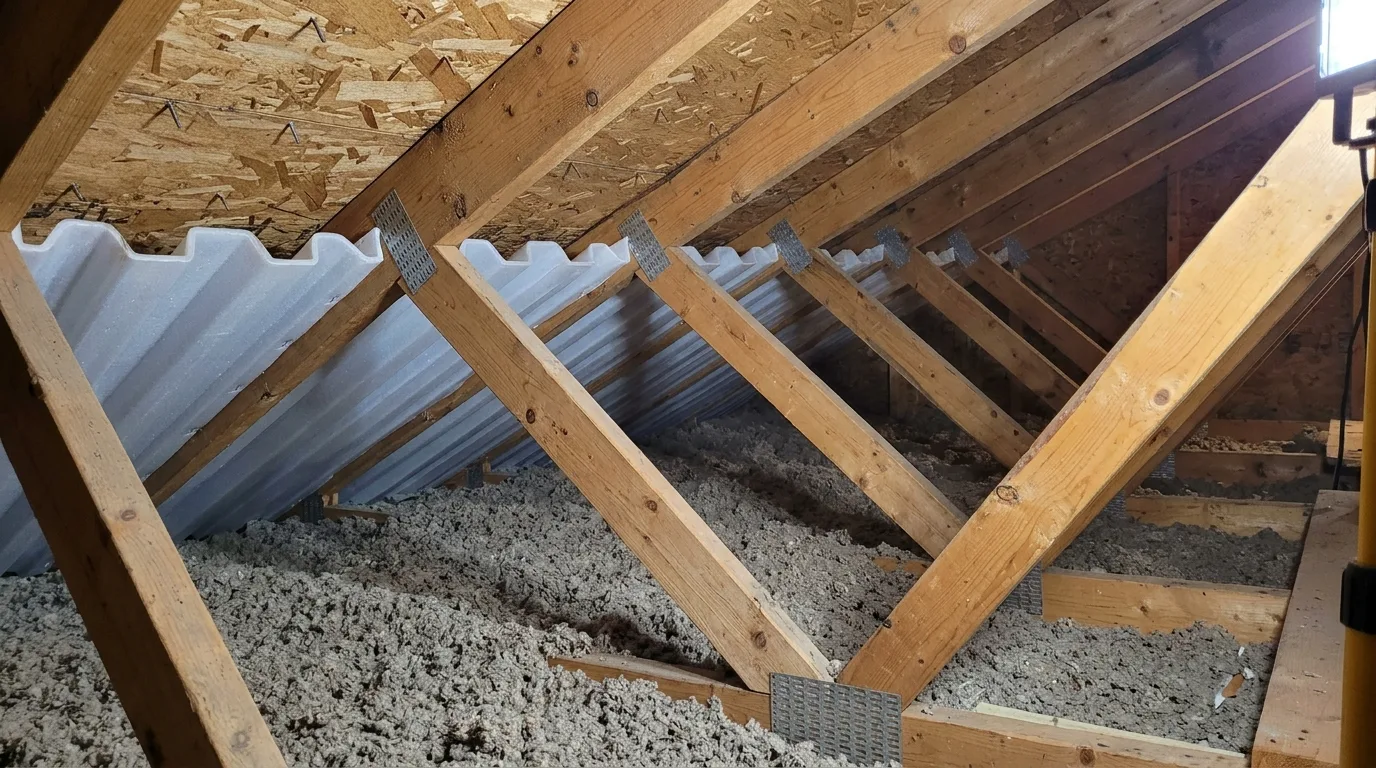
- Clearance (NBC 9.19.1.3): vented roof-joist spaces require 63 mm (2.5 in) clear space above insulation; truss eaves require rigid baffles holding 38 to 50 mm open above the finished R-60 depth.
Standard perforated soffit delivers roughly 2% to 3% actual open area per gross square foot (CAN3-A93-M), so size every vent strictly by published NFA square inches.
When not to overspend (and why powered attic fans backfire)
Many $2,500+ roof-vent quotes miss a $500 root cause. Per Natural Resources Canada’s Keeping the Heat In (Section 5: Roofs and Attics), moisture control always follows three steps in order: 1) air sealing, 2) insulation, 3) ventilation.
- Skip electric or solar attic fans ($900 to $1,800): NRCan warns against powered attic fans in typical Canadian homes. When soffits are tight or snow-covered, motors depressurize the attic, suck heated indoor air through pot lights and risk carbon monoxide backdrafting from gas appliances.
- Do not cut extra roof vents if baffles are buried: adding two static vents ($400 to $800) fails when loose insulation chokes the eaves. Installing 25 to 35 baffles ($500 to $1,200) restores intake first.
- Reconnect stray bathroom fan ducts ($250 to $550): an 80 CFM shower fan dumping vapour inside the attic causes heavy sheathing frost even with code-compliant vents.
- Hold off on ridge vents if shingles are 18+ years old: bundling a continuous ridge vent into your full reroof avoids paying $450 to $850 twice in ridge-cap labour.
Two-minute homeowner attic ventilation check before quotes
Skip climbing onto icy shingles. Five checks from the driveway and attic hatch with a flashlight expose 90% of real defects in two minutes:
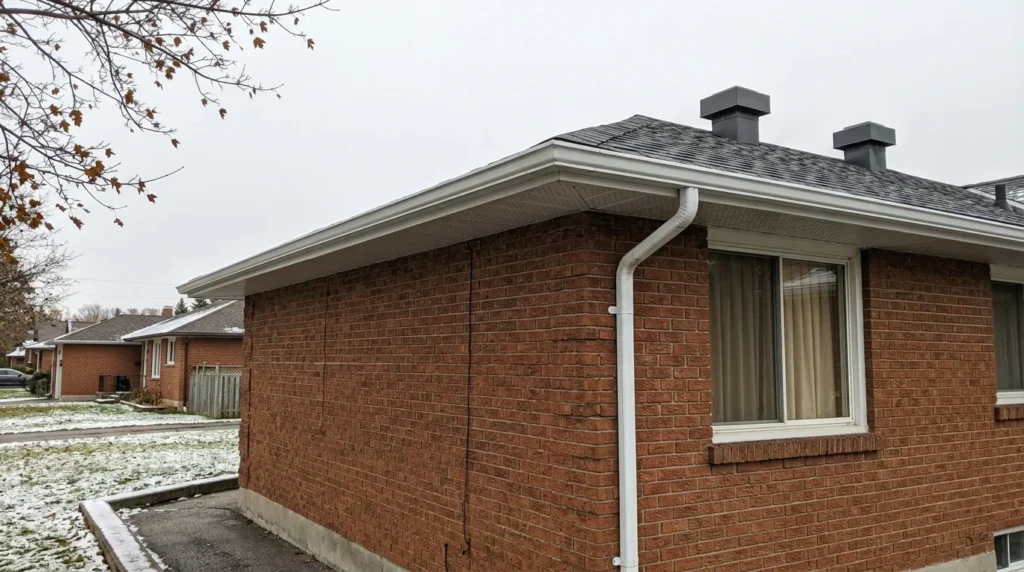
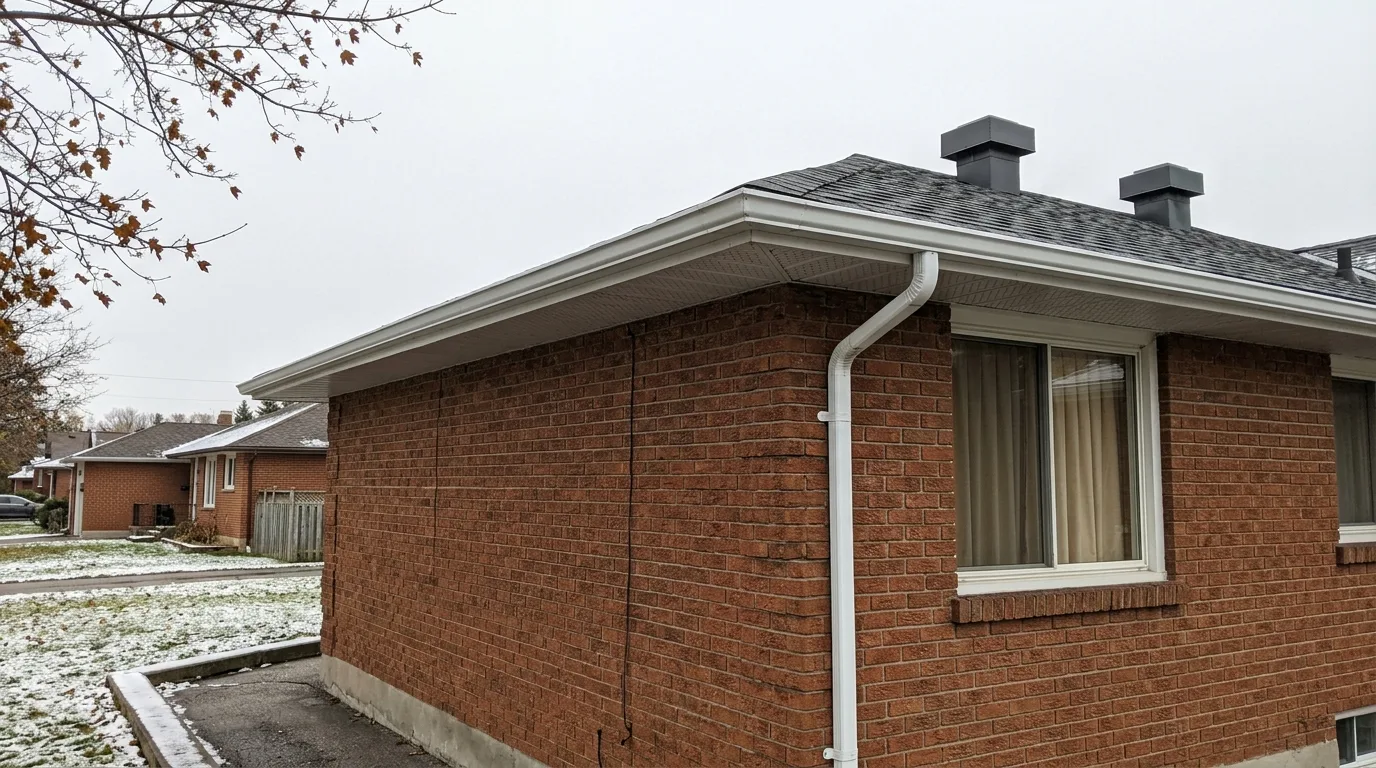
- Soffit scan from ground (30 s): confirm continuous perforated aluminum or vinyl soffits along both long eaves—painted solid wood soffits supply zero airflow.
- Upper exhaust check from ground (20 s): look for mixed exhaust types (ridge vent plus gable louvers or wind turbines) that short-circuit airflow and pull in blowing snow.
- Daylight and baffle check at hatch (30 s): turn off your flashlight in daytime and scan the eaves. Thin strips of daylight inside rigid baffles confirm clear intake; fluff pressed against roof decking means choked eaves.
- Frost and nail tips after −15 °C (20 s): NRCan flags frost thicker than 10 mm (3/8 in), rusted nail shanks or dark OSB stains as proof of indoor air leaks plus weak ventilation.
- Hatch gasket and ducts (20 s): check for compression weatherstripping and foam backing on the hatch, and verify bathroom exhaust ducts terminate outdoors (see our winter home maintenance checklist).
Vent types, baffles and 4-province attic ventilation costs
Installed component ranges below reflect Canadian residential retrofit quotes (November 2026, before tax). Ventilation, baffles and air sealing are normally itemized separately from blown-in insulation.
| Ventilation component | Role & typical NFA | Installed cost (before tax) | Cold-climate detail |
|---|---|---|---|
| Soffit baffles (foam or cardboard) | Holds 38–50 mm air channel open at eaves | $15 to $35/baffle ($500 to $1,200/bungalow) | Every truss bay; extend above final R-60 depth |
| Perforated aluminum/vinyl soffits | Low intake: ~2%–3% effective NFA | $6 to $14/linear ft | Cutting solid wood soffits adds $150 to $400 |
| Static box roof vents | High exhaust: 50–60 or 100–144 sq in NFA | $150 to $350 (std); $250 to $400 (high-cap) | Use snow-baffled housings in snowbelt regions |
| Continuous baffled ridge vent | High exhaust: 12–18 sq in NFA/linear ft | $12 to $22/linear ft | Best installed during full shingle replacement |
| Attic air sealing (hatch, stacks, wires) | Blocks indoor vapour before cold sheathing | $400 to $1,100/attic | Always complete prior to blowing insulation |
If you bundle blown-in insulation with ventilation work, compare our four-province November 2026 calculator benchmarks for a 1,000 sq ft attic (insulation supplied and installed; ventilation extra; see spray foam vs batt insulation for material rules):
| Province & sales tax | R-50 (1,000 sq ft pre-tax) | R-60 (1,000 sq ft pre-tax) | R-60 typical tax-in | Provincial aid / financing (Nov 2026) |
|---|---|---|---|---|
| Ontario (13% HST) | $1,750–$3,500 (typ. $2,500) | $2,100–$4,200 (typ. $3,000) | $3,390.00 | HRS up to $1,250 (no audit, Nov 30, 2026 cutoff) or $1,500 w/ audit |
| Quebec (14.975% GST+QST) | $2,000–$3,600 (typ. $2,800) | $2,400–$4,300 (typ. $3,350) | $3,851.66 | LogisVert $1,500 (R-50+seal) or Rénoclimat max $2,000 (R-60) |
| British Columbia (5% GST) | $1,900–$3,850 (typ. $2,750) | $2,300–$4,600 (typ. $3,300) | $3,465.00 | CleanBC Better Homes up to $1,200 (up to $2,000 income-qualified) |
| Alberta (5% GST; 0% PST) | $1,800–$3,650 (typ. $2,600) | $2,150–$4,350 (typ. $3,100) | $3,255.00 | No provincial cash grant; municipal CEIP PACE up to $50,000 |
Worked example with HST: 1,000 sq ft Ontario bungalow
Real case: 1978 Ontario bungalow, 1,000 sq ft insulated ceiling, 4:12 roof pitch (≥ 1:6), buried perforated soffits and two undersized vents. NBC/OBC 9.19.1.2 requires 480 sq in NFA (240 low + 240 high), met with 30 baffles plus four 60 sq in static box vents. Line-by-line totals with 13% HST:
| Scope (1,000 sq ft Ontario bungalow) | Ventilation & sealing | Blown-in insulation | Pre-tax | 13% HST | Tax-included |
|---|---|---|---|---|---|
| Option A: Ventilation + sealing only (30 baffles $650, 4 static vents $900, air sealing $500) | $2,050 | $0 | $2,050 | $266.50 | $2,316.50 |
| Option B: Ventilation + sealing + blown-in R-50 ($2.50/sq ft typical) | $2,050 | $2,500 | $4,550 | $591.50 | $5,141.50 |
| Option C: Ventilation + sealing + blown-in R-60 ($3.00/sq ft typical) | $2,050 | $3,000 | $5,050 | $656.50 | $5,706.50 |
Check grant deadlines before counting rebates: Ontario’s Home Renovation Savings attic stream covers 50% of after-tax insulation costs up to $1,250 without an audit for work completed by November 30, 2026 via a participating contractor (or up to $1,500 with assessment; details in our Ontario attic insulation rebate guide and attic insulation rebate calculator).
Recalculate the blown-in insulation share for your square footage and province in our attic insulation cost calculator.
Low-ball quotes: 5 hidden attic ventilation traps
A bid 35% below competing quotes almost always omits prep work hidden once fresh fluff covers the joists. Catch these five traps before signing:
- 1. No baffle count on the quote: blowing 16 to 20 inches of insulation without specifying 24 to 40 rigid baffles plugs soffit intake immediately.
- 2. Mixing incompatible high exhaust vents: adding a ridge vent while leaving gable louvers open short-circuits airflow across the peak.
- 3. Gross vent dimensions used instead of certified NFA: a 12 × 12 in cutout never yields 144 sq in of free airflow once screens and baffles are counted.
- 4. Zero ceiling air sealing or vermiculite check: covering unsealed pot lights or pre-1990 vermiculite (which requires asbestos testing before disturbance in Canada) locks in moisture and safety liabilities.
- 5. Missing written scope or cooling-off notice: simple top-ups rarely need a municipal permit unless roof framing changes, and direct in-home contracts in Ontario carry a mandatory 10-day cooling-off right under Consumer Protection Ontario.
RénoClair tip: Write a three-photo sign-off clause into your contract before blowing begins: cleared eaves, rigid baffles stapled in every truss bay, and weatherstripped hatch lid. Once R-60 fluff fills the floor, inspecting the eaves becomes virtually impossible.
Frequently asked questions
What is the Canadian building code ratio for attic ventilation?
Under NBC Section 9.19.1.2 (adopted across provincial codes), roofs sloped 1:6 (2:12) or steeper require at least 1/300 of insulated ceiling area in unobstructed Net Free Area—480 sq in for 1,000 sq ft. Roofs below 1:6 or cathedral joist roofs require 1/150.
How much does attic ventilation improvement cost in Canada?
Expect $1,000 to $3,000 before tax for baffles, static roof vents and ceiling air sealing—about $2,050 pre-tax ($2,316.50 with 13% HST) on a 1,000 sq ft Ontario bungalow. If bundling blown-in insulation to R-50 or R-60, price the insulation share in our attic insulation cost calculator.
Are solar or electric powered attic fans worth it in Canada?
No for standard Canadian homes. NRCan advises against powered attic fans because they depressurize the attic when soffits are restricted, sucking warm humid air out of living spaces and risking combustion backdrafting.
Can I combine ridge vents with gable vents or whirlybirds?
No. Combining two high exhaust systems on the same attic cavity short-circuits airflow, pulls wind-driven snow inside and leaves eaves stagnant. Pair one upper exhaust type with open soffits.
How do I check if my attic ventilation is blocked without climbing on the roof?
Open the attic hatch on a bright day, shut off your flashlight and check the eaves for slivers of daylight through rigid baffles. Frost exceeding 10 mm (3/8 in) on nails after −15 °C weather confirms moisture leaks and restricted airflow.
Do standalone attic ventilation upgrades qualify for Canadian rebates?
No—provincial grants (Ontario HRS, Quebec LogisVert/Rénoclimat, CleanBC) fund verified R-value insulation upgrades and air sealing rather than vents alone. Bundling baffles with an R-50 or R-60 top-up is the best way to capture incentives.
Do I need a permit to add soffit baffles or static roof vents?
Usually no for baffles or like-for-like static vents, though structural roof cuts or framing changes can require a municipal permit. Confirm locally—and in Quebec verify an active RBQ 7.0 licence.
The bottom line
Dependable attic ventilation in Canada rests on three numbers: 1/300 Net Free Area (480 sq in per 1,000 sq ft), a balanced 50/50 split between baffled soffits and one upper exhaust type, and ceiling air sealing completed before insulating. Skip powered fans, run the two-minute hatch check and price any bundled R-50 or R-60 upgrade in our attic insulation cost calculator before comparing three itemized quotes.
Sources
- Natural Resources Canada — Keeping the Heat In, Section 5: Roofs and Attics, checked November 26, 2026.
- Ontario Building Code (O. Reg. 332/12, Part 9 Section 9.19 Roof Spaces — harmonized with NBC 9.19.1.2 & 9.19.1.3), checked November 26, 2026.
- Home Renovation Savings Program (Save on Energy & Enbridge Gas) — Attic Insulation, checked November 26, 2026.
- Consumer Protection Ontario — Your rights when starting home renovations or repairs, checked November 26, 2026.