Official sources checked on November 28, 2026.
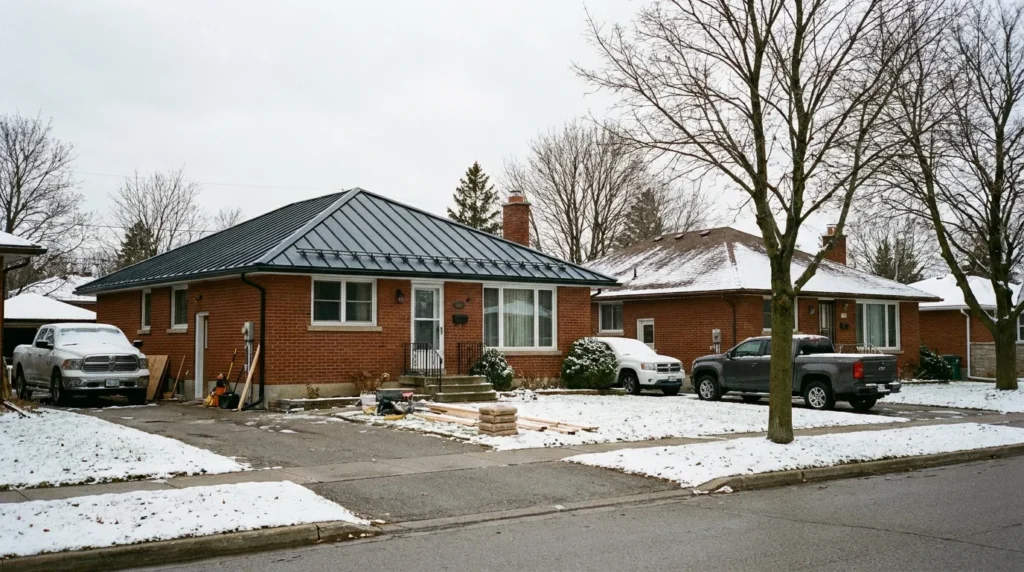
Metal roof vs shingles in Canada comes down to price today against years of service. In Ontario, architectural asphalt shingles cost about $6.50 per square foot of roof installed, exposed-fastener steel about $11.00 and standing seam metal about $18.00 (typical prices, before HST, November 2026), so a typical 1,568 sq ft roof costs about $10,200, $17,200 or $28,200. Shingles are rated for roughly 30 years and metal for 40 to 80, which means metal only comes out ahead on cost if you keep the roof for decades: about 51 years for exposed-fastener steel at today’s prices.
To price your own house, enter your footprint, pitch and province in our roof replacement cost calculator (Ontario, British Columbia, Alberta and Quebec prices, November 2026 data).
In this guide
Metal roof vs shingles at a glance
The short version: shingles are cheaper to buy, metal is cheaper to keep only over a very long ownership, and neither material prevents ice dams on its own. The table compares a typical Ontario job.
| Criterion | Architectural asphalt shingles | Metal roofing (steel) |
|---|---|---|
| Installed price, Ontario (typical, before HST) | $6.50 per sq ft of roof | $11.00 exposed-fastener / $18.00 standing seam |
| Typical 1,568 sq ft roof, Ontario | $10,200 | $17,200 / $28,200 |
| Expected service life (guideline) | About 30 years (20 for 3-tab) | 40 to 80 years |
| Snow | Holds snow; it melts in place | Sheds snow suddenly; plan snow guards over doors and walkways |
| Ice dams | Caused by attic heat loss, not by the covering | Same cause; metal does not fix a warm attic |
| Hail | Standard shingles damage easily; Class 4 (impact-resistant) versions exist | Steel tested to UL 2218 can reach Class 4 |
| Fire | Most are Class A | Class A on a noncombustible deck |
| Provincial rebate for the covering | None in Ontario or Alberta | None in Ontario or Alberta |
Prices come from the November 2026 data set of our roof calculator (sources listed on the calculator page). Lifespans are the InterNACHI guideline figures, which the association says are “guidelines only” and not guarantees.
Metal roof vs shingles cost by province in 2026
Metal costs about 1.7 times as much as architectural shingles for exposed-fastener steel and about 2.8 times as much for standing seam in Ontario. The gap varies by province: across the four provinces we track, exposed-fastener steel costs about 1.6 to 2.3 times the typical shingle price and standing seam about 2.4 to 3.7 times, the widest gap being in Alberta where shingles are cheapest. All prices below are per square foot of actual roof surface (not floor area), installed, before tax, November 2026.
| Province | Architectural shingles | Exposed-fastener steel | Standing seam metal |
|---|---|---|---|
| Ontario | $5.00 to $8.50 (typical $6.50) | $8.50 to $14.00 (typical $11.00) | $13.00 to $24.00 (typical $18.00) |
| British Columbia | $6.00 to $11.00 (typical $8.00) | $9.50 to $16.50 (typical $12.50) | $15.00 to $28.00 (typical $21.00) |
| Alberta | $4.30 to $7.80 (typical $5.80) | $9.80 to $17.80 (typical $13.60) | $15.50 to $28.50 (typical $21.50) |
| Quebec | $6.50 to $12.00 (typical $9.00) | $10.50 to $18.50 (typical $14.50) | $16.00 to $29.00 (typical $22.00) |
For the same reference roof (a 1,400 sq ft bungalow with a 6/12 pitch, or 1,568 sq ft of actual roof), architectural shingles cost about $10,200 in Ontario ($7,850 to $13,300), $12,550 in British Columbia ($9,400 to $17,250), $9,100 in Alberta ($6,750 to $12,200) and $14,100 in Quebec ($10,200 to $18,800), before tax.
Tax comes on top: 13% HST in Ontario, 5% GST in Alberta, 5% GST in British Columbia (provincial sales tax on materials is paid by the contractor and is already inside installed prices), and 14.975% GST + QST in Quebec.
What a quote should include, and the usual extras
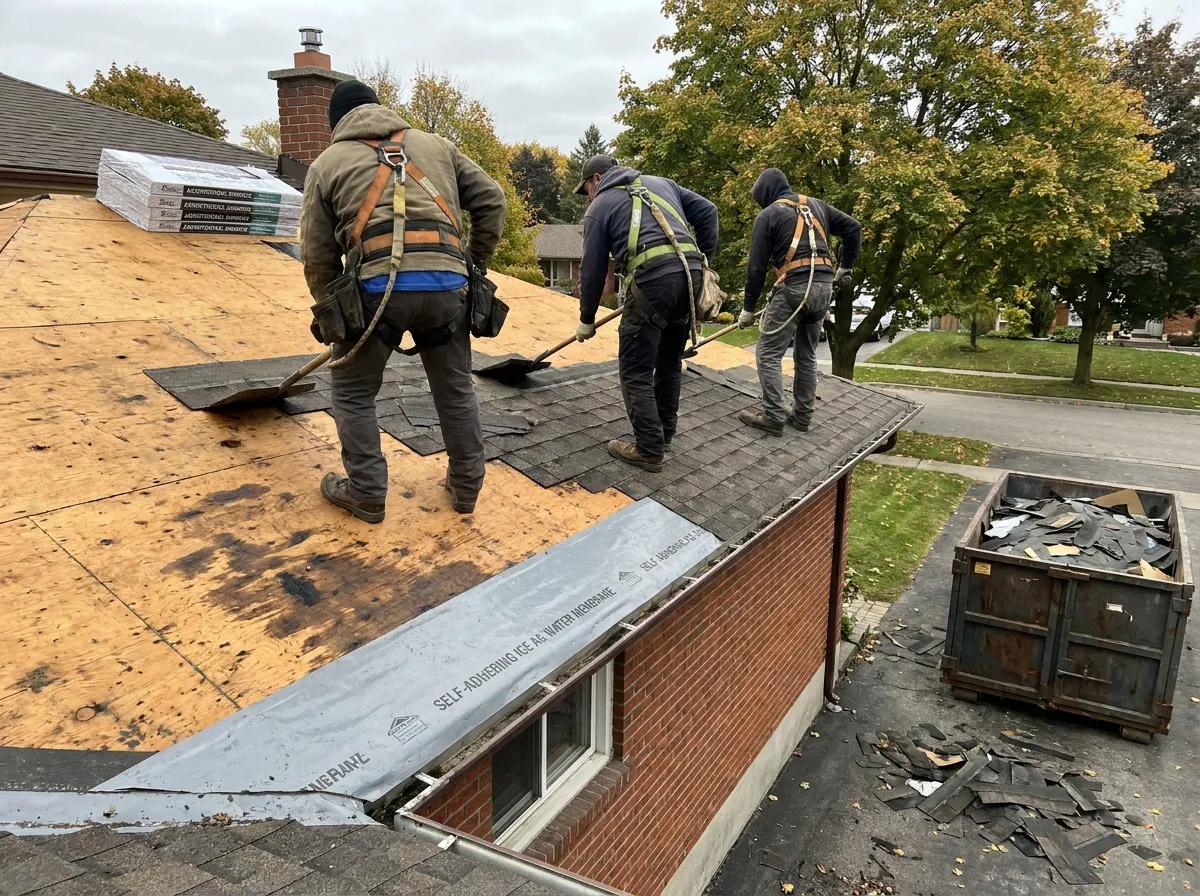
The prices above assume a complete job: protection of the property, removal of one existing layer and the disposal bin, inspection of the wood deck, self-adhering ice and water shield at the eaves and valleys, synthetic underlayment, the new covering, drip edge and step flashing. Common extras in Ontario are:
- Removing a second layer of old shingles: $1.25 to $2.50 per sq ft (typical $1.75).
- Replacing about 20% of the roof deck: $1.00 to $2.25 per sq ft (typical $1.50).
- Ventilation upgrade and chimney flashing: $800 to $2,000 (typical $1,250).
- Not included in any of these figures: gutters, soffits and fascia, chimney masonry, structural repairs, a permit where one is required, and a 10% to 15% contingency.
Worked example: a 1,568 sq ft Ontario roof over 60 years
Here is the full calculation for the reference house in Ontario (typical prices, November 2026). The cost per year of service divides the installed price by the expected life, in today’s dollars, with no inflation, financing or maintenance.
| Option | Before HST | With 13% HST | Extra vs shingles (before HST) | Cost per year of service |
|---|---|---|---|---|
| Architectural shingles (30-year life) | $10,200 | $11,526 | — | $340 |
| Exposed-fastener steel (40 / 60-year life) | $17,200 | $19,436 | $7,000 | $430 / $287 |
| Standing seam (40 / 60 / 80-year life) | $28,200 | $31,866 | $18,000 | $705 / $470 / $353 |
What the numbers say:
- Over 60 years, you would buy two shingle roofs ($20,400 at today’s prices) or one steel roof ($17,200). Exposed-fastener steel comes out $3,200 cheaper, but only if it really lasts 60 years.
- Break-even: at $340 a year for shingles, exposed-fastener steel needs about 51 years of service to cost less per year. If it lasts only 40 years, it costs more per year ($430) than shingles.
- Standing seam would need about 83 years to match shingles on cost alone, which is beyond the top of the 40 to 80-year guideline. People choose it for appearance, low maintenance and snow shedding, not to save money.
- If you plan to move within 10 to 15 years, the $7,000 to $18,000 premium is money you may not recover; there is no neutral Canadian data on how much a metal roof adds to resale value.
RénoClair tip
Ask each roofer for the same scope on paper: number of layers removed, deck repairs priced per sheet, underlayment type, ice and water shield coverage, ventilation work and snow guards. A metal quote that leaves out snow guards or the second-layer tear-off is not comparable to a shingle quote that includes them.
Redo this calculation with your own footprint, pitch and province in the roof replacement cost calculator; it shows low, typical and high prices with tax for each material.
Metal roof vs shingles lifespan: how long each lasts
Metal lasts longer, but the gap is smaller than many sales pitches suggest. The life-expectancy chart published by InterNACHI, a home inspection association, gives about 20 years for 3-tab asphalt shingles, 30 years for architectural shingles and 40 to 80 years for metal, and warns that the figures are guidelines only. The City of Calgary’s climate-ready roof guide says metal “lasts up to four times longer than asphalt shingles”.
Real life depends more on installation and the attic than on the label. A poorly ventilated attic overheats the deck in summer and creates condensation in winter, which shortens any covering. Before you pay for a longer-lasting roof, check that the attic has proper intake and exhaust: our guide to attic ventilation in Canada explains the 1/300 rule and baffles.
- A manufacturer’s warranty is not a life expectancy: read what it covers (materials only, labour, colour fade) and whether it is prorated.
- Architectural shingles have a longer guideline life than 3-tab shingles (about 30 years against 20).
Snow and ice: metal sheds it, shingles hold it
Metal is the better choice if you want snow off the roof, and the worse choice above a door, deck, driveway or sidewalk unless you add snow guards. A National Research Council building digest on sliding snow (CBD-228, 1983) warns that snow can break loose suddenly “endangering people”, recommends keeping parking and pedestrian access out of the slide zone, and names snow fences on the roof as one way to stop it, noting that metal roofs offer almost no friction. The City of Calgary also notes that on metal “ice slides right off”.
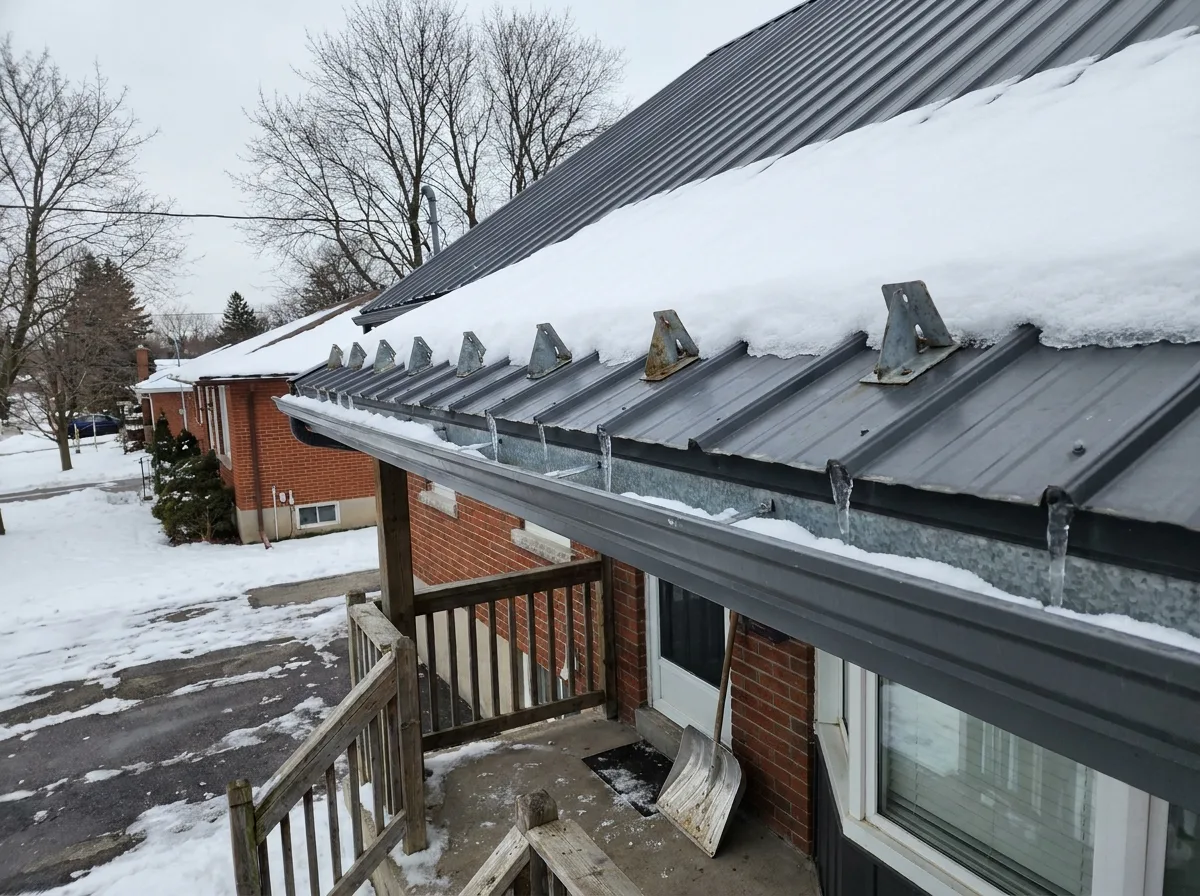
Some municipalities make owners responsible for snow and ice falling from a roof onto a sidewalk. Haldimand County’s By-law 301-02, for example, requires owners of buildings with a roof sloping towards a sidewalk to remove the snow and ice before 9:00 a.m. when it may fall and endanger pedestrians. Check your own municipality’s bylaw if your roof faces a public sidewalk.
Ice dams are an attic problem, not a roofing problem
Switching to metal does not cure ice dams. Natural Resources Canada’s Keeping the Heat In guide explains that when the attic is above freezing it warms the roof sheathing and melts the snow, and that “a well-sealed and insulated attic results in a cool roof and generally will also not have ice dams”. Its advice: seal all attic air leaks and insulate thoroughly. Metal may shed some of the snow before it refreezes, but the meltwater still forms at the eaves if heat escapes.
If you have had ice dams, fix the attic first: see our guide to ice dams on roofs and price the work with the attic insulation cost calculator.
Hail, wind and fire
In the Prairies, hail decides more roofs than price does. The Insurance Bureau of Canada says Alberta has had a major hailstorm every year for the past decade, causing more than $8 billion in insured damage, and that the 2024 Calgary storm produced over 130,000 insurance claims, making it the second costliest disaster in Canadian history after the 2016 Fort McMurray wildfires.
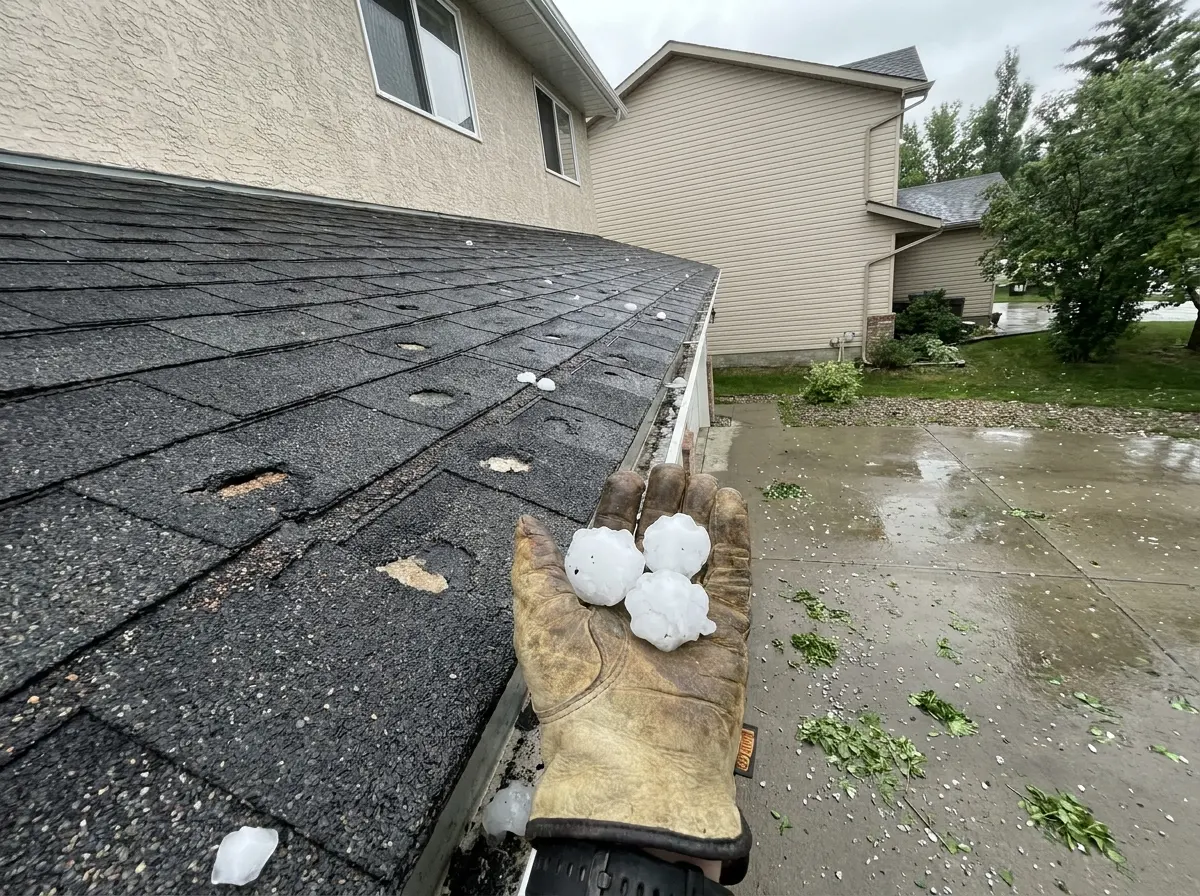
- What Class 4 means: impact-resistant products get a rating from 1 to 4. According to an Institute for Catastrophic Loss Reduction study (December 2024), a Class 4 product can resist fracture from a 50 mm hailstone; larger hail can still break impact-resistant shingles.
- How metal is tested: metal roofs are tested to UL 2218, a steel-ball impact test; a panel passes if no crack shows on its back, according to the Insurance Institute for Business & Home Safety.
- Insurance: the Insurance Bureau of Canada states that “a majority of insurers will provide home insurance savings of up to 50%” when hail-resistant materials are in place in Alberta. Ask your insurer for its exact discount before you choose.
- Price in Alberta: Class 4 hail-resistant shingles cost $7.60 to $13.40 per sq ft (typical $10.20), against $5.80 typical for standard architectural shingles; on the reference roof that is about $16,000 instead of $9,100 before GST. Exposed-fastener metal is $13.60 typical (about $21,300).
Fire: both materials can carry the top rating. The City of Calgary notes that most asphalt shingles have a Class A fire rating, and the National Building Code intent statement for Article 3.1.15.2 treats metal sheets or metal shingles on a noncombustible deck or framing as Class A roof assemblies. FireSmart guidance lists asphalt shingles, metal and tile among recommended Class A materials.
Can you install metal over existing shingles?
It is often sold as a way to save the tear-off cost, but removing the old shingles is the safer default. Natural Resources Canada says it is “typically recommended to remove existing shingles when installing new ones”, because a second layer adds load to the roof structure and hides the condition of the deck. A tear-off lets the roofer replace soft sheathing and install a continuous ice and water shield at the eaves.
- Removing one layer is already included in the prices above; a second layer adds $1.25 to $2.50 per sq ft in Ontario.
- If a contractor proposes metal over shingles, ask in writing how the deck will be inspected, what strapping is used and whether the metal manufacturer’s warranty allows it.
- Ontario’s building code is now O. Reg. 163/24, based on the National Building Code 2020; ask your municipality whether your project needs a permit before work starts (see our guide to building permits in Toronto).
Energy, noise and the environment
A metal roof does not insulate your home; the attic insulation does. Reflective “cool” roofs reduce summer heat, but a National Research Council review of white and high-performance roofs points out that in Canada, where heating dominates, there can be a winter penalty, although low winter sun limits it. For a house with an insulated attic, roof colour has a small effect on the heating bill compared with insulation and air sealing.
Noise: we found no neutral Canadian measurement comparing rain noise on metal and shingle roofs. The sound you hear depends on the solid deck, the underlayment and the attic insulation between the roof and your ceiling; a cathedral ceiling with little insulation transmits more sound than a full attic. Ask to see or hear a finished roof of the same type before signing.
Waste: a University of Waterloo thesis (2011) estimated that 1.5 million tonnes of asphalt roofing shingles are torn off and replaced in Canada each year, and recycling options vary: the City of Calgary, for example, stopped accepting separated shingle loads at a reduced recycling rate in September 2018. Steel roofing is recyclable as scrap metal at the end of its life.
Rebates: is a new roof covered?
Neither Ontario nor Alberta offers a provincial rebate for the roof covering itself, so do not count on one for metal or shingles.
- Ontario: the Home Renovation Savings program lists attic insulation (up to $1,250 without an assessment), heat pumps, windows and doors, air sealing and other upgrades, but not roofing. If the roof is coming off, it is the right moment to add attic insulation; check the program’s current deadlines on its site.
- Alberta: there is no provincial roofing rebate. Calgary’s former Resilient Roofing Rebate ($3,000 for a Class 4 roof) ended in 2022 when its funds were allocated, and City staff did not recommend bringing it back, according to Global News (updated January 2026). The Insurance Bureau of Canada asked the City to revive it in August 2026.
- Quebec: programs and municipal roof aid are covered in our French guide to asphalt vs metal roof prices in Quebec (in French).
How to choose: a 6-question checklist
- How long will you keep the house? Under about 30 years, shingles almost always cost less; metal pays off only over a very long ownership.
- Do you live in hail country? In Calgary, Red Deer or Edmonton, compare Class 4 shingles with steel and ask your insurer for the discount on each.
- Where will the snow land? If the roof slopes over a door, deck, driveway or public sidewalk, budget snow guards with metal.
- Is the attic right? Ice dams, condensation and short shingle life usually point to air leaks, insulation or ventilation. Fix those with the new roof.
- How steep and complex is the roof? Steep, cut-up roofs cost more to install in any material; low slopes need products rated for them.
- Are the quotes comparable? Same scope, same number of layers removed, deck repairs priced per sheet, warranty terms in writing.
Common mistakes when comparing metal and shingle quotes
- Comparing a standing seam price with an exposed-fastener price: they are different products with very different costs.
- Using floor area instead of roof area: a 6/12 pitch adds about 12% to the footprint, more on steep roofs.
- Assuming a “lifetime” warranty means the roof lasts a lifetime: read the transfer, proration and denting clauses.
- Forgetting tax: 13% HST on a $28,200 standing seam roof in Ontario is $3,666.
Frequently asked questions
Is a metal roof worth it in Canada?
Only if you keep the roof for a long time. In Ontario, exposed-fastener steel costs about $17,200 against $10,200 for architectural shingles on a typical roof, and needs about 51 years of service to cost less per year. It is also worth considering for snow shedding or hail resistance.
How much more does a metal roof cost than shingles?
In Ontario, about $7,000 more for exposed-fastener steel and $18,000 more for standing seam on a typical 1,568 sq ft roof, before HST (November 2026). Get your own estimate for each material with our roof replacement cost calculator.
Metal roof vs shingles: which lasts longer?
Metal. InterNACHI’s guideline figures are 40 to 80 years for metal, about 30 years for architectural shingles and 20 years for 3-tab shingles; installation and attic ventilation affect both.
Is metal or shingles better for snow?
Metal sheds snow, which keeps weight off the roof but can drop it suddenly on people and cars below, so snow guards are needed over doors, decks and walkways. Shingles hold the snow until it melts.
Does a metal roof stop ice dams?
No. Ice dams form when attic heat melts the snow; Natural Resources Canada says the best prevention is sealing attic air leaks and insulating thoroughly.
Can you put a metal roof over shingles?
It is done, but Natural Resources Canada recommends removing existing shingles, because an extra layer adds load and hides deck damage. Get the method and warranty conditions in writing.
Does a metal roof lower home insurance?
It can in hail-prone areas. The Insurance Bureau of Canada says most insurers in Alberta offer savings of up to 50% when hail-resistant materials are installed; ask your insurer for its rate.
The bottom line
Choose shingles if price matters most and you will not keep the roof for 50 years or more; choose metal if you want snow off the roof, live in hail country, or plan to stay for decades and accept paying about 1.7 to 2.8 times more today in Ontario. Either way, fix the attic first, insist on comparable quotes, and run your numbers through the roof replacement cost calculator before you sign.
Sources
- RénoClair roof replacement cost calculator, data version 2026.Q4-roofing-1, reviewed November 2026 (prices by province, before tax).
- InterNACHI, Standard Estimated Life Expectancy Chart, read November 28, 2026.
- City of Calgary, Climate ready measures: roofs, read November 28, 2026.
- Natural Resources Canada, Keeping the Heat In, Section 5: Roofs and attics, read November 28, 2026.
- National Research Council, Canadian Building Digest CBD-228, “Sliding Snow on Sloping Roofs” (1983).
- Haldimand County, Sidewalk and roof snow removal By-law 301-02.
- Institute for Catastrophic Loss Reduction, Alberta Climate Ready Homes resilience analysis (December 2024).
- Insurance Bureau of Canada, news releases of June 23, 2026 and August 11, 2026.
- Insurance Institute for Business & Home Safety, Roof 101 (updated September 2026).
- National Research Council, NBC intent statement for Article 3.1.15.2 and review of white and high-performance roofs (2008).
- FireSmart roof fact sheet, Richmond Fire-Rescue.
- Government of Ontario, O. Reg. 163/24 (Building Code).
- Home Renovation Savings program, homerenovationsavings.ca, read November 28, 2026.
- University of Waterloo, thesis on asphalt shingle recycling (2011); City of Calgary, asphalt shingles disposal page.
- Global News, Calgary resilient roofing rebate won’t return (updated January 2026).