Official sources checked on November 22, 2026.
In Canada, engineered hardwood flooring supplied and installed runs $7.00 to $18.00 per sq ft before tax (10% waste included): typically $10.50/sq ft in Ontario, $11.40 in Alberta, $12.00 in BC, and $13.00 in Quebec. Size your rooms and taxes in our flooring cost calculator.
In this guide
Engineered hardwood flooring cost by province and grade
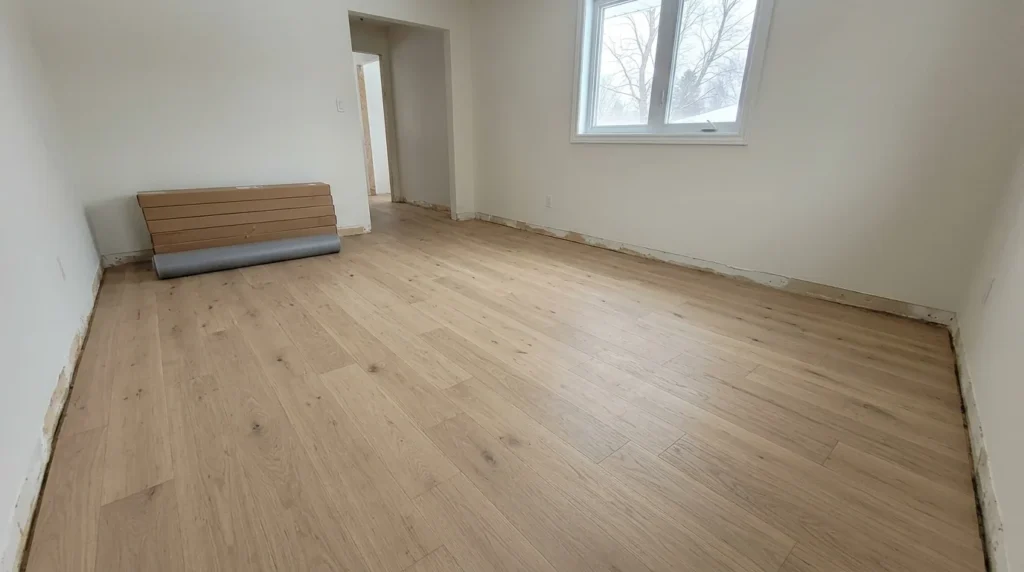
Engineered hardwood flooring bonds a real hardwood top wear layer (0.6 to 6 mm) onto a cross-laminated plywood or HDF core, delivering tighter dimensional stability than 3/4-in. solid planks over concrete slabs and dry winter subfloors. Verified November 2026 Canadian contractor pricing sits 10% to 22% below solid hardwood, with installation labour alone at $2.00 to $7.50/sq ft depending on floating, nail-down, or glue-down methods.
| Province (supply & install, before tax) | Engineered (Low / Typ / High) | Solid (Typ) | Removal | Subfloor prep | Tax |
|---|---|---|---|---|---|
| Ontario | $7.00 / $10.50 / $15.00 | $13.50/sq ft | +$2.50 | +$2.50 | 13% HST |
| Quebec | $8.50 / $13.00 / $18.00 | $14.50/sq ft | +$2.25 | +$3.00 | 14.975% |
| British Columbia | $8.00 / $12.00 / $17.00 | $14.50/sq ft | +$2.75 | +$3.00 | 5% GST* |
| Alberta | $7.60 / $11.40 / $16.80 | $13.80/sq ft | +$2.60 | +$2.85 | 5% GST |
In BC, turnkey supply-and-install real-property contracts charge 5% GST to the homeowner (contractors embed BC PST inside their material rate). By comparison, luxury vinyl plank (LVP/SPC) averages $6.00 to $7.50/sq ft installed and laminate $5.50 to $6.50/sq ft; see our vinyl plank vs laminate guide if waterproof performance outranks real wood.
Wear layer thickness (2 to 6 mm), resanding and CANFER
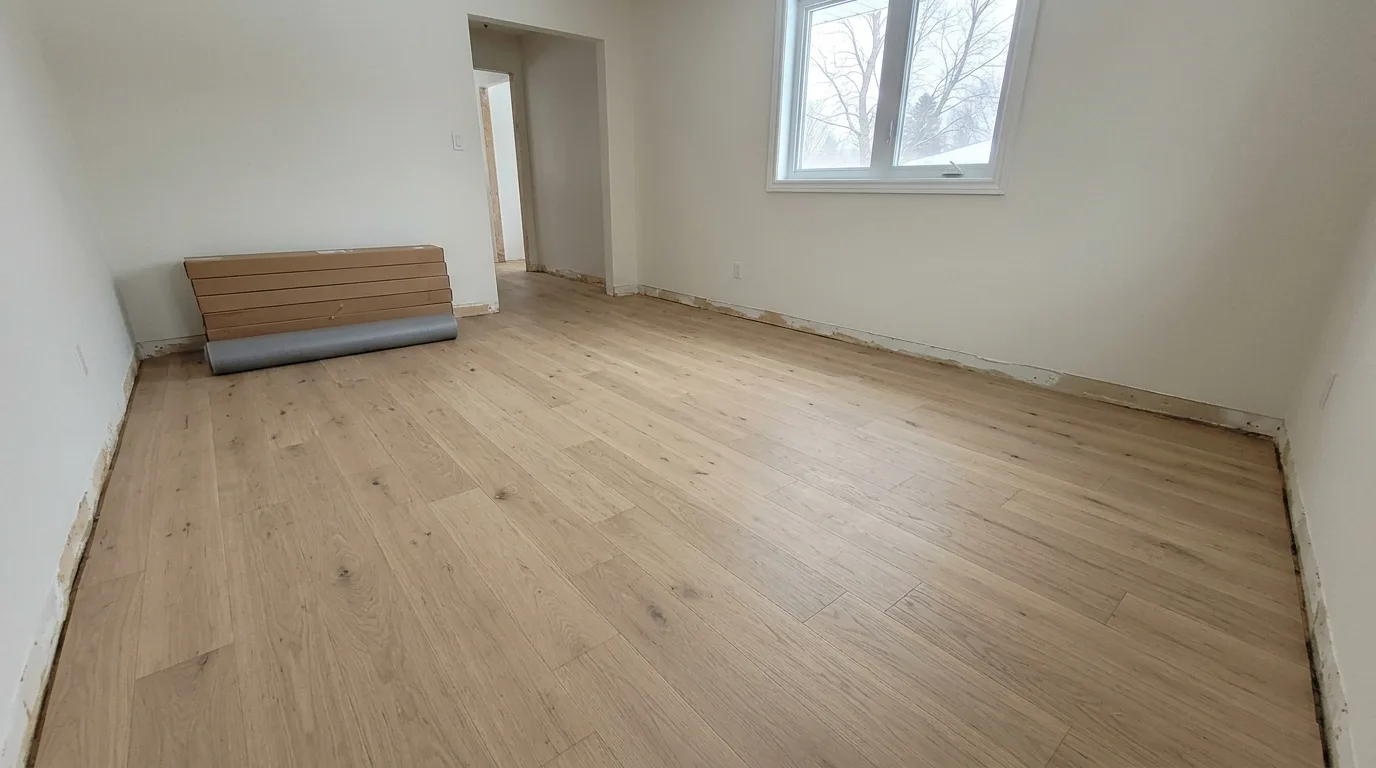
Total plank thickness (3/8, 1/2, or 5/8 in.) never reveals refinishing potential: only the solid top wear layer counts. Under National Wood Flooring Association (NWFA) guidelines, drum sanding removes 0.5 to 1.0 mm per pass, and sanding under 2.5 mm (3/32 in.) risks cutting into the plywood core.
| Wear layer | Veneer & core | Full resandings | Lifespan | Best Canadian room fit |
|---|---|---|---|---|
| 0.6–1.5 mm | Rotary veneer on HDF/ply | 0 (recoat only) | 10–15 yrs | Spare bedroom, short hold |
| 2.0 mm | Sliced or thin sawn | 0–1 (below 2.5 mm) | 15–25 yrs | Condos, upper bedrooms |
| 3.0 mm | Dry-sawn on 7-ply birch | 1 full sanding | 25–35 yrs | Standard main living areas |
| 4.0 mm | Dry-sawn on 7–9 ply birch | 2 full sandings | 35–50 yrs | Family homes, resale value |
| 6.0 mm | Thick sawn (matches solid) | 3+ full sandings | 50+ yrs | Custom builds, heritage homes |
Every engineered plank sold in Canada with a veneer of 6.4 mm or less over a composite core is governed by the Formaldehyde Emissions from Composite Wood Products Regulations (SOR/2021-148 / CANFER), in force since January 7, 2023. It caps formaldehyde at 0.05 ppm and mandates CANFER or TSCA Title VI labels on every carton. Pick a 7- to 9-ply Baltic birch core over HDF, which swells permanently when wet.

Condo acoustic rules (IIC/FIIC), radiant heat and winter RH
While building codes mandate airborne STC 50 between suites, condo corporations enforce impact noise under statutes such as Ontario’s Condominium Act, 1998. Most GTA, Ottawa, and Vancouver boards require written approval and tested underlayment meeting IIC or FIIC 55 to 60 dB (often 70+ lab IIC), adding $0.75 to $2.00/sq ft.
Over hydronic or electric radiant heating, white oak engineered flooring stays stable if an in-floor sensor caps surface heat at 27°C (80°F); see full limits in our heated floor cost guide. Health Canada advises 30%–50% indoor relative humidity while NWFA warranties demand 35%–55% RH: targeting 35%–45% RH in winter (with a humidifier in Alberta and Ontario) prevents face-checking without window condensation.
RénoClair tip: Secure written condo board approval matching your exact floor assembly (slab + acoustic pad + plank thickness) to the declaration’s IIC/FIIC minimum before ordering cartons. Installing an unapproved pad can trigger a forced tear-out costing $8,000+.
When NOT to spend $10–$18/sq ft on engineered hardwood
Skipping a $10,000+ engineered hardwood install is the smarter financial call in four common Canadian situations:
- Existing 3/4-in. solid hardwood with sandable wood left: professional sanding and three coats of waterborne finish run $3.50 to $5.50/sq ft ($2,800–$4,400 for 800 sq ft), saving 60% to 70%.
- Damp basement slabs without subfloor decoupling: plywood cores delaminate over wet concrete. Choose rigid SPC vinyl ($4.00–$9.00/sq ft) and see our basement insulation guide.
- Large dogs, wet mudrooms, or full bathrooms: standing winter boot meltwater stains seams black within 24 hours, and heavy claws dent softer domestic woods quickly.
- Rentals or dry homes under 25% winter RH: in unhumidified Calgary or Edmonton winters, wide 6.5–7.5 in. planks still gap and face-check even on multi-ply cores.
2-minute homeowner self-check before getting quotes
Four zero-cost checks before inviting estimators cut mid-project change orders by 80%:
- 24-hour taped plastic test (concrete): tape an 18 × 18 in. clear 6-mil poly square on all four edges. Condensation or darkened concrete after 24 hours requires an epoxy moisture barrier or SPC vinyl.
- 6-foot straightedge flatness check: NWFA tolerances allow at most 1/8 in. (3 mm) over 6 ft or 3/16 in. (4.8 mm) over 10 ft. Bigger dips require $1.50 to $5.00/sq ft of self-levelling.
- Winter hygrometer & pre-1990 asbestos check: confirm 35%–45% winter RH. Before scraping pre-1990 9×9 in. vinyl tiles or black mastic, pay $100–$300 for an accredited lab asbestos test.
- Wear layer & door-clearance check: verify a 3–4 mm sawn top face on a cut sample and check clearance under entry doors and dishwashers for 1/2 to 3/4 in. total height plus pad.
5 hidden traps in lowball engineered hardwood quotes
Teaser quotes at $5.99 to $7.50/sq ft installed routinely omit prep and trim that inflate final bills by 25% to 45%. Under consumer statutes like Ontario’s renovation contract rules (10% maximum overage on written estimates), lock in these five written clauses.
| Lowball quote trap | Hidden cost or risk | Written clause before deposit |
|---|---|---|
| 0.6–1.5 mm veneer billed as “5/8 in. wood” | Zero resandings; wears like laminate | Exact dry-sawn wear layer (≥ 3 mm) and 7–9 ply birch core. |
| Subfloor prep marked “TBD after demo” | +$1.50 to $5.00/sq ft (+$1,200–$4,000) | Laser flatness check pre-contract and capped per-bag leveller price. |
| 10% waste, urethane glue & trim excluded | +$2.00 to $4.50/sq ft extra invoice | Itemize net area + 10% waste, glue/pad brand, baseboards, and nosings. |
| Acclimation & moisture logging skipped | Cupping, gapping & voided warranty | 48–72 h on-site acclimation and recorded moisture readings. |
| Tile tear-out or pre-1990 mastic ignored | +$4.00–$7.00/sq ft demo; asbestos halt | Separate removal rate per material plus disposal bin fees. |
Worked example: 800 sq ft Canadian main floor with tax
Below is an 800 sq ft detached or semi-detached main floor using RénoClair’s November 2026 typical rates (including old floor removal, subfloor levelling, and 10% waste = 880 sq ft ordered). For a 500 sq ft Toronto condo with no tear-out or levelling, base install runs $5,250.00 before tax ($5,932.50 with 13% HST), or $7,750.00 ($8,757.50 with HST) with full prep.
| Line item (800 sq ft main floor, typical) | Ontario (13%) | Quebec (14.975%) | BC (5% GST) | Alberta (5%) |
|---|---|---|---|---|
| Engineered hardwood, supply & install (+10%) | $8,400.00 | $10,400.00 | $9,600.00 | $9,120.00 |
| Old flooring removal & disposal | $2,000.00 | $1,800.00 | $2,200.00 | $2,080.00 |
| Subfloor levelling & preparation | $2,000.00 | $2,400.00 | $2,400.00 | $2,280.00 |
| Subtotal before tax | $12,400.00 | $14,600.00 | $14,200.00 | $13,480.00 |
| Provincial / federal tax | $1,612.00 | $2,186.35 | $710.00 | $674.00 |
| Installed total with tax | $14,012.00 | $16,786.35 | $14,910.00 | $14,154.00 |
| Base-only total w/ tax (no prep) | $9,492.00 | $11,957.40 | $10,080.00 | $9,576.00 |
Removing mortar-set tile raises demo to $4.00–$7.00/sq ft (+$1,200 to $3,600 on 800 sq ft), while hardwood stairs add $80 to $150+ per step. Test your exact rooms and province in our flooring cost calculator.
Frequently asked questions
How much does engineered hardwood flooring cost per sq ft installed in Canada?
In November 2026, engineered hardwood flooring supplied and installed costs $7.00 to $18.00/sq ft before tax (10% waste included): typically $10.50 in Ontario, $11.40 in Alberta, $12.00 in BC, and $13.00 in Quebec. Run your exact square footage in our flooring cost calculator.
What wear layer thickness can be sanded and refinished?
Buy at least 3 mm dry-sawn for one full sanding and 4 mm for two. Under NWFA standards, sanding thinner than 2.5 mm (3/32 in.) risks burning into the plywood core.
Can you install engineered hardwood over a concrete basement slab?
Yes, if a 24-hour taped plastic test stays dry and you use a vapour barrier or moisture-cure urethane adhesive. On damp slabs, pick waterproof SPC vinyl instead.
Does engineered hardwood work over radiant floor heating?
Yes, provided the product is radiant-rated, an in-floor sensor caps heat at 27°C (80°F), and you choose stable species like white oak over maple or beech.
What acoustic rating do Canadian condos require for wood floors?
Most Ontario, BC, and Quebec condo declarations require an acoustic assembly rated at least IIC or FIIC 55 to 60 dB (often 70+ lab IIC). Secure written board approval first.
Is engineered hardwood better than solid wood for Canadian winters?
Yes, especially for wide planks over 5 in.: cross-laminated birch cores move and gap far less than solid 3/4-in. planks at 30%–35% winter RH and allow glue-down over concrete.
Do flooring replacements qualify for Canadian energy rebates?
No. Flooring does not qualify for Ontario Home Renovation Savings, Quebec LogisVert/Rénoclimat, or BC Hydro grants, though accessible remodels may qualify for federal tax credits when eligible.
The bottom line
In November 2026, Canadian engineered hardwood flooring runs $7.00 to $18.00/sq ft before tax installed ($10.50 typical in Ontario, $11.40 Alberta, $12.00 BC, $13.00 Quebec), or $14,012 to $16,786 with tax for an 800 sq ft main floor with removal and levelling. Insist on a 3–4 mm sawn wear layer over CANFER-compliant birch plywood, get written condo IIC approval, and verify your budget in our flooring cost calculator before signing.
Sources
- Justice Canada: Formaldehyde Emissions from Composite Wood Products Regulations (SOR/2021-148 / CANFER, 0.05 ppm cap, effective January 7, 2023), checked November 22, 2026.
- NWFA: subfloor flatness (3/16 in. over 10 ft), 2.5 mm minimum sandable wear layer, and 35%–55% RH standards, checked November 22, 2026.
- Government of Ontario: Condominium Act, 1998 (board approval and acoustic rules), checked November 22, 2026.
- Government of Ontario: renovation contract rights and 10% written estimate cap, checked November 22, 2026.
- RénoClair pricing dataset (2026.Q4-flooring-1, November 2026); see our sources and methodology.