Official sources checked on November 24, 2026. Prices: published installed prices from Ontario fabricators, a national retailer and Canadian price guides, November 2026, before tax.
Quartz vs granite in Canada comes down to care and use more than price. In Ontario, mid-range quartz usually costs about $75 to $110 per square foot installed and common granite about $65 to $120, before tax, so a typical 40 sq ft kitchen counter lands between roughly $4,500 and $5,000 with HST for either material. Quartz is non-porous and never needs sealing; granite tolerates heat better but should be sealed when water starts soaking in. Health Canada says granite is not a significant source of radon, while the dust from cutting engineered quartz is a serious hazard for fabrication workers, not for your kitchen once installed.
To see what countertops mean for the whole project, try our kitchen renovation cost calculator (prices for Ontario, British Columbia, Alberta and Quebec). It estimates the full kitchen, so use the per-square-foot figures below for the countertop line.
In this guide
Quartz vs granite at a glance
The short version, with the details and sources in the sections below.
| Point | Quartz (engineered stone) | Granite (natural stone) |
|---|---|---|
| What it is | Crushed quartz bound with resins and pigments | A single slab of natural rock, cut and polished |
| Installed price, Ontario (mid-range) | About $75–$110 per sq ft | About $65–$120 per sq ft |
| Sealing | Never needed (non-porous) | Needed when water darkens the stone; frequency depends on the slab |
| Heat | More sensitive: resins can scorch or discolour | Tolerates hot cookware better; use trivets anyway |
| Stains | Very resistant | Resistant when sealed; light, porous slabs can absorb oil and wine |
| Look | Uniform colour, consistent from sample to slab | Every slab is unique; choose the actual slab |
| Health facts | Silica dust is a hazard for workers who cut it | Health Canada: not a significant radon source |
| Best for | Busy family kitchens, low maintenance | Bakers and cooks, unique look, outdoor-adjacent use |
What quartz and granite actually are
Quartz countertops are a manufactured product; granite is quarried rock. According to the Canadian Centre for Occupational Health and Safety (CCOHS) fact sheet on engineered stone countertops, engineered stone is made from crushed quartz rock, resins, additives and other materials, and it can contain 90% to 97% silica, compared with less than 45% for granite and usually less than 5% for marble.
That composition explains most of the practical differences. The resin makes quartz non-porous and very consistent in colour, but it is also the part that reacts to high heat. Granite is a mix of minerals formed in the earth: each slab has its own pattern and some natural porosity, which is why it is sealed.
Do not confuse quartz with quartzite. Quartzite is a natural rock sold in slabs like granite, with its own price range and care needs; a showroom label that says “quartzite” is not engineered quartz.
Quartz vs granite price in Canada (2026)
The price ranges overlap: entry-level granite can be the cheapest stone option, while rare or imported granite is the most expensive. The table below summarizes installed prices published in 2026 by six Ontario and national sources (a Toronto fabricator, a Toronto renovation company, an Ontario builders’ price guide, a national home-improvement retailer and two Canadian price-guide sites), for 3 cm slabs including templating, fabrication, a standard edge, delivery and installation, before tax.

| Tier (Ontario, installed, before tax) | Quartz per sq ft | Granite per sq ft |
|---|---|---|
| Entry level / common colours | $55–$85 | $45–$85 |
| Mid-range (most kitchens) | $75–$110 | $65–$120 |
| Premium / designer or exotic slabs | $110–$155 | $95–$150+ |
Two things move the price more than the material name. For quartz, it is the collection: plain whites and greys sit in the lower tiers, while marble-look patterns with long veins sit at the top. For granite, it is the slab itself: common, locally stocked colours are inexpensive, and imported or exotic slabs can exceed premium quartz.
Extras that are often left off the first price
| Item | Typical published price (Ontario, 2026) |
|---|---|
| Undermount sink cutout and polishing | $150–$300 each (some shops include it) |
| Cooktop cutout | $125–$150 each |
| Upgraded edge (ogee, mitre, bullnose) | $10–$40 per linear foot; eased edge usually included |
| Removal and disposal of the old countertop | $200–$700 |
Other provinces and sales tax
We found the most published prices for Ontario. One Calgary fabricator’s 2026 guide gives wider ranges (about $70–$150 per sq ft for quartz and $50–$200 for granite), so ask for at least three written quotes wherever you live. Sales tax is added on top: according to the Canada Revenue Agency GST/HST rate table, Ontario charges 13% HST, Alberta 5% GST with no PST, and British Columbia 5% GST plus a 7% PST, so ask a B.C. fabricator whether PST on materials is already built into the price.
Worked example: a 40 sq ft kitchen counter in Ontario
In this example, common granite costs $452 less than mid-range quartz, but an exotic granite slab costs $1,582 more than the quartz. The kitchen has 40 sq ft of 3 cm countertop (an L-shaped run of cabinets), one undermount sink, an eased edge and an old laminate top to remove.
| Line | Mid-range quartz ($95/sq ft) | Common granite ($85/sq ft) | Exotic granite ($130/sq ft) |
|---|---|---|---|
| Countertop, 40 sq ft installed | $3,800 | $3,400 | $5,200 |
| Undermount sink cutout | $200 | $200 | $200 |
| Remove and dispose of old top | $400 | $400 | $400 |
| Subtotal before tax | $4,400 | $4,000 | $5,800 |
| HST 13% | $572 | $520 | $754 |
| Total with HST | $4,972 | $4,520 | $6,554 |
The per-square-foot rates are the middle of the published Ontario ranges above; the sink cutout and removal use the middle of the extras table. Granite sealer is not counted because most homeowners apply it themselves and no reliable Canadian price set was available. Redo this calculation with your own layout and see the rest of the kitchen budget in our kitchen renovation cost calculator.
Heat, stains, scratches and chips: daily use
Both materials are hard and durable enough for a family kitchen; the real differences are heat and stains.
- Heat: granite tolerates hot cookware better because it contains no resin. Quartz resins can scorch, yellow or crack under a hot pot or a slow cooker left in one spot. Use trivets on both and read the manufacturer’s care and warranty guide to see whether heat damage is excluded.
- Stains: quartz does not absorb liquids. Granite resists stains when sealed, but light-coloured, more porous slabs can darken from oil, wine or coffee if the sealer has worn off.
- Scratches: both resist normal knife contact, but cutting directly on stone dulls knives quickly. Use a cutting board.
- Chips: edges and corners near the sink and dishwasher take the most knocks. A rounded or eased edge chips less than a sharp square edge on either material.
- Sunlight: if the counter sits next to a sunny window or will be used outdoors, ask whether the quartz collection is rated for UV exposure; natural granite is not affected in the same way.
Sealing and maintenance
Quartz needs only soap and water; granite also needs a sealer when the stone starts absorbing water. There is no single official interval for resealing granite: it depends on the slab’s porosity and the sealer used. Instead of a fixed “once a year” rule, use the water test.
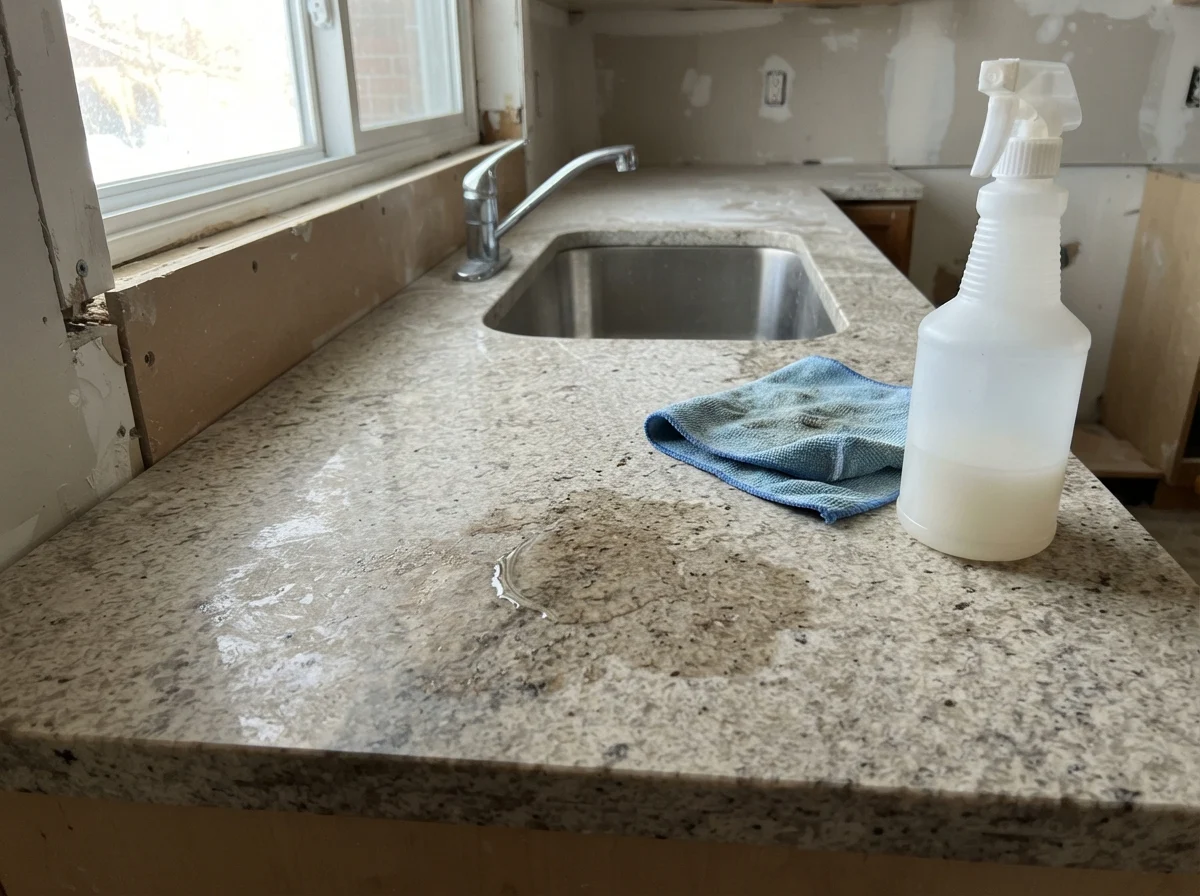
- Pour a small puddle of water (about the size of a coaster) on a busy area, near the sink or the stove.
- Wait several minutes, then wipe it off.
- If the stone has darkened under the water, it is absorbing liquid: clean, let dry and apply a stone sealer following the label.
- If the water beads and the stone stays the same colour, there is no need to seal yet.
For daily cleaning, use mild dish soap and a soft cloth on both. Avoid bleach, vinegar and abrasive pads on granite (they wear down the sealer and the polish) and avoid harsh solvents on quartz.
RénoClair tip
Ask the fabricator to seal granite before installation and write it on the quote, then do the water test after three months. Keep a small offcut of your slab: it lets you test a cleaner or a sealer before using it on the counter.
Health questions: silica dust and radon
Quartz: silica dust is a hazard for workers who cut it
The risk is in cutting, grinding and polishing engineered stone, not in using an installed countertop. CCOHS describes silicosis as an incurable lung disease and lists workers who manufacture, finish, size and install engineered stone as at risk; it recommends wet cutting and HEPA dust collection on tools. The Government of Ontario issued an alert on silica exposure during countertop manufacturing and installing (October 27, 2023), noting that engineered stone can contain up to 95% silica and that the risk is especially high for workers using hand-held tools to cut or grind it.
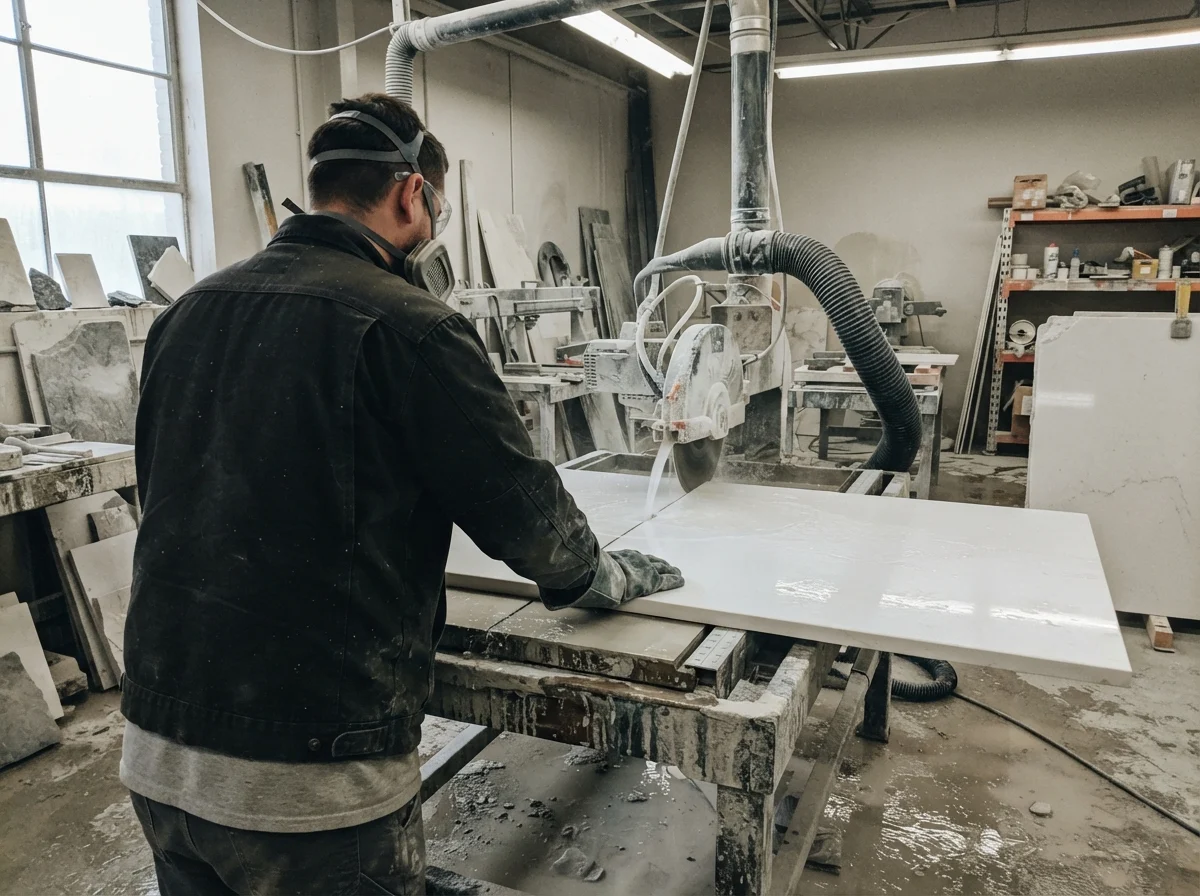
In Australia, governments banned engineered stone benchtops, panels and slabs on July 1, 2024. Safe Work Australia states that installed engineered stone does not pose a safety risk in a home as long as it is not processed (cut or polished). The Canadian occupational health pages we checked on November 24, 2026 (CCOHS, Ontario, and a WorkSafeBC article in the BC Medical Journal) describe exposure limits and controls, not a ban.
What this means for you: ask the fabricator to make all cuts, including sink and cooktop holes, in the shop with wet methods, and do not cut or grind quartz yourself during a renovation.
Granite: not a significant radon source
Granite countertops are not the radon problem in Canadian homes; the soil under the house is. Health Canada’s Radon Reduction Guide for Canadians (February 2023) says building materials such as granite are not a significant source of radon in Canada, and that a 2010 Health Canada study of 33 types of granite commonly purchased in Canada found none with significant radon levels. The U.S. EPA’s page on granite countertops and radiation reaches the same conclusion.
The Canadian radon guideline is 200 Bq/m³, and Health Canada recommends a long-term test of at least three months in fall or winter. If radon worries you, test the lowest lived-in level, whatever your counter is made of: see our guide to the radon test for Canadian homes.
Quartz or granite: which should you choose?
Choose quartz for low maintenance and a uniform look; choose granite for heat tolerance, a one-of-a-kind slab or the lowest price on a common colour.
- Busy family kitchen, no time for upkeep: quartz. No sealing, very stain resistant.
- You bake or cook a lot and set hot pans down: granite, still with trivets.
- Tight budget: get quotes on common, locally stocked granite colours and on the entry collection of quartz; at the low end, granite is often slightly cheaper.
- White marble look: marble-look quartz is usually easier to live with than real marble, but it sits in the top price tier.
- Bright window or covered outdoor kitchen: granite, or a quartz collection explicitly rated for UV.
- Resale: both are seen as an upgrade over laminate; we found no Canadian data showing that one adds more value than the other.
Comparing floors for the same kitchen? See our comparison of vinyl plank vs laminate flooring. French-speaking readers in Quebec can read our quartz vs granite guide with Quebec prices (in French).
Before you sign: 8 points to put in the countertop quote
- Material, collection or slab name, colour and thickness (2 cm or 3 cm).
- Total square footage measured from a template, not just from your sketch.
- Number and location of seams, especially on an L-shaped or island top.
- Edge profile, and the price per linear foot if it is not the standard eased edge.
- Every cutout: sink, cooktop, faucet and soap-dispenser holes, and who supplies the sink.
- Removal and disposal of the old countertop, and plumbing disconnection and reconnection.
- For quartz: cuts made in the shop with wet methods; for granite: sealing included before installation, and slab selection in person.
- Warranty for fabrication and installation, the manufacturer’s product warranty, and taxes shown separately.
Frequently asked questions
Quartz vs granite: which is cheaper in Canada?
Neither is always cheaper. In Ontario in 2026, common granite runs about $45–$85 per sq ft installed and entry-level quartz about $55–$85, so granite is often slightly cheaper at the low end, while exotic granite costs more than most quartz. Estimate the rest of your kitchen with our kitchen renovation cost calculator.
How much does a quartz countertop cost per square foot installed?
About $75 to $110 per sq ft for mid-range quartz in Ontario in 2026, before tax, with entry collections from about $55 and designer collections up to about $155. Sink cutouts, upgraded edges and removal of the old top are often extra.
Does granite need to be sealed?
Yes, when the stone starts absorbing water. Do the water test: if a small puddle darkens the granite within a few minutes, it is time to apply a stone sealer. Quartz never needs sealing.
Can you put a hot pan on quartz?
It is not recommended. The resins in engineered quartz can scorch, discolour or crack with direct heat, so check your warranty for heat-damage exclusions. Use a trivet on quartz and on granite.
Do granite countertops give off radon?
Not at levels that matter in Canada. Health Canada tested 33 types of granite sold in Canada in 2010 and found none with significant radon levels; the main source of radon is the soil under the house.
Is a quartz countertop dangerous to have at home?
No. The health risk is silica dust created when engineered stone is cut, ground or polished, which affects fabrication and installation workers. Have all cuts done in the shop and do not cut quartz yourself.
What is the difference between quartz and quartzite?
Quartz countertops are engineered from crushed quartz and resin. Quartzite is a natural rock cut into slabs, like granite, so it has natural variation and its own care needs.
The bottom line
In the quartz vs granite decision, price is rarely the deciding factor: in Ontario both usually cost between $65 and $120 per square foot installed in the mid-range, and the 40 sq ft example lands at $4,520 for common granite and $4,972 for mid-range quartz with HST. Pick quartz if you want zero sealing and stain worries, granite if you need heat tolerance or love a specific slab. In either case, compare three detailed quotes, insist on shop-made cuts for quartz, and use our kitchen renovation cost calculator to place the countertop in your overall budget.
Sources
- CCOHS, Engineered Stone Countertops (page modified October 20, 2026; read November 24, 2026).
- Government of Ontario, Alert: silica exposure during countertop manufacturing and installing (issued October 27, 2023; read November 24, 2026).
- BC Medical Journal / WorkSafeBC, Silicosis and emerging risks to patients working with engineered stone (Vol. 68, No. 1, January–February 2026).
- Safe Work Australia, Engineered stone ban (ban in force since July 1, 2024; read November 24, 2026).
- Health Canada, Radon Reduction Guide for Canadians (February 2023).
- Health Canada, Government of Canada radon guideline (modified September 24, 2025).
- U.S. EPA, Granite countertops and radiation (updated January 12, 2026).
- Canada Revenue Agency, GST/HST and PST rates (read November 24, 2026).
- Countertop prices: published installed prices from a Toronto fabricator, a Toronto renovation company, an Ontario builders’ price guide, a national home-improvement retailer, two Canadian price-guide sites and a Calgary fabricator, collected November 2026. These are planning ranges, not quotes.