
Official sources checked on November 21, 2026.
Basement waterproofing cost in Ontario is usually quoted per linear foot of wall: about $180 per foot before tax for exterior waterproofing (excavation, membrane and new weeping tile; $130 to $260) and about $130 per foot for an interior drainage system ($95 to $185), based on 2026 Ontario price guides. For a typical 140-foot bungalow perimeter, that is roughly $28,500 outside or $22,700 inside with a new sump pump, 13% HST included. Toronto and Ottawa subsidize sump pumps and backwater valves in 2026, but not the drainage work itself.
To price your own walls, enter the length to treat, the method and your province in our foundation waterproofing cost calculator (Ontario, Quebec, British Columbia and Alberta rates). If you are also planning to finish the space afterwards, the basement renovation cost calculator covers framing, insulation and finishes.
In this guide
Basement waterproofing cost in Ontario at a glance
The table uses the same Ontario rates as our calculator (data reviewed November 13, 2026). Prices are installed, before 13% HST, for a typical single-family home with normal access and depth.
| Work (Ontario, before tax) | Low | Typical | High |
|---|---|---|---|
| Exterior waterproofing: excavation, membrane, new weeping tile (per linear foot) | $130 | $180 | $260 |
| Interior drainage system to a sump (per linear foot) | $95 | $130 | $185 |
| Exterior, 120 linear feet | $15,600 | $21,600 | $31,200 |
| Interior, 120 linear feet | $11,400 | $15,600 | $22,200 |
| Crack injection from inside (per linear foot of crack) | – | $60 | – |
| Sump pit and pump with battery backup | – | $1,900 | – |
| Backwater valve | – | $1,400 | – |
Not included in these figures: landscaping, removing and rebuilding a driveway, patio or deck, structural repairs, underpinning and iron ochre treatment. Published Ontario price guides (November 2026) show a wide spread, roughly $100 to $300 per foot outside and $70 to $200 inside, which is why two quotes for the same house can differ by thousands of dollars.
Interior vs exterior waterproofing: what you are paying for
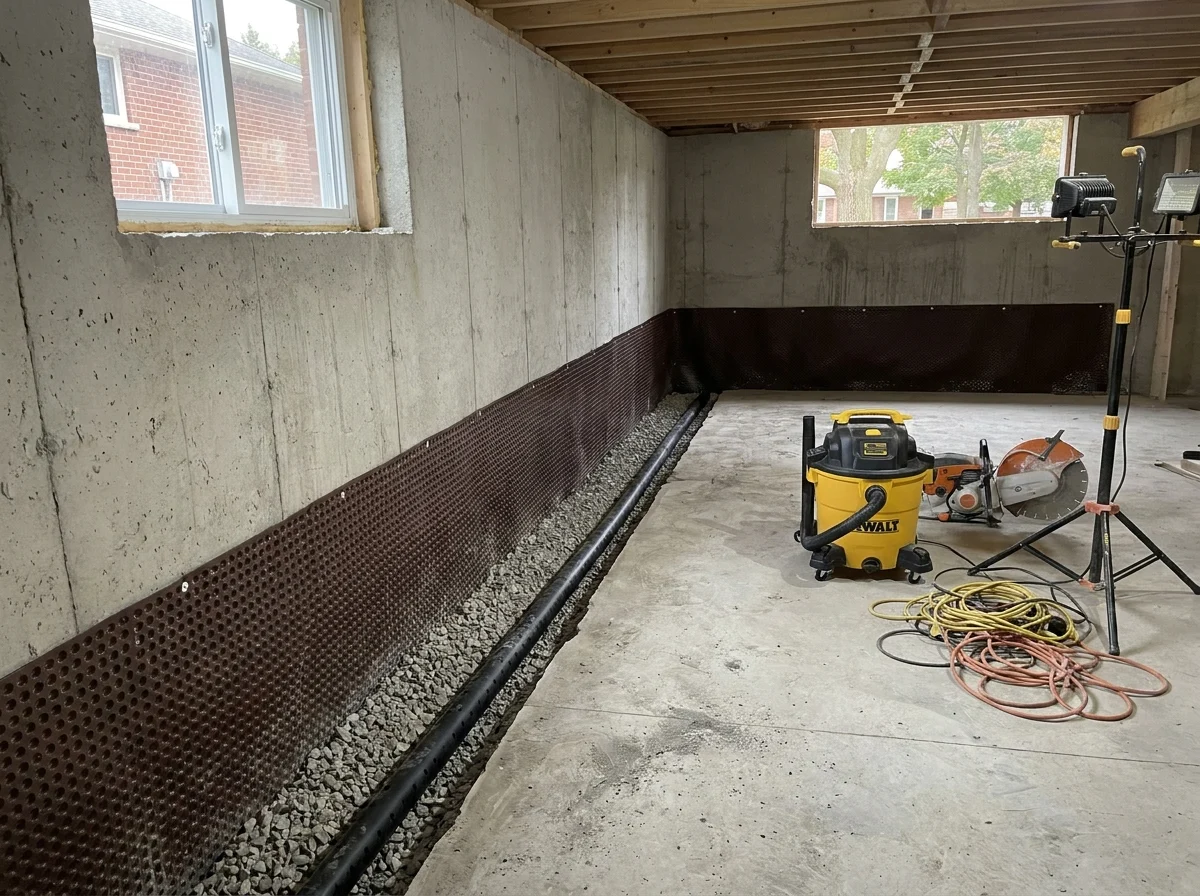
Exterior waterproofing stops water before it reaches the wall; interior drainage manages water that has already come through. That difference explains most of the price gap.
| Exterior waterproofing | Interior drainage | |
|---|---|---|
| What is done | Dig down to the footing, clean the wall, apply a membrane or dimple board, lay new perforated weeping tile in clean stone, backfill | Cut the slab along the wall, lay a perforated pipe in stone at the base of the wall, send the water to a sump pit and pump |
| Typical Ontario rate (before tax) | $180 per linear foot | $130 per linear foot (plus a sump if you have none) |
| Keeps the wall dry? | Yes | No: water still reaches the concrete, then drains away |
| Disruption | Yard, walkways, decks and plantings along the wall | Inside: finished walls and flooring along the perimeter must come out |
| Best when | Water comes through many points, the weeping tile is clogged or crushed, or you want a long-term fix | Outside access is impossible (driveway, neighbour, deck) or the budget is tight |
| Main extra cost risks | Deep basement, hard digging, cracks or iron ochre found once the wall is exposed | A new sump pit and pump, electrical work, refinishing the basement |
A single leaking crack is a different job. Injecting it from inside with epoxy or polyurethane costs about $60 per linear foot of crack in our Ontario rates, far less than either system, but it only fixes that crack. If water shows up along the floor joint on several walls, injection alone is unlikely to be enough.
RénoClair tip
Ask every contractor to write the method, the length in linear feet and the depth on the quote. A quote that says only “waterproof basement” cannot be compared with another one.
Cost per linear foot: what moves the price up or down
- Depth. A full-height basement means more digging than a crawl space or a raised bungalow foundation.
- Access. Narrow side yards, driveways, porches, decks and stairs along the wall slow the work or must be removed and rebuilt (not included in the rates above).
- Soil and backfill. Heavy clay and wet sites need more clean stone and more care around the footing.
- What the crew finds. Cracks, crumbling parging or iron ochre often appear only once the wall is exposed. Keep a 10% to 15% contingency on exterior work.
- Sump and plumbing. Interior systems need a sump pit and pump if the house has none; a backwater valve is a separate plumbing job with its own permit in Toronto and Ottawa.
- Taxes. Ontario adds 13% HST to the invoice (rate confirmed on the Canada Revenue Agency GST/HST rates page).
If the basement is already finished, add the cost of removing and rebuilding drywall and flooring along the treated walls to an interior quote. Our guide to basement insulation in Canada explains how to rebuild those walls so moisture does not get trapped behind the new finish.
Worked example: three ways to fix a 140-foot bungalow in Ontario
A 1970s bungalow measuring 40 by 30 feet has a 140-foot foundation perimeter. Water appears along the floor joint after spring thaw. Here are three options priced with the typical Ontario rates above, before and after 13% HST.
| Option | Calculation (before tax) | Before tax | With 13% HST |
|---|---|---|---|
| A. Exterior waterproofing, full perimeter | 140 ft × $180 | $25,200 | $28,476 |
| B. Interior drainage, full perimeter + new sump pump with battery | 140 ft × $130 + $1,900 | $20,100 | $22,713 |
| C. Exterior on the one wet wall (40 ft) + 8 ft of crack injection | 40 ft × $180 + 8 ft × $60 | $7,680 | $8,678 |
What the numbers say: option B costs about $5,760 less than option A with tax, but water will keep reaching the wall and the sump pump becomes a permanent piece of equipment to maintain. Option C is the cheapest by far, about a third of option B, and makes sense only if a camera inspection or a test pit shows the problem is limited to one wall. With the low and high Ontario rates, option A ranges from $18,200 to $36,400 before tax and option B from $15,200 to $27,800. On option A, a 15% contingency adds about $3,780.
Run the same calculation with your own lengths and options in the foundation waterproofing cost calculator: it shows low, typical and high values for Ontario and emails you the detailed budget.
How Ontario compares with British Columbia and Alberta
Our calculator uses the following typical rates for the same 120-foot reference job (before tax, November 2026). Taxes differ: 13% HST in Ontario, 5% GST in Alberta and British Columbia, where the contractor pays PST on materials that become part of the house and includes it in the price.
| Province | Exterior, 120 ft (typical) | Interior, 120 ft (typical) | Exterior per foot (typical) |
|---|---|---|---|
| Ontario | $21,600 | $15,600 | $180 |
| British Columbia | $23,400 | $17,400 | $195 |
| Alberta | $21,600 | $15,600 | $180 |
Toronto and Ottawa subsidies in 2026: what they cover
No Ontario or federal program pays for basement waterproofing itself in 2026, but several cities subsidize the plumbing devices that keep sewer water out. The two largest programs, checked on their official pages on November 21, 2026:

| Item | City of Toronto (work on or after Nov. 12, 2025) | City of Ottawa |
|---|---|---|
| Backwater valve | 80% of the cost, max $1,600 per device (up to 2 devices) | Up to $1,000 (indoor sanitary or storm valve); up to $2,500 for an outdoor storm valve |
| Sump pump | 80%, max $2,250 (1 device) | With battery backup: up to $1,500 in an existing pit, up to $3,000 if a pit is built |
| Sump pump battery backup | 80%, max $300 extra | Included in the sump pump amounts |
| Foundation drain severance and capping | 80%, max $400 (labour, materials and taxes) | Not listed |
| Plumbing assessment | 80%, max $500 | Not listed |
| Building permit fee | Not listed | 100% of the current fee |
| Maximum | Up to $6,650 per property | Lesser of the maximum or the cost of the work |
Toronto conditions, per the City of Toronto Basement Flooding Protection Subsidy Program page (modified November 6, 2026): you must be the registered owner of a single-family home, duplex, triplex or fourplex; your downspouts must be disconnected (or exempted); the contractor must hold a valid City of Toronto business licence at the time of the work; a building permit and inspection are required for a backwater valve; and you apply online within two years of the work. Funding is first-come, first-served.
Ottawa conditions, per the Residential Protective Plumbing Program page: the home must be built before January 1, 2004 for storm-side work or before January 1, 2012 for sanitary-side work; you need a building permit before installation and an inspection report; you apply within one year of the permit date; and repairs or replacements of existing devices are not eligible.
Applied to option B above, the Toronto sump pump subsidy would be about $1,520 (80% of $1,900 before tax). Adding a $1,400 backwater valve would bring a further $1,120. The subsidy is calculated on your actual itemized invoice, so ask the plumber to list the pump, the battery backup and the valve separately.
Does home insurance cover a leaking basement?
Usually not for seepage through the foundation. The Insurance Bureau of Canada notes that water entering through cracks in the foundation and basement walls is generally excluded, and that sewer backup is covered only if you bought optional sewer backup coverage (IBC, July 17, 2025). Overland flood coverage is a separate option as well; the Government of Canada says flooding is not typically included in a standard policy and that the average cost to repair a flooded basement is over $40,000 (Canada.ca, overland flood insurance).
Practical consequence: waterproofing is almost always paid out of pocket, while a backwater valve and a sump pump with battery backup protect against the kind of event some policies do cover. Tell your insurer when you install them and keep the invoices.
Before you dig: locates, permits and a quote checklist
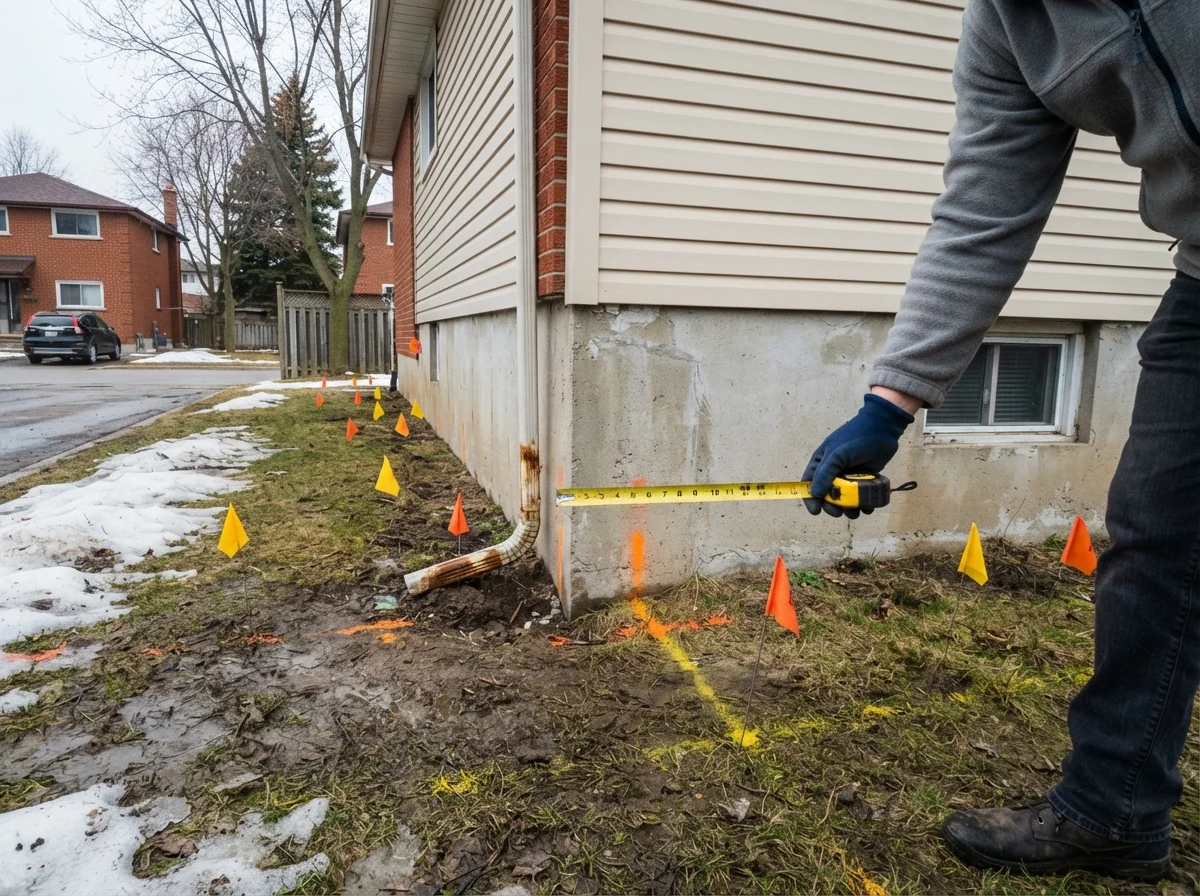
Book a utility locate before any excavation. In Ontario, locate requests are free and go through Ontario Dig Authority (formerly Ontario One Call), at least 5 business days before a single-address project. Private lines such as your sewer lateral are not located by this service; the homeowner arranges a private locate.
Check with your city whether your scope needs a permit. Toronto and Ottawa both require a building permit for a backwater valve, and Ottawa requires one for its subsidized devices.
Not sure whether your project needs a City of Toronto permit, or what it costs? Our guide to building permits in Toronto lists the 2026 fees, including $38.67 for a backwater valve or sump with pump, and what happens if you start work first.
Quote checklist (ask for each item in writing):
- Method (exterior, interior or crack injection) and the exact walls and linear feet treated.
- Depth of excavation and whether the old weeping tile is replaced or only cleaned.
- Membrane or dimple board type, drain pipe with filter fabric, clean stone, and how the window wells are drained.
- Where the water goes: existing storm connection, new sump pit, discharge location away from the foundation.
- What is excluded: driveway, deck, landscaping, interior finishes, structural repairs, iron ochre.
- Price per extra foot and per crack if more problems appear once the wall is open.
- Written warranty: length, what it covers and whether it transfers to a buyer.
- For Toronto subsidies: the contractor’s City business licence number and an itemized invoice.
RénoClair tip
Before paying for full excavation, ask for a camera inspection of the weeping tile and a look at the grading and downspouts. Water pooling against the wall from a short downspout is a far cheaper fix than a new drainage system.
Common mistakes that raise the bill
- Fixing the inside before the outside. Grading that slopes toward the house and downspouts that discharge at the wall send water straight to the foundation. The City of Toronto recommends draining downspouts about two metres away from the foundation where feasible (how to prevent basement flooding).
- Finishing a damp basement. Drywall and carpet over a wall that still leaks trap moisture and mould. Solve the water first; our winter home maintenance checklist for Ontario covers the seasonal checks.
- Comparing quotes by total only. Compare the price per linear foot for the same method and the same walls.
- Skipping the backwater valve. Waterproofing does nothing against sewer backup through floor drains.
- Forgetting radon. Cutting the slab for an interior drain is a good moment to add a radon sub-slab pipe if your test is high; see radon mitigation system cost in Canada.
- Ignoring maintenance. The federal flood-ready guidance lists backwater valves to inspect annually, sump pumps to test annually and foundations to inspect annually (Canada.ca, actions to reduce flood damage).
If you read French, our guide to water infiltration in the basement (in French) walks through seven causes and how to diagnose them.
Frequently asked questions
What is the average basement waterproofing cost in Ontario?
About $180 per linear foot before tax for exterior waterproofing with new weeping tile and about $130 per foot for an interior drainage system (2026 Ontario rates). For 120 feet, that is about $21,600 outside or $15,600 inside before 13% HST. Price your walls with the foundation waterproofing cost calculator.
Is interior or exterior basement waterproofing better?
Exterior waterproofing is the more complete fix because it keeps water off the wall. Interior drainage costs less and avoids digging, but water still reaches the concrete and you depend on a sump pump.
How much does it cost to waterproof one basement wall?
For a 40-foot wall, about $7,200 before tax outside at $180 per foot, or $5,200 inside at $130 per foot, plus a sump pump if an interior drain needs one.
How much does crack injection cost?
About $60 per linear foot of crack in our Ontario rates. It fixes a single leaking crack, not water entering along the base of several walls.
Does Toronto give a rebate for basement waterproofing?
Not for the waterproofing itself. Toronto pays 80% of eligible costs for backwater valves (max $1,600 each), a sump pump (max $2,250), a battery backup (max $300), foundation drain severance (max $400) and a plumbing assessment (max $500), up to $6,650 per property.
Does home insurance pay for basement waterproofing?
No. Insurers generally exclude water that seeps through foundation cracks, and sewer backup is covered only with optional coverage, according to the Insurance Bureau of Canada.
Do I need a permit to waterproof my basement in Ontario?
It depends on your city and scope. A building permit is required for a backwater valve in Toronto and Ottawa; ask your building department about excavation and drainage work, and always book a free utility locate before digging.
Is HST charged on basement waterproofing in Ontario?
Yes. The 13% HST applies to the invoice, so a $20,100 interior job becomes about $22,713.
The bottom line
In Ontario, plan on about $180 per linear foot for exterior waterproofing and $130 for interior drainage before tax, with wide ranges driven by depth, access and what the crew finds. Exterior work is the long-term fix; interior drainage is the budget option when you cannot dig; crack injection is for a single crack. Add 13% HST, a contingency, and the city subsidies for the backwater valve and sump pump, which you claim separately. Our foundation waterproofing cost calculator gives a first budget in a minute.
Sources
- City of Toronto, Basement Flooding Protection Subsidy Program (modified November 6, 2026; read November 21, 2026).
- City of Toronto, How to prevent basement flooding (modified April 17, 2026).
- City of Ottawa, Residential Protective Plumbing Program (read November 21, 2026).
- Insurance Bureau of Canada, Good, better, best basement flood protection (July 17, 2025).
- Government of Canada, Overland flood insurance and Actions to reduce flood damage (modified March 23, 2026).
- Ontario Dig Authority, Locates overview (read November 21, 2026).
- Canada Revenue Agency, GST/HST rates (read November 21, 2026).
- CMHC, About Your House: Avoiding basement flooding (revised 2011), background reading.
- Prices: rates of the RénoClair foundation waterproofing cost calculator (data version 2026.Q4-foundation-2, reviewed November 13, 2026), cross-checked against three published Ontario price guides (November 2026). Not a quote.