Official sources checked on November 15, 2026.
The window replacement cost in Ontario is about $500 to $1,100 per standard white vinyl (PVC) double-glazed window, supplied and installed as an insert, with $750 as a typical price before 13% HST. For a house with 10 windows, that is about $7,500 before tax ($5,000 to $11,000), or $8,475 with HST at the typical price. Full-frame installation, triple glazing, fibreglass frames and patio doors push the total higher, and the only Ontario rebate for windows in 2026 requires two energy assessments and a booking before November 30.
To run the numbers for your own house, use our window replacement cost calculator: it covers Ontario, British Columbia, Alberta and Quebec and uses the same price grid as this guide.
In this guide
Window replacement cost in Ontario at a glance
These are installed prices per opening in Ontario, before HST, for a typical house. The typical column is what most standard projects land near; the high column covers large sizes, custom shapes and difficult access.
| Window or door (supplied and installed) | Low | Typical | High |
|---|---|---|---|
| White vinyl (PVC), low-E argon double glazing, insert | $500 | $750 | $1,100 |
| Fibreglass, low-E argon double glazing (estimate) | $600 | $1,050 | $1,760 |
| Hybrid vinyl / aluminum, double glazing | $650 | $950 | $1,400 |
| Vinyl or hybrid, ENERGY STAR Most Efficient triple glazing | $850 | $1,250 | $1,850 |
| Thermally broken aluminum or architectural wood | $1,250 | $1,850 | $2,800 |
| Full-frame installation surcharge (per opening) | $150 | $220 | $320 |
| Bay window or custom large opening | $1,600 | $2,500 | $3,800 |
| 6 ft sliding patio door | $2,200 | $3,200 | $4,800 |
| Insulated steel entry door system | $1,400 | $2,200 | $3,500 |
| Basement egress cut-out and window well (concrete cut) | $1,800 | $2,600 | $3,800 |
RénoClair price grid, November 2026, before tax. Cross-checked against published installed prices from Ontario and national window manufacturers, installers and cost guides (November 2026). These are planning figures, not quotes; only a written quote after a site visit gives the price of your project.
Cost per window by frame material and glazing
White vinyl with low-E argon double glazing is the price baseline in Ontario, and every upgrade adds to it. Most replacement quotes for houses in the province start from this spec because vinyl frames are the least expensive to make and install. Published installed prices from the sellers and cost guides we compared in November 2026 cluster in the same zone as our grid: roughly $500 to $1,200 for a standard vinyl unit.
- Vinyl (PVC), double glazed: $500 to $1,100, typical $750. The default choice for most bungalows, semis and townhouses.
- Fibreglass, double glazed: $600 to $1,760, typical $1,050. Our fibreglass figures are estimates built as the vinyl price plus 20% (low), 40% (typical) and 60% (high). See our comparison of vinyl vs fiberglass windows for where the extra cost makes sense.
- Hybrid vinyl / aluminum: $650 to $1,400, typical $950.
- Triple glazing, ENERGY STAR Most Efficient: $850 to $1,850, typical $1,250, about $500 more per window than standard vinyl double glazing at the typical price.
- Thermally broken aluminum or architectural wood: $1,250 to $2,800, typical $1,850. Usually chosen for design or heritage reasons rather than budget.
Window style also matters. Operating units (casement, awning, sliders) cost more than fixed picture windows of the same size because of the hardware, and bays or bows are priced as a project of their own. When you compare quotes, make sure both contractors priced the same style for each opening.
Insert or full-frame installation: the choice that moves the price
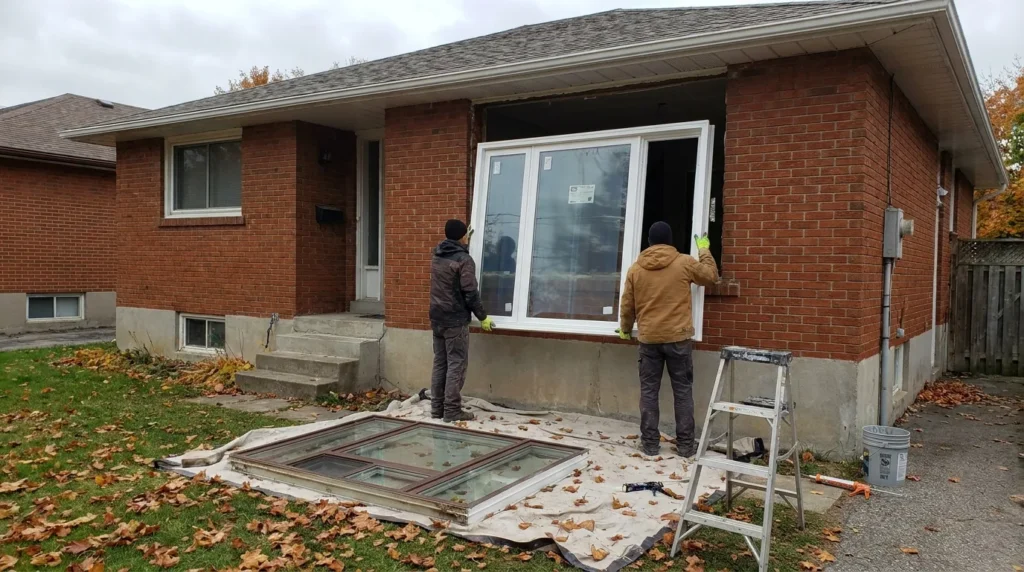
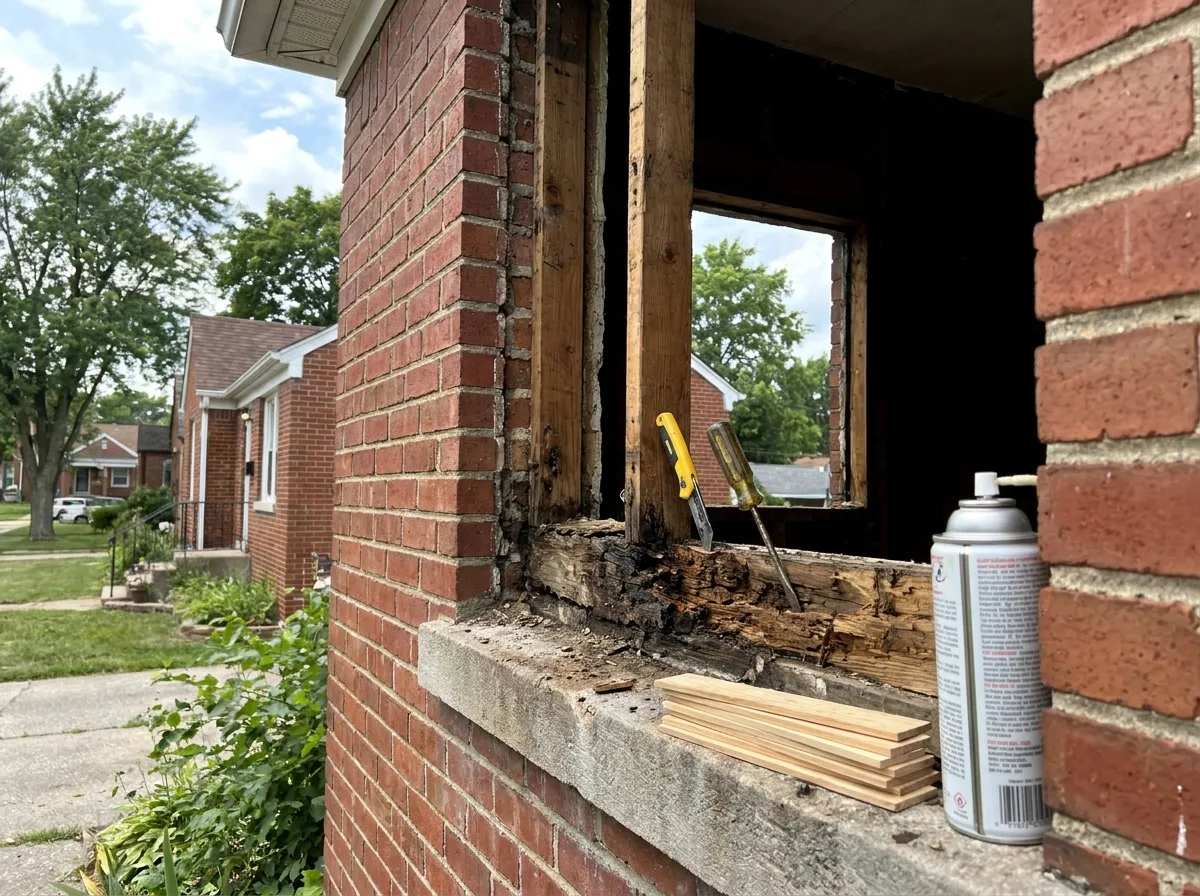
An insert (retrofit) installation is the less expensive option; full-frame installation adds about $150 to $320 per opening ($220 typical) in Ontario. With an insert, the installer removes the old sashes and fits a complete new window unit inside the existing frame, then insulates and seals the gap. With full-frame installation, the old frame comes out down to the rough opening, which lets the installer inspect and repair the structure, re-flash the opening and, often, gain a little glass area.
- Choose an insert when the existing frames are dry, square and solid, and the exterior trim is in good shape.
- Choose full-frame when you see soft or rotten wood, water stains below the sill, drafts around the frame (not just the sash), or when you are replacing exterior cladding at the same time.
- Ask each contractor what happens if rot appears during tear-out: a price per opening written into the contract avoids surprises on installation day.
Replacing only the glass or a sash is a different job (a repair), and it does not count as a window replacement for the Ontario rebate described below: the program terms state that replacing only the glass, sash or door without a frame is not eligible.
Worked example: 10 windows and a patio door
A detached Ontario house with 10 vinyl windows and one 6 ft patio door comes to about $11,140 before tax at typical prices, or $12,588.20 with 13% HST. In this example, eight windows go in as inserts and two need full-frame installation because of rot under the sills.
| Line | Low | Typical | High |
|---|---|---|---|
| 10 white vinyl double-glazed windows | $5,000 | $7,500 | $11,000 |
| Full-frame surcharge on 2 openings | $300 | $440 | $640 |
| 1 sliding patio door, 6 ft | $2,200 | $3,200 | $4,800 |
| Total before tax | $7,500 | $11,140 | $16,440 |
| 13% HST (typical) | $1,448.20 | ||
| Total with HST (typical) | $12,588.20 |

Two variations show what drives the bill. Choosing ENERGY STAR Most Efficient triple glazing for the same 10 windows raises the window line from $7,500 to $12,500 at the typical price, $5,000 more. Choosing fibreglass double glazing raises it from $7,500 to $10,500, $3,000 more. If the house had only the 10 windows as inserts and no door, the bill would be $7,500 before tax and $8,475 with HST.
If this homeowner had already done a pre-retrofit energy assessment under Home Renovation Savings and every unit is ENERGY STAR certified, the 11 rough openings would qualify for $100 each, or $1,100, which would bring the typical total with HST down to $11,488.20. That rebate also requires a second qualifying upgrade and a post-retrofit assessment (details below).
Rerun this example with your own window count, frame material and installation method in our window replacement cost calculator.
Doors, bay windows and basement egress windows
Doors and special openings are priced per unit and often cost two to four times a standard window. In our Ontario grid:
- 6 ft sliding patio door: $2,200 to $4,800, typical $3,200 (see our full patio door replacement cost guide).
- Insulated steel entry door system: $1,400 to $3,500, typical $2,200.
- Bay window or custom large opening: $1,600 to $3,800, typical $2,500.
- Basement egress window with concrete cut-out and window well: $1,800 to $3,800, typical $2,600. This is structural work: cutting a new or larger opening needs a building permit.
If you are replacing an entry door at the same time as windows, ask for both on one quote. The contractor saves a trip, and you can check that the same energy rating level applies to every unit.
Taxes, permits and what a quote should include
Window replacement in Ontario is taxed at 13% HST, and a same-size replacement in a house usually does not need a building permit. The 13% HST rate for Ontario is listed on the Canada Revenue Agency GST/HST rates page. Most contractors quote before tax, so add 13% to compare budgets.
For permits, the City of Toronto’s page “When do I need a building permit” (modified July 21, 2026) says replacing a window or door in an existing opening of a detached house, semi-detached house or single-unit row house does not need a permit, as long as the opening keeps the same location and size, the structural support is not altered and no new exit is created. New openings, enlarged or relocated openings, and window replacement in other building types (for example multi-unit buildings) do need one. Other Ontario municipalities apply the same Building Code but publish their own lists, so check with your city’s building department before enlarging any opening.
For the full list of Toronto projects that do and do not need a permit, with the 2026 City fees, see our building permit Toronto guide.
A complete quote should list, for each opening:
- The frame material, glazing (double or triple, low-E, gas fill) and the ENERGY STAR status with the U-factor or Energy Rating of the model.
- Insert or full-frame installation, and the price per opening if the method changes on site.
- Removal and disposal of the old windows, insulation of the gap with low-expansion foam, exterior caulking, screens and cleanup.
- What is excluded: structural lintels, masonry repair, interior trim painting and any permit fees.
- The product and installation warranties, in writing.
Rebates for window replacement in Ontario (November 2026)
The only provincial rebate for replacement windows in Ontario is $100 per rough opening through the Home Renovation Savings program, and it only works with energy assessments before and after the work. According to the Home Renovation Savings assessment stream page and its program documents (version dated November 2025), read on November 15, 2026:
Before counting on the $100 per opening, read our guide to the window rebate in Ontario: the energy assessment must come first, and the post-renovation assessment has to be booked by November 30, 2026.
- Amount: $100 per rough opening for each window, door, skylight or sliding door replaced with an ENERGY STAR certified model, installed by a professional contractor.
- Minimum: at least three window rough openings, or one door, skylight or sliding door. Replacing only one or two windows does not qualify.
- Assessments: a pre-retrofit home energy assessment before any work starts, and a post-retrofit assessment afterwards. The program reimburses up to $600 toward the cost of the two assessments.
- Two upgrades: you must complete at least two qualifying upgrades; windows count as one. The program page also advertises an extra $500 when you bundle three upgrades.
- Caps: up to $5,000 in total for homes heated mainly with Enbridge natural gas, and up to $10,000 for homes heated with electricity, oil, propane or wood, including the $600 assessment rebate.
- Deadlines: the post-retrofit assessment must be scheduled and entered in the program’s system by November 30, 2026, and completed within 180 days of the pre-retrofit assessment or by December 31, 2026, whichever comes first.
- Keep the ENERGY STAR labels on the windows until the post-retrofit assessment.
RénoClair tip
If you have not had a pre-retrofit assessment yet, do not sign a window contract counting on the 2026 rebate: with custom windows, the November 30 booking deadline leaves almost no time. Price the job without the rebate and check homerenovationsavings.ca for the next program year before you commit.
Our guide to the Home Renovation Savings program explains every measure, and our page on the home energy audit in Ontario covers the assessment itself. Attic insulation is a common second upgrade; you can estimate it with our attic insulation cost calculator.
Federal help for windows has ended. The Greener Homes Grant for Ontario is closed (December 1, 2025 was the deadline for the post-retrofit evaluation), and the Canada Greener Homes Loan is closed too: its page says funding is fully committed and new loan applications cannot be approved. Some price guides still list these programs as available.
ENERGY STAR ratings: what to ask for
An ENERGY STAR certified window in Canada must have a U-factor of 1.22 W/m²·K or lower, or an Energy Rating (ER) of 34 or higher. These are the Version 5.0 criteria in force since January 1, 2020, according to the Natural Resources Canada technical specification (modified December 23, 2024). The page sets one set of values for the whole country, and a model must meet the specification in effect on its date of manufacture.
- U-factor: how much heat passes through the whole window. Lower is better.
- Energy Rating (ER): a single number that combines heat loss, solar heat gain and air leakage. Higher is better.
- ENERGY STAR Most Efficient: a separate, stricter label used for top performers; these are usually triple-glazed and sit in the $850 to $1,850 row of our grid.

Ask each contractor for the U-factor or ER of the exact model on the quote, not a brochure range. If your current problem is fog between the panes, the sealed unit has failed; our guide to condensation on windows in winter explains how to tell it apart from surface condensation caused by indoor humidity.
Common mistakes and a checklist before you sign
- Comparing quotes on different specs. Line up insert vs full-frame, glazing, ENERGY STAR status and window style for each opening before comparing totals.
- Forgetting HST. Add 13% to every before-tax quote, or ask for totals with tax.
- Counting on a rebate you cannot get. The $100 per opening needs a pre-retrofit assessment before work starts, at least three windows, a second upgrade and the 2026 deadlines.
- No plan for rot. Get a written price per opening for switching to full-frame if damage appears.
- Enlarging an opening without a permit. A larger or new opening, including a basement egress window, needs a building permit.
- Vague warranties. Ask for the product warranty and the installation warranty in writing, with what each covers.
Frequently asked questions
How much does window replacement cost in Ontario per window?
A standard white vinyl double-glazed window costs about $500 to $1,100 installed in Ontario, with $750 as a typical price before 13% HST. Fibreglass, triple glazing and full-frame installation cost more. Estimate your own project with our window replacement cost calculator.
How much does it cost to replace 10 windows in Ontario?
About $7,500 before tax for 10 vinyl double-glazed windows installed as inserts ($5,000 to $11,000), or $8,475 with 13% HST at the typical price. Adding a patio door and full-frame work on two openings brings it to about $11,140 before tax.
Is full-frame window replacement worth the extra cost?
Only when the existing frames are damaged, out of square or leaking. Full-frame adds about $150 to $320 per opening ($220 typical) in Ontario, but it lets the installer fix rot and re-seal the rough opening.
Do I need a permit to replace windows in Ontario?
Usually not for a same-size replacement in a house. In Toronto, replacing a window in an existing opening of a detached, semi-detached or single-unit row house needs no permit if the size, location and structural support do not change; enlarging or adding an opening does need one. Check your own municipality.
Is there a rebate for new windows in Ontario?
Yes, but only through the Home Renovation Savings assessment stream: $100 per rough opening for ENERGY STAR certified windows and doors, minimum three windows, with assessments before and after and at least two upgrades. The post-retrofit assessment must be booked by November 30, 2026.
Are triple-pane windows worth it in Ontario?
They cost about $500 more per window in our grid ($1,250 typical vs $750), or $5,000 more for 10 windows. Ask for the U-factor or Energy Rating of both options: any ENERGY STAR model already meets U-factor 1.22 or ER 34.
Does HST apply to window replacement in Ontario?
Yes. Window replacement is taxed at 13% HST in Ontario, so a $7,500 job costs $8,475 with tax.
How much more do fibreglass windows cost than vinyl?
In our Ontario grid, fibreglass double-glazed windows are estimated at $1,050 typical installed, against $750 for vinyl, or $3,000 more on 10 windows.
The bottom line
Budget about $750 per standard vinyl window installed in Ontario, or roughly $7,500 before HST for 10 windows, then add for full-frame work, triple glazing, fibreglass and doors. Get at least three written quotes on the same specification, add 13% HST, and treat the Home Renovation Savings rebate as a bonus only if your pre-retrofit assessment is already done. Our window replacement cost calculator gives you a quick estimate for your own house before you call contractors.
If you are combining new windows with new exterior cladding so flashing and trim are only installed once, check our four-province breakdown of siding replacement cost in Canada.
Sources
- Home Renovation Savings, assessment stream page and Additional Program Eligibility Requirements and Terms and Conditions (version dated November 2025), read November 15, 2026.
- Natural Resources Canada, Windows, doors and skylights – ENERGY STAR Canada technical specification, Version 5.0 (page modified December 23, 2024), read November 15, 2026.
- City of Toronto, When do I need a building permit (modified July 21, 2026), read November 15, 2026.
- Canada Revenue Agency, GST/HST rates, read November 15, 2026.
- Government of Canada, Canada Greener Homes Loan and Closed: Greener Homes Grant – Ontario (pages dated October 29, 2026), read November 15, 2026.
- Prices: RénoClair price grid (November 2026), cross-checked against published installed prices from Ontario and national window manufacturers, installers and cost guides, November 2026.