

Official sources checked on November 3, 2026.
The heat pump water heater rebate in Ontario is $500, paid through the Home Renovation Savings program run by Save on Energy and Enbridge Gas. It is only available in the assessment stream: you need a home energy assessment before any work, at least two qualifying upgrades, and a follow-up assessment. For 2026, that follow-up must be booked by November 30, 2026 and completed by December 31, 2026.
This guide explains who qualifies, why the $500 never comes on its own, three worked examples of what a household could actually receive, and what a heat pump water heater could save on an Ontario electricity bill at the November 1, 2026 prices.
In this guide
Heat pump water heater rebate in Ontario at a glance
| Item | What the official rules say |
|---|---|
| Rebate amount | $500 per home |
| Program | Home Renovation Savings, assessment stream (Save on Energy and Enbridge Gas) |
| Water heater it can replace | A natural gas, oil, propane or electric domestic water heater |
| Equipment | ENERGY STAR certified domestic heat pump water heater on NRCan’s list of eligible products |
| Installer | A licensed and trained professional |
| Minimum work | At least two qualifying upgrades after an initial assessment |
| Assessment rebate | $600, once per participant and home |
| Bonus | $500 for three or more upgrades (follow-up assessment on or after January 5, 2026) |
| Maximum rebates | $5,000 (Enbridge natural gas heated homes) or $10,000 (electricity, oil, propane or wood) |
| 2026 deadlines | Follow-up booked by November 30, 2026; completed within 180 days of the first assessment or by December 31, 2026, whichever comes first |
| Payment | About 60 days by cheque, or 30 days by Interac e-Transfer |
Amounts and conditions come from the program’s assessment stream page and its Additional Program Eligibility Requirements (version date November 2025), both read on November 3, 2026.
Who qualifies for the heat pump water heater rebate
In short: Ontario homeowners in an existing low-rise home, heated either with Enbridge natural gas or with electricity, oil, propane or wood on the provincial grid.
- You own the home. The program page says you must own your home; where there are tenants, the owner applies. Tenants cannot apply.
- Your heating fuel fits one of two groups. Either you are an Enbridge Gas customer heating mainly with a natural gas furnace or boiler, or your home is connected to the Ontario electricity grid through a local utility and heated with electricity, oil, propane or wood. Cornwall Electric customers are excluded from the electricity group.
- The house type is eligible. Detached and semi-detached houses, row houses and townhomes (except stacked townhomes) and mobile homes on a permanent foundation. Multi-unit residential buildings are excluded.
- It is not a new build. The home needs at least six months of occupancy.
- The work comes after the first assessment. Any upgrade completed before the initial assessment does not qualify.
If your home has a hybrid system with an electric heat pump as part of the space heating, the program treats electricity as the primary heating source. One more rule matters for electrically heated homes: if you switch to oil, propane or wood between the two assessments, you lose eligibility.
The two-upgrade rule: why the $500 never comes alone
This is the point most summaries miss. A heat pump water heater on its own does not qualify. The assessment stream requires at least two qualifying upgrades, and the water heater counts as one of them.
Other upgrades you can pair it with in the same stream include:
| Upgrade | Rebate (official table) | Key condition |
|---|---|---|
| Attic insulation | $1,500, $1,200 or $900 | Reach R-50, starting from R-12 or less, R-12 to R-25, or R-25 to R-35; at least 50% of the roof assembly; pro-rated |
| Cathedral ceiling or flat roof | $780 | Reach R-20 or R-28 depending on the starting level |
| Exterior wall insulation | $1,200 to $3,600 | At least 20% of wall area; pro-rated |
| Basement wall insulation | $900 or $1,500 | At least 20% of basement wall area; pro-rated |
| Windows, doors, skylights | $100 per rough opening | At least three windows, or one door, skylight or sliding door; ENERGY STAR replacing non-ENERGY STAR |
| Air sealing | $200 or $250 | Meet the airtightness target in your report, or beat it by 10% |
| Heat pump water heater | $500 | ENERGY STAR, on NRCan’s eligible list, professional installation |
For semi-detached houses and end-unit row houses, wall, basement and crawl space insulation rebates are limited to 75% of the maximum; middle units get 50%. The program also notes that air sealing results vary and recommends choosing it as a third upgrade or later, so a missed target does not drop you below the two-upgrade minimum.
If you only want one upgrade, look at the no-assessment stream instead, which covers heat pumps for space heating, attic insulation and a few others. Our Home Renovation Savings program guide compares both streams. Heat pump water heaters are not part of the no-assessment stream. For attic insulation on its own, see our Ontario attic insulation rebate guide and the attic rebate calculator.
RénoClair tip
Count your upgrades before booking. If the heat pump water heater is your only real project, the $500 is out of reach unless you add a second qualifying upgrade, such as attic insulation or three new windows.
2026 deadlines: book by November 30, finish by December 31
Conclusion first: if you have not yet had your initial assessment, you now have a very short window. As of November 3, 2026, there are 27 days left to get the follow-up assessment scheduled.
| Date | What must happen |
|---|---|
| Before any work | Initial home energy assessment (pre-assessment) by a registered energy advisor |
| November 30, 2026 | Follow-up assessment scheduled and entered in the program’s tracking system |
| December 31, 2026 (or 180 days after your first assessment, if earlier) | Follow-up assessment completed, with at least two upgrades installed |
| After the follow-up | Your energy advisor submits documents; rebate paid in about 60 days by cheque or 30 days by e-Transfer |

The terms say the follow-up assessment must be completed within 180 days of the first one or by December 31, 2026, whichever comes first, and that all follow-ups must be scheduled by November 30, 2026. For anyone starting now, December 31 is therefore the real limit. The documents we read do not say what replaces the assessment stream after 2026; check the terms and conditions page before planning work for 2027.
Worked examples: what three Ontario homes could receive
These examples use only the official amounts. They show how the $500 combines with the other rebates and caps. Contractor prices are not included.
Example 1: gas-heated detached house in Ottawa
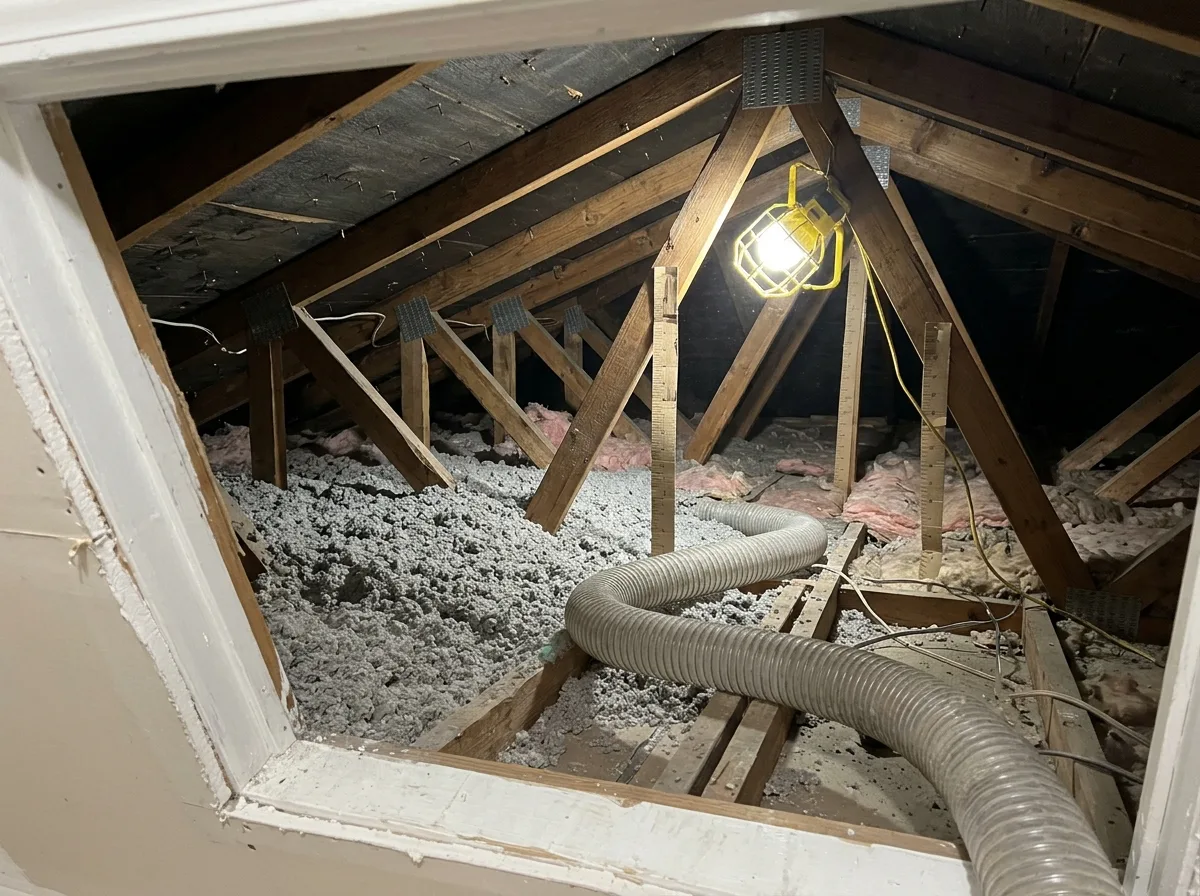
The attic is at about R-10. The owners insulate the full attic to R-50 and replace their gas tank with an ENERGY STAR heat pump water heater.
| Rebate | Amount |
|---|---|
| Attic insulation, R-12 or less to R-50, 100% of the attic | $1,500 |
| Heat pump water heater | $500 |
| Assessment rebate | $600 |
| Total | $2,600 |
That is well under the $5,000 cap for natural gas heated homes. Adding air sealing that meets the base target ($200) would make it three upgrades and unlock the $500 bonus, for $3,300 in total.
Example 2: electrically heated bungalow in Sudbury
The house has baseboard heaters and an electric tank. The owners replace five old windows and the water heater, and do air sealing as a third upgrade.
| Rebate | Amount |
|---|---|
| Five windows at $100 per opening | $500 |
| Heat pump water heater | $500 |
| Air sealing, target beaten by 10% | $250 |
| Bonus for three upgrades | $500 |
| Assessment rebate | $600 |
| Total | $2,350 |
The $10,000 cap for electricity, oil, propane or wood heated homes is far away. If the air sealing target were missed, the home would still have two qualifying upgrades, but would lose both the $250 and the $500 bonus.
Example 3: gas-heated semi-detached house in Hamilton
The owners insulate the full basement wall area by adding about R-12 (our basement insulation guide covers materials) and install a heat pump water heater.
| Rebate | Amount |
|---|---|
| Basement walls, R-10 to R-22, at 75% of $900 (semi-detached) | $675 |
| Heat pump water heater | $500 |
| Assessment rebate | $600 |
| Total | $1,775 |
The semi-detached rule cuts the insulation rebate, but not the $500 for the water heater or the $600 assessment rebate. In all three cases, the heat pump water heater adds exactly $500.
Will a heat pump water heater lower your bill in Ontario?
Yes, if you are replacing an electric tank. According to the U.S. Department of Energy, heat pump water heaters can be two to three times more energy efficient than conventional electric resistance water heaters, because they move heat from the surrounding air into the tank instead of making it with an element.
ENERGY STAR estimates that a certified model can save a household of four about US$550 a year compared with a standard electric water heater, assuming US$0.146 per kWh (ENERGY STAR savings page). Dividing one by the other gives roughly 3,767 kWh saved per year. This is our derived figure, based on U.S. assumptions; your actual use depends on household size, water temperature and where the unit sits.
Applied to the Ontario Energy Board prices effective November 1, 2026:
| OEB price used | Price per kWh | Estimated yearly saving |
|---|---|---|
| Time-of-use off-peak | 9.1¢ | $343 |
| Tiered, tier 1 | 11.2¢ | $422 |
| Tiered, tier 2 | 13.2¢ | $497 |
These figures cover the electricity price only, before delivery and regulatory charges and HST. Even so, they show that the $500 rebate equals about one to one and a half years of savings for a family of four on an electric tank. For a home replacing a gas water heater, the change in bills depends on gas and electricity rates and was not calculated here.
Is your basement right for a heat pump water heater?
Location matters as much as the model. The U.S. Department of Energy says these units need a space that stays between 4.4 °C and 32.2 °C year-round and about 1,000 cubic feet (28.3 m³) of air space around the water heater.
- Room size: roughly 1,000 cubic feet of air, for example an open utility area of about 12 × 11 feet with an 8-foot ceiling (about 1,056 cubic feet), or a door to a larger area.
- Temperature: a heated basement or utility room. Unheated garages and crawl spaces in an Ontario winter fall outside the range.
- Cooling effect: the unit cools the room it is in. In winter, some of that heat comes from your space heating; in summer, ENERGY STAR notes it can help cool and dehumidify the space.
- Backup mode: in cold spaces or with cold incoming water, the unit may switch temporarily to its electric elements, which uses more energy.
- Venting: the air leaving the unit can be exhausted to the room or ducted outdoors.
- Electrical and drain needs: ask your installer about the circuit and the condensate drain for the model you choose.

A furnace room is often a good spot: the energy.gov page notes that installing a heat pump water heater in a space with excess heat increases its efficiency.
Rented water heater? What to check first
Many Ontario homes rent their water heater. The rebate rules talk about replacing your domestic water heater and require the owner of the home to apply; they do not address rental contracts. Before replacing a rented tank, check your contract for buyout and removal terms. Our guide to water heater rental vs buying in Ontario explains buyouts and a 15-year cost comparison.
How to apply, step by step
- Fill out the form on the assessment stream page to get a list of service organizations in your area, then book your initial home energy assessment. It must be done by a registered energy advisor licensed by NRCan and working for an approved service organization.
- Read your renovation upgrade report and choose at least two upgrades, including the heat pump water heater.
- Hire a licensed and trained professional to install an ENERGY STAR model on NRCan’s list of eligible products. Keep every invoice.
- Schedule the follow-up assessment by November 30, 2026, with the same service organization that did the first one.
- Complete the follow-up by December 31, 2026. Your advisor submits the documents, including invoices and your property tax bill.
- Receive the rebates by cheque (about 60 days) or Interac e-Transfer (about 30 days).
The program’s help and support page adds that questions about assessments and which rebates you qualify for should go to your registered energy advisor.
Common mistakes that cost the rebate
- Installing the water heater before the initial assessment.
- Doing only one upgrade, or counting on air sealing as the second upgrade and missing the target.
- Booking the follow-up after November 30, 2026.
- Buying a model that is not ENERGY STAR certified or not on NRCan’s eligible list. The program warns that the rebate amount shown on that NRCan list refers to the closed Canada Greener Homes Grant, not to Home Renovation Savings.
- Using a different service organization for the follow-up assessment.
- Assuming the federal Greener Homes Grant still pays: it is closed. For space heating, see our heat pump rebate guide for Ontario.
The $500 heat pump water heater rebate sits in the assessment stream, so an EnerGuide audit comes first. The cost of the audit, the $600 audit rebate and the November 30 and December 31, 2026 deadlines are covered in our home energy audit Ontario guide.
Frequently asked questions
How much is the heat pump water heater rebate in Ontario?
$500 per home, through the Home Renovation Savings assessment stream. You also get a $600 assessment rebate once you complete the program.
Can I get the heat pump water heater rebate without an energy assessment?
No. The heat pump water heater is only listed in the assessment stream, which requires an initial assessment, at least two upgrades and a follow-up assessment.
What is the deadline to get the rebate in 2026?
The follow-up assessment must be scheduled by November 30, 2026 and completed by December 31, 2026, or within 180 days of the first assessment if that comes first.
Does replacing a gas water heater qualify?
Yes. The rules list natural gas, oil, propane and electric water heaters as eligible to be replaced by an ENERGY STAR heat pump water heater.
Can tenants apply?
No. Only the owner of the home can participate; where there are tenants, the owner must apply.
Can I install the heat pump water heater myself?
No. The rules require installation by a licensed and trained professional.
How long does payment take?
About 60 days by cheque or 30 days by Interac e-Transfer, after your energy advisor submits all required documents.
The bottom line
Ontario’s heat pump water heater rebate is a fixed $500, but it only pays as part of a bundle: initial assessment, at least two upgrades, follow-up assessment. With a $600 assessment rebate and a possible $500 bonus, a typical bundle in our examples reaches $1,775 to $3,300. The 2026 calendar is the real constraint: book the follow-up by November 30 and finish by December 31.
Planning a wider HVAC upgrade? See our heat pump cost calculator to estimate the cost of an air-source heat pump before rebates in Ontario and Quebec.
If you are on a tight budget, also check the Energy Affordability Program, which offers free upgrades to income-qualified households. Gas customers can also compare the other programs in our Enbridge heat pump rebate guide.
Sources
- Home Renovation Savings, “Rebates that require a home energy assessment”, read November 3, 2026 (no update date shown).
- Home Renovation Savings, Additional Program Eligibility Requirements for the assessment stream, version date November 2025, via the terms and conditions page, read November 3, 2026.
- Home Renovation Savings, Help and support (FAQ), read November 3, 2026.
- Ontario Energy Board, Electricity rates, prices effective November 1, 2026, read November 3, 2026.
- U.S. Department of Energy, Heat pump water heaters, read November 3, 2026.
- ENERGY STAR, Heat pump water heaters: benefits and savings, read November 3, 2026.


