Official sources checked on November 25, 2026.
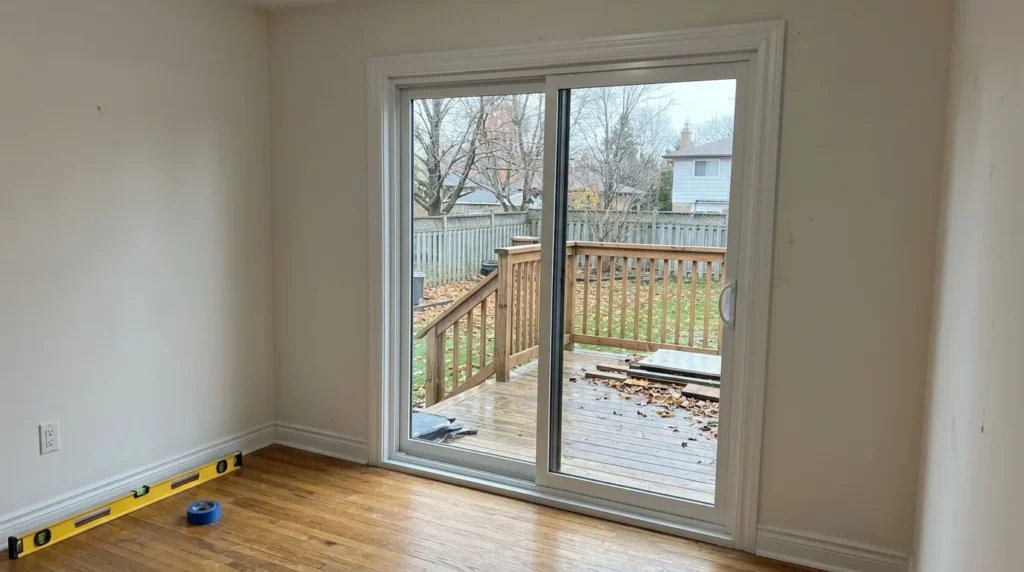
In Canada, patio door replacement cost for a standard 6-foot Low-E argon sliding glass door runs $1,900 to $5,200 before tax installed across Quebec, Ontario, Alberta, and British Columbia. Typical tax-in totals land at $3,046.84 in Quebec (14.975%), $3,616.00 in Ontario (13% HST), $3,517.50 in Alberta (5% GST), and $3,675.00 in BC (5% GST).
Model your exact province, frame material, window count, and tax-in total in our window replacement cost calculator.
In this guide
Patio door replacement cost by province (ON, QC, BC & AB)
Labour rates, coastal rain-screen flashing, cold-climate triple glazing, and provincial sales tax create a $600+ spread on the exact same 72 × 80 inch sliding door. This benchmark aligns with our November 2026 pricing grid (version 2026.Q4-windows-2) for a like-for-like 6-foot Low-E argon sliding patio door with screen installed in an existing rough opening.
| Province | Supply-only | Installed before tax (Low / Typ / High) | Tax rate | Typical tax-in | Rebate status (Nov 2026) |
|---|---|---|---|---|---|
| Ontario (ON) | $1,500 – $3,300 | $2,200 / $3,200 / $4,800 | 13% HST | $3,616.00 | HRS $100/opening (2+ upgrades; post-eval booked by Nov 30, 2026) |
| Quebec (QC) | $1,350 – $2,450 | $1,900 / $2,650 / $3,400 | 14.975% | $3,046.84 | Rénoclimat $300/opening (Most Efficient U ≤ 1.05, RBQ 8.0) |
| British Columbia (BC) | $1,600 – $3,500 | $2,400 / $3,500 / $5,200 | 5% GST | $3,675.00 | BC Home Renovation Rebate $100 (U ≤ 1.22, excl. City of Vancouver) |
| Alberta (AB) | $1,520 – $3,300 | $2,300 / $3,350 / $4,950 | 5% GST | $3,517.50 | No provincial grant; municipal CEIP loans where active |
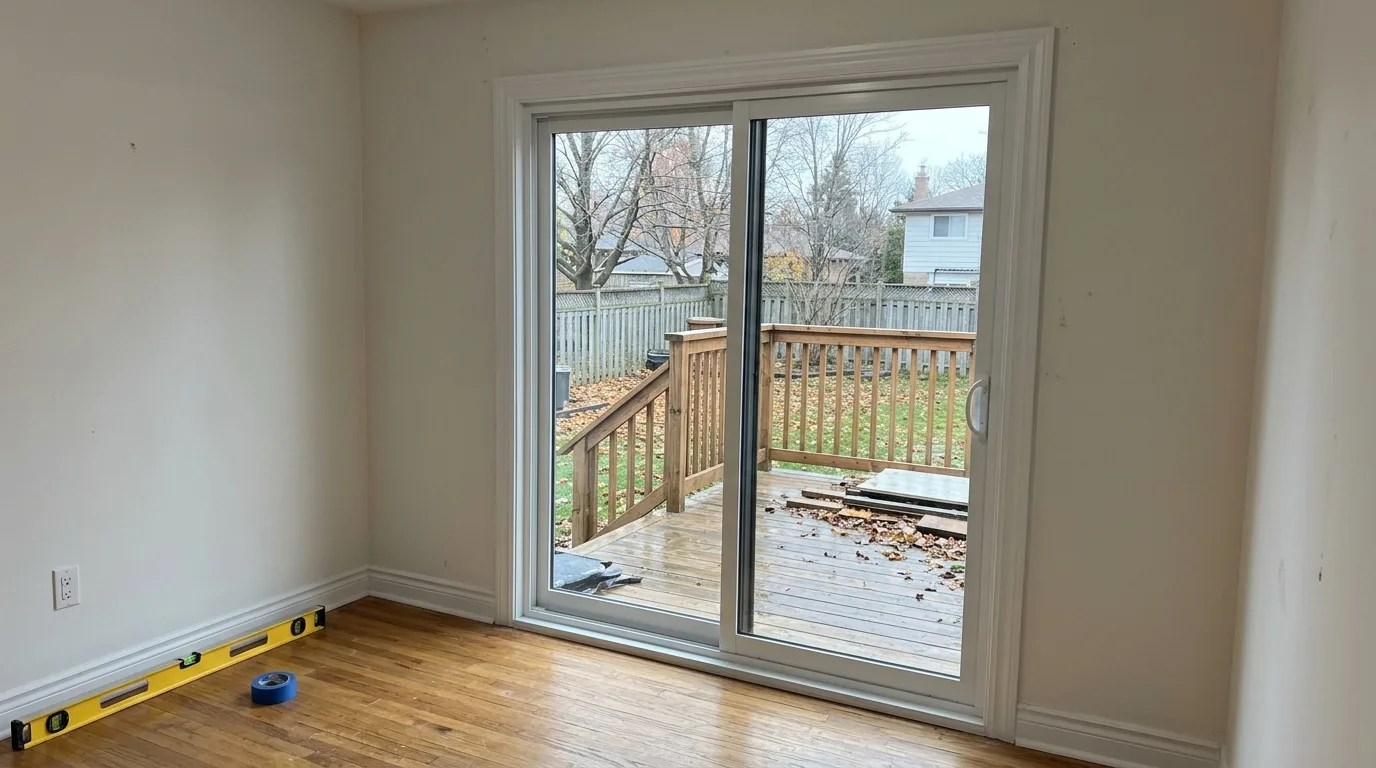
Two upgrades drive totals steeply upward. Stepping from a 6-foot (72-inch) slider to an 8-foot (96-inch) door adds 30% to 40% ($2,900 to $6,500+ before tax) for steel-reinforced stiles and heavier glass. Widening a 6-foot opening to 8 feet in a load-bearing wall adds $1,500 to $4,000+ for temporary shoring, an engineered header, and a municipal permit—such as the rules on the City of Toronto building permit page, which exempt same-size swaps in detached, semi-detached, and row houses but require permits whenever framing changes.
When to skip a full replacement (and save $2,500+)
Roughly 75% to 80% of sticking or drafty Canadian sliding doors do not need a $3,600 tear-out. When the perimeter frame is square and the sub-sill wood is dry, targeted service runs $200 to $450 before tax ($226 to $509 HST-in in Ontario; $210 to $473 GST-in in BC or Alberta) and extends life by 5 to 10 years.
- Heavy grinding or derailing panel ($150 – $350 before tax): winter grit flattens tandem rollers and pits aluminum tracks. Swapping both tandem roller assemblies and snapping on a stainless-steel track cap takes 90 minutes with zero wall disruption.
- Cold draft at the meeting rail ($90 – $200 before tax): fresh interlock pile weatherstripping and a quarter-turn on the lower roller adjustment screws stop −15 °C whistles ($20 to $50 DIY in parts with two people lifting the 50 kg sash).
- Fogged glass between panes ($300 – $800 per tempered IGU): on a square frame under 15 years old, a glazier swaps only the sealed Low-E argon tempered glass unit—saving over $2,500 (note: glass-only swaps are rebate-ineligible).
- Interior frost at −20 °C: indoor humidity above 30% causes condensation even on modern glass; review our condensation on windows in winter guide before buying a new door.
Replace the full unit only when the frame is over 6 mm out of square, the sill plate underneath is soft with rot, you still have a 1970s–1980s non-thermally-broken aluminum slider, or you are bundling exterior windows.
2-minute homeowner check before calling for quotes
Grab a $5 bill, a flathead screwdriver, and 250 mL of warm water. Five checks in two minutes separate a $300 tune-up from a $3,500 full-frame job.

- $5 bill compression test (20 s): lock the door over a bank note at the centre interlock. Zero drag means worn pile seals or a loose keeper—not a failed frame.
- 5 mm parallel reveal check (25 s): slide the door within 5 mm of the lock jamb. An even gap top-to-bottom confirms a square frame; 2 mm at the top and 12 mm at the bottom flags collapsed rollers or a sagging sill.
- Weep-slot drainage test (30 s): pour 250 mL of warm water into the outer track. Water must exit onto the exterior sill flashing—never pool or drain behind the deck ledger.
- Sub-sill rot probe (25 s): press a screwdriver into the basement rim joist under the door. Wood yielding over 3 mm means reserving a 10% contingency ($320 to $350 minimum) for sill repair.
- Tempered glass stamp & date (20 s): verify the permanent CAN/CGSB-12.1 safety etching in the glass corner and the year on the spacer bar. Units over 20 years old with solid aluminum spacers typically exceed U 2.4 W/m²·K.
Frame materials, glazing ratings and Canadian codes
Under Natural Resources Canada (NRCan) ENERGY STAR Canada Version 5.0 specifications, standard certified sliding glass doors require U ≤ 1.22 W/m²·K or ER ≥ 34, while ENERGY STAR Most Efficient units require U ≤ 1.05 W/m²·K (0.18 Btu/h·ft²·°F) or ER ≥ 40.
- White multi-chamber vinyl (PVC): lowest upfront price ($1,900 to $3,200 installed for 6 ft) with strong insulation. Avoid dark-painted pure vinyl on south or west walls—3 to 5 mm summer thermal expansion binds the latch.
- Hybrid (vinyl interior + extruded aluminum exterior): adds 20% to 35% over white vinyl, holds dark finishes rigid, and reaches U ≤ 1.05 with triple-pane Low-E argon glass.
- Fibreglass frames: priced 20% to 60% above white vinyl across Canadian manufacturers (see our vinyl vs fibreglass windows comparison). Matching glass’s thermal expansion rate makes fibreglass ideal for 8-foot wind-exposed spans.
Every Canadian quote should specify three building-code baselines: mandatory CAN/CGSB-12.1 tempered or laminated safety glass under National Building Code (NBC) Section 9.6.1.4; a NAFS (CSA A440 / A440S1) Canadian Supplement Performance Grade (PG) rating for wind, water, and forced entry; and CAN/CSA-A440.4 installation using a sloped (~6%) or back-dammed sub-sill flashing pan, structural shims under the rollers, and low-expansion polyurethane foam.
RénoClair Tip: Keep at least 50 to 100 mm (2 to 4 inches) of clearance between backyard deck boards and the bottom of the patio door sill. Flush decks trap snow directly against the weep slots and drive meltwater over the sill pan.
Worked examples: real Canadian house budgets tax-in
Rebates vary sharply across borders. In Ontario, the Home Renovation Savings (HRS) assessment stream pays $100 per ENERGY STAR sliding door opening (1 door/slider plus a second qualifying upgrade and pre/post EnerGuide audits), with the post-retrofit audit required to be booked by November 30, 2026 and completed within 180 days or by December 31, 2026 (details in our Ontario window rebate guide). In BC (outside the City of Vancouver), the Better Homes BC Home Renovation Rebate pays $100 per eligible unit (U ≤ 1.22 W/m²·K, max $2,000, invoiced October 15, 2026 or later by a licensed BC contractor with a GST number); CleanBC Energy Savings dropped windows and doors on July 6, 2026, and federal Greener Homes programs are closed.
| Canadian home scenario (Nov 2026) | Before-tax subtotal | Sales tax | Total tax-in | Rebate / net cost |
|---|---|---|---|---|
| Targeted repair — sound 6 ft frame (rollers + cap + seals) | $200 – $450 | $26–$58.50 (ON) / $10–$22.50 (BC/AB) | $226–$509 (ON) / $210–$473 (BC/AB) | $0 (saves $2,500+) |
| 1984 Ontario back-split (GTA / Ottawa) — Standalone 6 ft slider | $3,200.00 | $416.00 (13% HST) | $3,616.00 | $0 standalone (+$320 reserve) |
| 1988 Calgary / Edmonton two-storey (AB) — 6 ft patio door + 4 triple Most Efficient full-frame windows | $9,610.00 | $480.50 (5% GST) | $10,090.50 | No provincial grant; CEIP eligible |
| 1992 Lower Mainland BC (outside Vancouver) — 6 ft patio door + 2 hybrid full-frame windows | $6,120.00 | $306.00 (5% GST) | $6,426.00 | −$300 BC rebate = $6,126.00 net |
Run standalone versus bundled window scenarios in our window replacement cost calculator, or check line-by-line Ontario pricing in our window replacement cost in Ontario guide.
Low-ball patio door quotes: 5 hidden traps on a contract
When one quote undercuts competing bids by $700 to $1,100 on the same 6-foot rough opening, five shortcuts usually explain the gap:
- Trap 1 — Insert install over an uninspected wood sill: skipping full-frame tear-out saves $250 to $360, narrows glass width by 50 to 75 mm, and hides wet framing with no CAN/CSA-A440.4 sill pan.
- Trap 2 — Standard ENERGY STAR quoted where Most Efficient is needed: U 1.22 double glass fails Quebec’s $300 Rénoclimat rule (U ≤ 1.05) and runs cold at −30 °C in Alberta. Put the NRCan model number, U-factor, ER, and NAFS PG rating in writing.
- Trap 3 — Exterior capping, interior casings, and disposal excluded: headline ads around $1,900–$2,200 often omit bent aluminum cladding, neutral-cure sealant, interior trim, and hauling away a 90 kg door (+$400 to +$750 on install day).
- Trap 4 — Unpermitted 6-ft-to-8-ft header cut: widening a load-bearing opening without a municipal permit can stall home resale and void water-damage insurance coverage.
- Trap 5 — Pressure deposits ignoring 10-day cooling-off laws: direct in-home contracts include a statutory 10-day cancellation right in Ontario, BC, Alberta, and Quebec (zero deposit permitted during those 10 days in Quebec). Reject same-night pressure pricing.
Frequently asked questions
What is the average patio door replacement cost in Canada?
Plan on $1,900 to $5,200 before tax installed for a 6-foot Low-E argon sliding glass door: typical tax-in totals are $3,047 in Quebec, $3,616 in Ontario, $3,518 in Alberta, and $3,675 in BC. Estimate your exact province and window bundle in our window replacement cost calculator.
Is it cheaper to repair or replace a sliding glass patio door?
Yes: repairing saves over $2,500 if the outer frame is square and dry. New tandem rollers, a stainless track cap, and brush weatherstripping cost $200 to $450 before tax, while swapping one fogged tempered glass pane runs $300 to $800.
How much more does an 8-foot patio door cost than a 6-foot door?
Expect 30% to 40% more ($2,900 to $6,500+ before tax installed) for a like-for-like 8-foot swap. Widening an existing 6-foot opening to 8 feet in a load-bearing wall adds $1,500 to $4,000+ for an engineered header and permit.
Are patio doors eligible for Canadian rebates right now?
Yes in three provinces (verified November 25, 2026): Ontario HRS pays $100 per sliding door with a second upgrade and EnerGuide audits (post-audit booked by November 30, 2026); Better Homes BC pays $100 per U ≤ 1.22 door invoiced October 15, 2026+ (excluding Vancouver); Quebec Rénoclimat pays $300 only for Most Efficient (U ≤ 1.05) models installed by an RBQ contractor.
Do I need a building permit to replace a patio door in Canada?
No in most Canadian cities—including Toronto, Ottawa, Calgary, Edmonton, Vancouver, and Montreal—for a same-size swap in a detached, semi-detached, or row house. Yes whenever you widen the opening or alter a structural header.
Is triple-pane glass worth it on a Canadian sliding patio door?
Yes in Alberta, Saskatchewan, Manitoba, Northern Ontario, and Quebec to cut radiant winter drafts or qualify for Quebec’s U ≤ 1.05 Rénoclimat tier. Confirm heavy-duty steel tandem rollers rated for the extra 15 to 25 kg glass weight.
What safety glass and installation codes apply to patio doors?
NBC Section 9.6.1.4 mandates CAN/CGSB-12.1 tempered or laminated safety glass (check the etched corner stamp). Units require a NAFS / CSA A440S1 PG label, and installation should follow CAN/CSA-A440.4 with a sloped or back-dammed sill pan, shims, and low-expansion foam.
The bottom line
Before spending $3,047 to $3,675+ tax-in on a new 6-foot sliding patio door, run the two-minute squareness, weep-slot, and sill-rot check—a $200 to $450 mechanical service fixes four out of five sticking, drafty doors. When full-frame replacement makes sense, require CAN/CSA-A440.4 sill-pan flashing, CAN/CGSB-12.1 tempered glass, written NRCan U-factor and ER figures, and a 10% sill-rot contingency in your contract.
Sources
- Natural Resources Canada (NRCan): ENERGY STAR Canada Technical Specification v5.0 (U ≤ 1.22) and Most Efficient (U ≤ 1.05 / ER ≥ 40), checked November 25, 2026.
- Ontario Home Renovation Savings (Save on Energy / Enbridge Gas): Assessment Stream Windows & Doors ($100/opening, Nov 30, 2026 booking deadline), checked November 25, 2026.
- Better Homes BC: Home Renovation Rebate Program ($100/unit U ≤ 1.22, effective October 15, 2026, excl. City of Vancouver), checked November 25, 2026.
- City of Toronto: When Do I Need a Building Permit (same-size replacement exemption vs structural opening changes) & NBC 9.6.1.4 / CAN/CSA-A440.4, checked November 25, 2026.