

Official sources checked on October 30, 2026. Prices are published retail prices, read the same day, and are presented as commercial data.
Vinyl vs laminate comes down to one question: will the floor see water? Rigid vinyl plank has a plastic core and is the safer choice for kitchens, bathrooms, entrances and basements, while standard laminate has a wood-fibre core and belongs in dry rooms such as bedrooms and living rooms. In October 2026, three national retailers in Canada listed laminate from about $1.18 to $4.78 per sq ft and click vinyl plank from about $1.79 to $4.28 per sq ft, before 13% HST in Ontario.
In a dry room, both floors do the job and the cheapest laminate still costs a little less. As soon as water, a concrete slab or a busy entrance is involved, vinyl plank is the more forgiving product. The rest of this guide explains why, what the labels mean, and what a real 500 sq ft project costs.
In this guide
Vinyl vs laminate at a glance
| Criterion | Vinyl plank (rigid core or solid vinyl) | Laminate |
|---|---|---|
| Core | Plastic: a polymeric rigid core (SPC/WPC) or solid vinyl | High-density fibreboard (HDF), a wood-fibre panel |
| Water | Water does not damage the plank itself; water can still get through the joints | Standard laminate is not meant for areas that get wet often |
| Bathroom | Commonly sold for bathrooms; follow the installation guide | Only if the manufacturer explicitly allows it |
| Basement on concrete | Good choice once the slab is dry | Possible on a dry slab with the right underlay; riskier if water ever gets in |
| Durability rating | Wear layer thickness in mil (6, 12, 20, 22 mil seen in stores) | AC class from the European standard EN 13329 (AC3, AC4, AC5 in stores) |
| Typical thickness in stores | About 4 to 7 mm, often with a 1 mm pad attached | 8, 10, 12 or 14 mm |
| Formaldehyde rules | Not a composite wood product | HDF core must meet Canada’s formaldehyde emission limits since January 7, 2023 |
| Published price, October 2026 | $1.79 to $4.28 per sq ft (click/rigid plank) | $1.18 to $4.78 per sq ft |
Prices: published prices from three national retailers in Canada, read on October 30, 2026, before tax. Product descriptions come from the standards bodies and federal sources cited in each section below.
What vinyl plank and laminate actually are
The two floors look the same once installed, and both click together without glue or nails. The difference is inside the plank.
Laminate is a printed wood or stone image under a clear protective layer, bonded to a core of high-density fibreboard. That core is made of wood fibres and resin, which is why laminate is covered by Canada’s rules on formaldehyde in composite wood products.
Vinyl plank is a plastic product. The ASTM standard for rigid core flooring, ASTM F3261, covers resilient tiles and planks that are “surface decorated or printed and protected by a clear wear layer” over a “polymeric rigid core”. These are the planks stores sell as SPC or WPC. Thinner flexible planks fall under ASTM F1700, the specification for solid vinyl tiles and planks. Both standards say the products are intended for residential as well as commercial buildings.
In everyday Canadian usage, people also call laminate a “floating floor”. That is confusing, because click vinyl plank floats too. When you compare products, ask about the core, not the installation method.
Water: the deciding factor
Bottom line: if a room can get wet, choose vinyl plank. The current European laminate standard, EN 13329:2023, sets the classes used to market laminate and excludes areas subject to frequent wetting, such as bathrooms, laundry rooms and saunas, unless the manufacturer authorizes them. A wood-fibre core that absorbs water swells, and swollen laminate does not go back to its original shape.

Vinyl plank does not swell, but “waterproof” describes the plank, not the floor. Water that sits on the surface can find its way down through the joints and get trapped against the subfloor, where it can feed mould. Wipe spills, keep a mat at the door and seal the perimeter where the manufacturer says to.
The line has blurred in recent years. In October 2026, several premium laminates sold in Canada were marketed as water-resistant for 24 to 48 hours, and a few as waterproof. These are manufacturer claims, not a standard rating. Before you install one in a kitchen or bathroom, read the warranty: it tells you exactly which rooms are covered and what happens if water damage occurs.
RénoClair tip
Read the warranty’s room list before you buy, not after. If the laminate warranty excludes bathrooms or full baths, the manufacturer is telling you it does not belong there, whatever the box says about water resistance.
Basements: test the slab before you choose
A basement floor sits on concrete that is in contact with the ground, so moisture comes from below as well as from spills. Natural Resources Canada, in Keeping the Heat In, Section 6, describes a simple test: tape a sheet of plastic about 1 m (40 in.) square to the slab, wait a day or two, then look. Condensation on top of the plastic points to high indoor humidity. Condensation under it means moisture is moving from the ground into the home, and NRCan adds that this can also signal possible radon entry. NRCan says to do the test even if the slab looks dry.
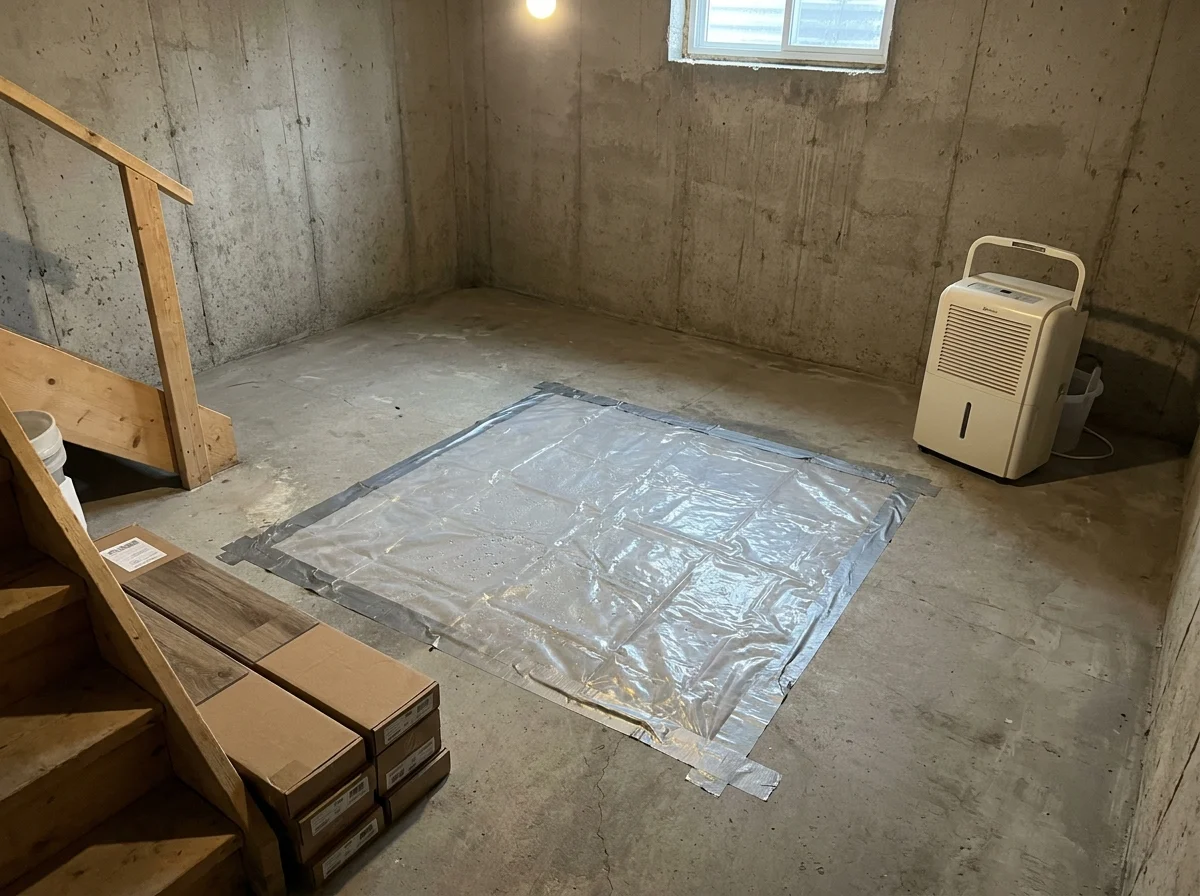
- Dry slab, finished basement: either floor can work. Vinyl plank is more forgiving if a pipe leaks or water comes in during a spring thaw.
- Damp slab: fix the moisture first (grading, gutters, cracks, a dehumidifier). Health Canada’s guide Addressing Mould in Your Home recommends running a dehumidifier in the basement to reduce dampness year round.
- Laminate on concrete: it always needs an underlay with a moisture barrier rated for concrete. Follow the manufacturer’s instructions to the letter; most warranties depend on it.
If you are also insulating the floor, read our guide to basement insulation materials for walls and floors before choosing the finish floor, because the insulation and subfloor change what you can install on top.
Durability: how to read AC ratings and wear layers
Laminate: the AC class
Laminate durability is usually shown as an AC (abrasion class) rating. According to an ANSI member update on a NALFA white paper, the AC classification comes from EN 13329, a European standard, and runs from AC1 to AC6. The North American laminate standard, NALFA LF-01, does not use AC classes, even though they are widely used in marketing. In Canadian stores in October 2026, most 12 mm laminate was listed as AC3 or AC4, with a few AC5 products.

A higher AC class means the surface held up longer in abrasion testing. It does not make the core more water-resistant. Thickness (8 to 14 mm) mostly affects feel, sound and how well the floor bridges small subfloor dips.
Vinyl: the wear layer, in mil
For vinyl plank, durability depends on the clear wear layer on top, measured in mil (thousandths of an inch; 1 mil is 0.0254 mm). In October 2026, retail listings in Canada showed wear layers of 6, 12, 20 and 22 mil. Some products give it in millimetres: 0.3 mm is about 12 mil and 0.5 mm about 20 mil.
Total plank thickness is a different number. A thicker rigid plank hides small subfloor flaws better, but it does not resist scratches better if the wear layer is thin. Compare wear layer to wear layer.
| What you see on the box | Laminate | Vinyl plank |
|---|---|---|
| Main durability figure | AC class (AC3, AC4, AC5) | Wear layer (mil or mm) |
| Entry level in stores, Oct. 2026 | 8 to 10 mm, AC3 | 4 to 5 mm, 6 to 12 mil |
| Mid-range in stores, Oct. 2026 | 12 mm, AC4 | 5 mm, 12 to 20 mil |
| Upper range in stores, Oct. 2026 | 12 to 14 mm, AC4 or AC5, marketed as water-resistant | 6.5 to 7 mm, 20 to 22 mil |
Vinyl vs laminate prices in Canada (October 2026)
Bottom line: at the entry level, laminate is still a little cheaper; in the mid-range, the two cost about the same. No public body publishes flooring prices, so the figures below are published prices from three national retailers in Canada, read online on October 30, 2026, before tax. Prices can vary by store and region, and some of the lowest-priced items were out of stock online.
| Product | Published price per sq ft | What you get |
|---|---|---|
| Laminate, entry level (8 to 10 mm, AC3) | $1.18 to $1.98 | Dry rooms, lighter traffic |
| Laminate, mid-range (12 mm, AC4) | $2.18 to $2.98 (one product $2.69 regular, $1.95 on sale) | Most living areas |
| Laminate, upper range (12 to 14 mm, water-resistant claims) | $3.00 to $4.78 | Marketed for kitchens and some wet areas, per warranty |
| Vinyl plank, entry level (6 to 12 mil) | $1.79 to $2.58 | Bedrooms, basements, rentals |
| Vinyl plank, mid-range (12 to 20 mil) | $2.97 to $3.35 | Kitchens, entrances, family rooms |
| Vinyl plank, upper range (22 mil, 6.5 to 7 mm) | About $4.28 | Heavy traffic, pets |
Installation is the other half of the budget. In October 2026, the large retailers we checked did not publish a per-square-foot installation rate for laminate or vinyl plank in Canada: their installation services start with a paid in-home measure and a written quote. Ask for at least two written quotes that separate the floor, the underlay, the trim, removal of the old floor and the labour.
For the French-language version of this comparison, with Quebec prices, see our vinyl vs laminate guide (in French).
Worked example: 500 sq ft of flooring in Ontario
Take an open living and dining area of 500 sq ft. We add 10% for cuts and waste, a common allowance for a simple rectangular room, so you buy 550 sq ft. Prices are products listed by national retailers on October 30, 2026; HST is 13% in Ontario according to the Canada Revenue Agency’s GST/HST rates page. Other provinces use different rates.
| Product | Price per sq ft | 550 sq ft before tax | With 13% HST |
|---|---|---|---|
| Laminate 10 mm | $1.88 | $1,034.00 | $1,168.42 |
| Laminate 12 mm | $2.18 | $1,199.00 | $1,354.87 |
| Vinyl plank 5 mm, 12 mil | $1.98 | $1,089.00 | $1,230.57 |
| Vinyl plank, 20 mil, attached pad | $2.99 | $1,644.50 | $1,858.29 |
| Water-resistant laminate 12 mm | $4.28 | $2,354.00 | $2,660.02 |
| Vinyl plank 22 mil | $4.28 | $2,354.00 | $2,660.02 |
Three things to notice. First, the 5 mm, 12 mil vinyl plank actually costs about $110 less than the 12 mm laminate for this room before tax, so in the mid-range price alone rarely decides it. Second, laminate needs a separate underlay unless one is attached, while many rigid vinyl planks already include a 1 mm pad. Third, the material is not the full bill: add transition strips, baseboards or quarter round, and labour if you do not install it yourself.
To work out quantities for your own rooms, our flooring quantity calculator (in French) takes the room size, the waste allowance and the coverage per box.
Health: formaldehyde, phthalates and indoor air
Laminate: federal formaldehyde limits since 2023
Canada’s Formaldehyde Emissions from Composite Wood Products Regulations (SOR/2021-148) apply to any composite wood product that contains formaldehyde. Environment and Climate Change Canada states that since January 7, 2023, non-compliant products can no longer be imported or sold. The emission limits are 0.11 ppm for medium-density fibreboard and 0.13 ppm for thin MDF, among others.
One detail matters for flooring. The federal guidance document explains that the “laminated product” rules do not apply to laminate flooring whose top layer is a printed wood-look image, because a printed layer is not a veneer. The fibreboard core, however, must still come from a compliant panel. In practice, that means any laminate sold legally in Canada today has a core that meets the federal limit.
Look for the label. Finished products must show the name of the manufacturer, importer or seller and the month and year of manufacture, and the regulations recognize a bilingual “TSCA Title VI compliant” label from the United States as well as a “CANFER compliant” label on panels. If a bargain laminate carries none of this, ask the seller before you buy.
Vinyl: plasticizers
Vinyl is not a wood product, so the formaldehyde rules do not apply. The issue raised for vinyl is plasticizers. Environment and Climate Change Canada’s risk management approach for DEHP lists flooring tiles among the product uses of this phthalate and notes that resilient flooring was a priority use in a 2006 study. Health Canada’s phthalates fact sheet says the 14 substances in its phthalate grouping were found not harmful to health at current exposure levels, while DEHP itself was assessed as harmful to human health in 1994. If this matters to you, ask for the product’s declaration or data sheet and choose one stated to be free of ortho-phthalates.
Indoor air after installation
Health Canada’s page Formaldehyde in your home sets indoor limits of 123 µg/m³ (100 ppb) over one hour and 50 µg/m³ (40 ppb) over eight hours. It advises choosing low-emission products when possible, opening windows and increasing ventilation when painting, varnishing or installing carpets with glue, and keeping humidity around 50% in summer and 30% in winter. The same habits make sense after any new floor, especially a glued one.
Which one to choose, room by room
| Room | Better choice | Why |
|---|---|---|
| Kitchen | Vinyl plank | Spills, dishwasher leaks and mopping |
| Bathroom and laundry | Vinyl plank | EN 13329 excludes frequently wet areas for laminate unless the maker allows it |
| Entrance and mudroom | Vinyl plank | Snow, salt and meltwater from boots all winter |
| Basement | Vinyl plank, after a slab moisture test | Moisture from the slab and risk of flooding |
| Living and dining room | Either; laminate if on a tight budget | Dry room; laminate is often cheaper and feels solid underfoot |
| Bedrooms | Either; laminate if on a tight budget | Dry room, low traffic |
| Sunny rooms | Check the fade warranty | Strong sun can fade or discolour some floors; use blinds |
Many homes mix both: vinyl plank in the kitchen, entrance and basement, and laminate in the bedrooms. If you do, plan the transitions so the floors meet at door frames rather than in the middle of an open space.
Common mistakes and a checklist before you buy
- Buying exact square footage. Add a waste allowance (10% for a simple room, more for angles and herringbone) and keep one spare box for future repairs.
- Comparing thickness instead of durability. Compare AC class to AC class for laminate, and wear layer to wear layer for vinyl.
- Trusting “waterproof” without reading the warranty. Check the list of covered rooms and how long standing water is covered.
- Skipping the slab test in the basement. Tape down the plastic sheet for a day or two first.
- Doubling the underlay. If the vinyl has a pad attached, check whether the maker allows any additional underlay; many do not.
- Ignoring the subfloor. Both floors need a flat, clean surface; follow the manufacturer’s flatness tolerance and acclimatization time.
- No label on a bargain laminate. Check for the manufacturer or importer name and the date of manufacture.
- Comparing quotes that are not alike. Ask each installer to list floor, underlay, trim, removal, disposal and labour separately.
To price your project, try our flooring cost calculator: supplied-and-installed range by floor type, with removal and subfloor options.
Frequently asked questions
Vinyl vs laminate: which is cheaper in Canada?
At the entry level, laminate is a little cheaper: published prices in October 2026 started around $1.18 per sq ft for laminate and $1.79 for click vinyl plank. In the mid-range, both cost roughly $2 to $3.35 per sq ft before tax.
Is vinyl plank better than laminate for a basement?
Usually, yes. Vinyl plank does not swell if it gets wet and can be lifted and dried after a leak. Do a plastic-sheet moisture test on the slab first, as Natural Resources Canada recommends.
Can you put laminate in a bathroom?
Only if the manufacturer explicitly allows it. The European laminate standard EN 13329 excludes areas that get wet often, such as bathrooms and laundry rooms, unless the manufacturer authorizes them.
Is vinyl plank flooring really waterproof?
The plank itself is not damaged by water, but water can seep through the joints and get trapped underneath. Wipe spills quickly and follow the installation guide for wet rooms.
What AC rating should I choose for laminate?
In Canadian stores, AC3 and AC4 are the most common for homes and AC5 is the top of the range. A higher AC class means a more abrasion-resistant surface, not a more water-resistant core.
What wear layer do I need for vinyl plank?
Stores in Canada list 6, 12, 20 and 22 mil wear layers. A thicker wear layer resists scratches longer, which matters in kitchens, entrances and homes with pets.
Does laminate flooring contain formaldehyde?
Its fibreboard core is made with resin, so it can emit some. Since January 7, 2023, composite wood panels sold in Canada must meet federal formaldehyde emission limits, including the core of laminate flooring.
The bottom line
In the vinyl vs laminate decision, start with water. Kitchens, bathrooms, entrances and basements call for vinyl plank. Bedrooms and living rooms can take either, and entry-level laminate still saves a little money there. For durability, compare AC classes on laminate and wear-layer thickness on vinyl, not total thickness. Check the label and warranty before you pay, test the slab before you floor a basement, and budget for underlay, trim and installation on top of the price per square foot.
Sources
- Formaldehyde Emissions from Composite Wood Products Regulations, SOR/2021-148, Justice Laws Website (current to September 30, 2026), read October 30, 2026
- Factsheet on the Formaldehyde Emissions from Composite Wood Products Regulations, Environment and Climate Change Canada (February 16, 2023), read October 30, 2026
- Guidance document for the Formaldehyde Emissions from Composite Wood Products Regulations, Health Canada (modified December 18, 2024), read October 30, 2026
- Formaldehyde in your home, Health Canada (modified January 11, 2021), read October 30, 2026
- Risk management approach for DEHP, Environment and Climate Change Canada (modified March 2, 2023), read October 30, 2026
- Phthalates fact sheet, Health Canada (June 18, 2021), read October 30, 2026
- Keeping the Heat In, Section 6: Basement insulation, Natural Resources Canada (modified December 23, 2024), read October 30, 2026
- Addressing Mould in Your Home, Health Canada, read October 30, 2026
- GST/HST calculator and rates, Canada Revenue Agency, read October 30, 2026
- EN 13329:2023, Laminate floor coverings, standard listing, read October 30, 2026
- NALFA white paper on wear resistance and AC ratings, ANSI member update (January 4, 2023), read October 30, 2026
- ASTM F3261, rigid polymeric core resilient flooring and ASTM F1700, solid vinyl floor tiles and planks, ASTM International, read October 30, 2026
- Prices: published prices from three national retailers in Canada, read online on October 30, 2026, before tax


